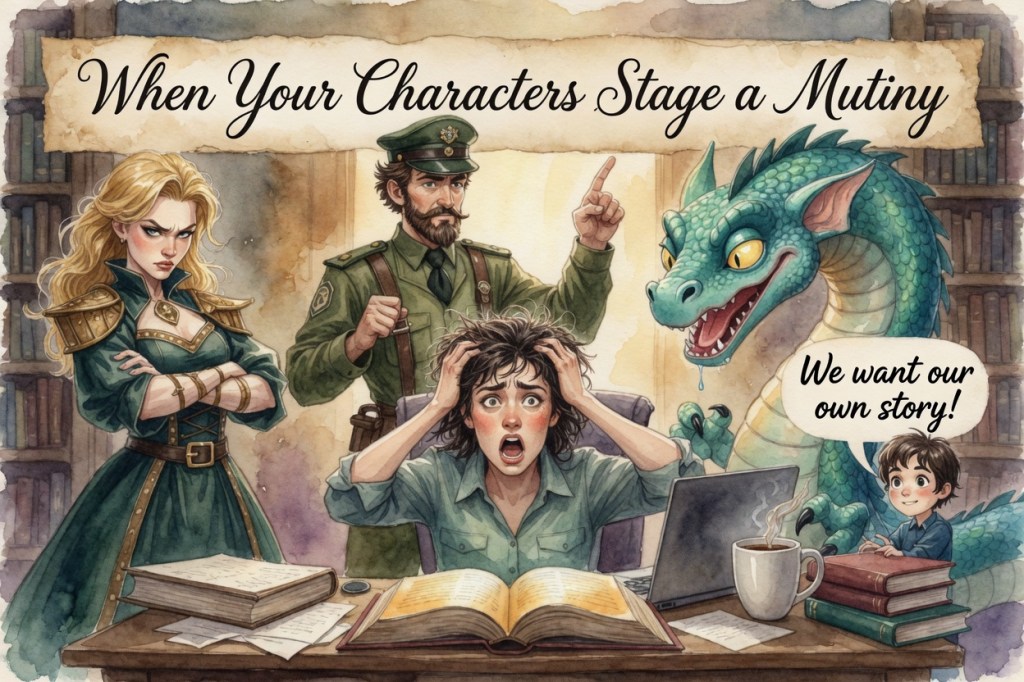
So what do you do when a character takes on a life of their own and starts hijacking your carefully planned story? Or when a side character suddenly elbows the protagonist aside and announces they’re the main attraction now? Worst of all is when a character crosses their arms, glares at you, and then refuses to speak or even make eye contact.
I’m a near-pure pantser, so this happens to me constantly. Plotters with detailed outlines may dodge some of it, but from what I hear in the comments and elsewhere, even the most disciplined outliners get ambushed by rebellious characters now and then.
Why does this happen?
Logically, I know these people are figments of my imagination. They can’t actually think for themselves. In practice, though, what appears on the page often surprises me, and that surprise is part of the fun. It keeps me from getting bored, which (hopefully) keeps readers turning pages.
Characters behaving like real people is really just the author’s deep observation and subconscious integration of human behavior leaking onto the page. You’ve absorbed thousands of tiny details about how people move, speak, and react under pressure. Your brain hands them to the character at exactly the right (or wrong) moment.
How do you handle a character who’s gone off-script?
You probably can’t fully control them and you shouldn’t always try. But you can pay close attention. One technique I’ve seen work well (though I admit I don’t always do it) is the character interview. Skip the favorite-color nonsense. Ask hard questions: What are you most afraid of right now? What do you want that you’re ashamed to admit? What would you never do, and why?
When a character stonewalls you, stop and ask: Am I breaking this character by forcing them down this path? Sometimes the resistance is your brain telling you the plot is wrong.
I wrote years ago about using Maslow’s hierarchy of needs for characters, and it still holds up. A person fighting for survival isn’t going to obsess over social status or self-actualization. If your character is acting “out of character,” check what need level they’re really operating from. Are you forcing them into a motivation that doesn’t match their current state?
When you’re blocked, open a fresh document and let the character break the fourth wall. Let them complain directly:
“Who do you think you are, making me do this?”
“Why are you ruining my life for your stupid plot?”
Answering the basic reporter questions — Who? What? Why? When? How? — from their point of view often reveals plot holes and unlocks the story again.
Side characters who demand their own book are a special kind of chaos. My advice: tell them to sit down and wait their turn. Open a new file, jot notes, maybe write a couple of scenes or a short story outline. Then close it and return to the main project. Keep the promise to yourself to write that story, even if it’s only a newsletter exclusive or blog bonus later. Your subconscious might be spotting something valuable that your conscious mind hasn’t caught yet.
When I was writing Tomato Wyrm, I realized I couldn’t tell the story properly from just one point of view if I wanted a full cast who weren’t simply dancing to Cecilia’s whims. I started writing from only Cecilia’s point of view, then after a conversation with Dorothy Grant realized I should add Grieg’s perspective, but then Jock the gamekeeper and even Arinto the wyrm insisted on having their say. By allowing that ensemble cast to pitch in and tell parts of the story in their own voices, the whole book became far richer and more deeply told than it ever could have been if I’d stubbornly stuck to simply Cecilia’s viewpoint.
Bottom line:
Meaningful dialogue with your characters even when they’re being difficult produces living, breathing people on the page. Cardboard cutouts never captured anyone’s heart. When a character balks, they’re usually trying to tell you something important. Sometimes the best move is to trust them and see where they lead.
What about you? What’s the best (or worst) thing a character of yours ever did to derail your plans? How did you handle it and did the story end up better for it? Drop your stories in the comments. I read every one even if I’m terrible at replying to them.



 Mad Genius Club
Leave a reply to jaglionpress Cancel reply