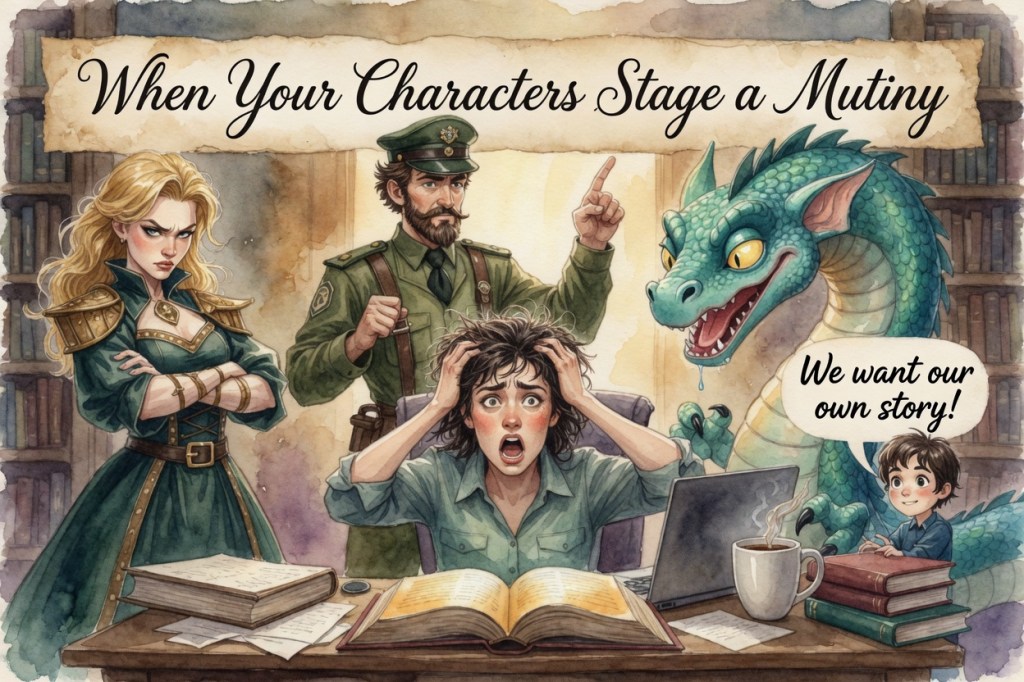
So what do you do when a character takes on a life of their own and starts hijacking your carefully planned story? Or when a side character suddenly elbows the protagonist aside and announces they’re the main attraction now? Worst of all is when a character crosses their arms, glares at you, and then refuses to speak or even make eye contact.
I’m a near-pure pantser, so this happens to me constantly. Plotters with detailed outlines may dodge some of it, but from what I hear in the comments and elsewhere, even the most disciplined outliners get ambushed by rebellious characters now and then.
Why does this happen?
Logically, I know these people are figments of my imagination. They can’t actually think for themselves. In practice, though, what appears on the page often surprises me, and that surprise is part of the fun. It keeps me from getting bored, which (hopefully) keeps readers turning pages.
Characters behaving like real people is really just the author’s deep observation and subconscious integration of human behavior leaking onto the page. You’ve absorbed thousands of tiny details about how people move, speak, and react under pressure. Your brain hands them to the character at exactly the right (or wrong) moment.
How do you handle a character who’s gone off-script?
You probably can’t fully control them and you shouldn’t always try. But you can pay close attention. One technique I’ve seen work well (though I admit I don’t always do it) is the character interview. Skip the favorite-color nonsense. Ask hard questions: What are you most afraid of right now? What do you want that you’re ashamed to admit? What would you never do, and why?
When a character stonewalls you, stop and ask: Am I breaking this character by forcing them down this path? Sometimes the resistance is your brain telling you the plot is wrong.
I wrote years ago about using Maslow’s hierarchy of needs for characters, and it still holds up. A person fighting for survival isn’t going to obsess over social status or self-actualization. If your character is acting “out of character,” check what need level they’re really operating from. Are you forcing them into a motivation that doesn’t match their current state?
When you’re blocked, open a fresh document and let the character break the fourth wall. Let them complain directly:
“Who do you think you are, making me do this?”
“Why are you ruining my life for your stupid plot?”
Answering the basic reporter questions — Who? What? Why? When? How? — from their point of view often reveals plot holes and unlocks the story again.
Side characters who demand their own book are a special kind of chaos. My advice: tell them to sit down and wait their turn. Open a new file, jot notes, maybe write a couple of scenes or a short story outline. Then close it and return to the main project. Keep the promise to yourself to write that story, even if it’s only a newsletter exclusive or blog bonus later. Your subconscious might be spotting something valuable that your conscious mind hasn’t caught yet.
When I was writing Tomato Wyrm, I realized I couldn’t tell the story properly from just one point of view if I wanted a full cast who weren’t simply dancing to Cecilia’s whims. I started writing from only Cecilia’s point of view, then after a conversation with Dorothy Grant realized I should add Grieg’s perspective, but then Jock the gamekeeper and even Arinto the wyrm insisted on having their say. By allowing that ensemble cast to pitch in and tell parts of the story in their own voices, the whole book became far richer and more deeply told than it ever could have been if I’d stubbornly stuck to simply Cecilia’s viewpoint.
Bottom line:
Meaningful dialogue with your characters even when they’re being difficult produces living, breathing people on the page. Cardboard cutouts never captured anyone’s heart. When a character balks, they’re usually trying to tell you something important. Sometimes the best move is to trust them and see where they lead.
What about you? What’s the best (or worst) thing a character of yours ever did to derail your plans? How did you handle it and did the story end up better for it? Drop your stories in the comments. I read every one even if I’m terrible at replying to them.

 Mad Genius Club
16 responses to “When Your Characters Stage a Mutiny: Dealing with Rebellious Imaginary People”
— Logically, I know these people are figments of my imagination. —
Don’t be too sure of that. We still don’t know what feeds or fuels the imagination.
Yep. Logic doesn’t always provide the full answer.
I tend not to have this specific problem, although the Bela Lugosi influenced suspect in the mystery wants really badly to be Recurring Shady Ally, and I might indulge him on that point because he was fun to write. I do occasionally have “shape of the story requires characters to do X, but *why* would they do that?” In Spiderstar, the fact that the two main leads were going to be on bad terms for about the third quarter of the book, but wouldn’t tell me what triggered it, held up the writing SO badly; it might be the longest a book has taken me to write. Dragon’s Teeth has something similar, in that I knew my crazy-prepared monster hunter was going to go charging into a situation without backup and find himself in over his head, and I knew it was probably going to be retaliation for an attack on the female lead, but I spent, like, alot of the spare brain cycles left over when I was writing the book before it (Undead Flight) figuring out what the attack on the female lead looked like, what kinds of emotional pressures were involved from his friend the Prime Minister. I was literally only just sitting down to write the scenes involved when I realized that 1). the Prime Minister was chomping at the bit to help, and the monster hunter was going it alone partly to keep the Prime Minister from jumping into danger alongside him and 2). the reason it all goes so badly for the monster hunter is that he’s made a very excusable category error about what he’s up against.
Please, stop your psychobabble nonsense. We necromancers, er writers, all know that a good writer’s characters are actually real, and you should really stop conjuring them if you think otherwise. 🙂
Years after the original novel, Ray Bradbury wrote a stage version of Fahrenheit 451 because one of the firefighters (Manfred I believe) sat on the edge of his bed and told him there was more to the story. My wife’s characters would tell her the story. So much so, that, when she was finishing her novel and writing 10k words a day, I seriously considered an exorcism. Fortunately she finished it and returned to normal before I called a priest (who probably would have looked at us askance considering our excommunicated status).
As for me, a secondary character is now asserting that he’s the main character in my new novel. Sigh, but the previous main character is the one I identify with! <stomps feet and pouts>
Seriously though, excellent advice, especially about interviewing your characters. I like using that technique.
Just as long as the characters don’t get TOO real. Lester Dent, the author of the Doc Savage stories, once talked about the time when in the middle of working out a scene he looked up and saw Monk and Ham, two characters from the series, standing right in front of him. They had a friendly if bizarre discussion for half an hour before Dent remembered, “Wait a minute. You’re not real. I made you up!” Apparently Monk then said to him, “Hey buddy, for all you know WE made YOU up!”
They promptly vanished and Mr. Dent took a long overdue vacation.
He wasn’t the only author to have to deal with that sort of thing, either. Makes me wonder about a story where an author is confronted by one of their less-liked characters and has to do some fast explaining.
“So what do you do when a character takes on a life of their own and starts hijacking your carefully planned story?”
Run behind with a camera and capture all the action I can. Probably the worst way to do things, but that’s what I do.
Honestly, since my first book I don’t plan anything. It’s pointless, my characters come up with way better stuff than I do. “Intellectually” I know this is all me, but my experience is that they’re doing it and I just write it down.
I can hear the Plotters out there screaming in frustration. “But that’s WRONG!!!” they say.
I recall many years ago a reasonably well-known author being quite incensed at my suggestion that sometimes characters decide things on their own. “Are you saying I can’t plot a novel properly?!!!” was the gist of her feeling on the matter. Took it as a personal insult.
Which I still think was weird, even 10 years later, honestly. I may have suggested cutting back on the caffeine, that’s the type of smart-assery I usually get up to out there on the Internets. ~:D.
I’ve known pantsers to kind of obliquely deprecate plotters as soulless killjoys incapable of listening to their characters. (For my part, I try to assume that any reasonably character-oriented plotter simply knows their characters that well). It’s possible the author was being thin-skinned because she’d been dealing with a lot of that lately, and your good-natured remark simply caught her at a bad moment.
“…good-natured remark simply caught her at a bad moment.”
It was during the Affaire Du Puppy, ~2016 or so, I was dealing with robot girlfriends who adamantly refused to remain inanimate. I was forced to go back and write an entire chapter pretty near the beginning of Unfair Advantage, Charlotte Smith’s origin story where she becomes a sentient being and not just a cool robot.
So I wondered if Author ever had the same thing happen, where the characters laugh and say they’re not doing it. “NO! HOW DARE YOU!!!11! THE VERY IDEA!!!!!!”
It could be that pantsing is a forbidden thing among the Established Lefty people. It smacks of Conservatism? More central planning is more better? Hard to say from a sample of one. ~:D
On a related note, I have noticed of late the absence of Leftists arguing in the comments of this and other SFF blogs I frequent. They’ve all gone quiet, suddenly. Like when the frogs all stop creaking at the same time.
I wonder if they were funded by US AID and now the money has run out.
Tradpub tended to demand a couple of opening chapters and an outline, so plotting can be an indirect indicator of tradpub aspirations/political alignment. But I have known centrist/right-leaning plotters as well, so it’s not an absolute thing.
That would explain why your characters spend so much time holding hands and staring soulfully into each other’s eyes.
To be fair to me, it’s an adventure romance series. Most of them are robots or teenagers, that’s all they ever want to do. I have to think up things to make them get off the couch. ~:D
As the books go forward that gets harder to do. Secret Empire as an example, they were all quite put out to have their lounging and coffee drinking disturbed. That’s why they laid it on so heavy at the end, to be sure their “get off my lawn” communication was delivered in a way that couldn’t be ignored.
So of course in the next book, forthcoming soon I –swear-, we must take the threat level up high enough to make an entire empire break into a cold sweat.
Sometimes, the 3S solution is the only viable one
Well, in A Diabolical Bargain, I got to the end and Nick told me he wasn’t happy. Not what would make him happy, not what would happen next, just that he wasn’t happy.
Worked out a second ending and trudged to it. He still wasn’t happy. Or telling what was happening next or what would make happy.
Finally, the third ending worked.
My story people tend to come from real life. They’re not carbon copies, nor are they just inspired by. They are more the descendants of pure expression via a clouded lens, coupled with over forty years of reading people as a survival mechanism for the socially blind, deaf, and dumb (not *quite* that bad, but still close).
Sometimes a reader throws a wrench in the works (because I write episodically and when post hits, their eyeballs see it). That has happened a few times to reveal parts of the story I initially hadn’t accounted for. It’s killed a bad subplot that would derail the story and opened a new one at least once.
For the one MC, corralling him back to the plot can be hectic. He’s not one to care much about his own survival so long as what he’s aiming at gets achieved. This can lead to headaches. And careful examination of what he’s allowed to get into. Somewhat like trying to keep a toddler or a kitten from things he’s Not Supposed To Be In.
Jill Bearup wrote a whole novel, Just Stab Me Now, about an author whose characters keep rebelling. It’s an absolutely delightful book.
It has its interesting aspects. OTOH, I notice that the characters never refused to reveal anything, or were vague, or in fact acted anything except an alternate universe where people did their own thing.
Witness the way that characters never split into two or merged.