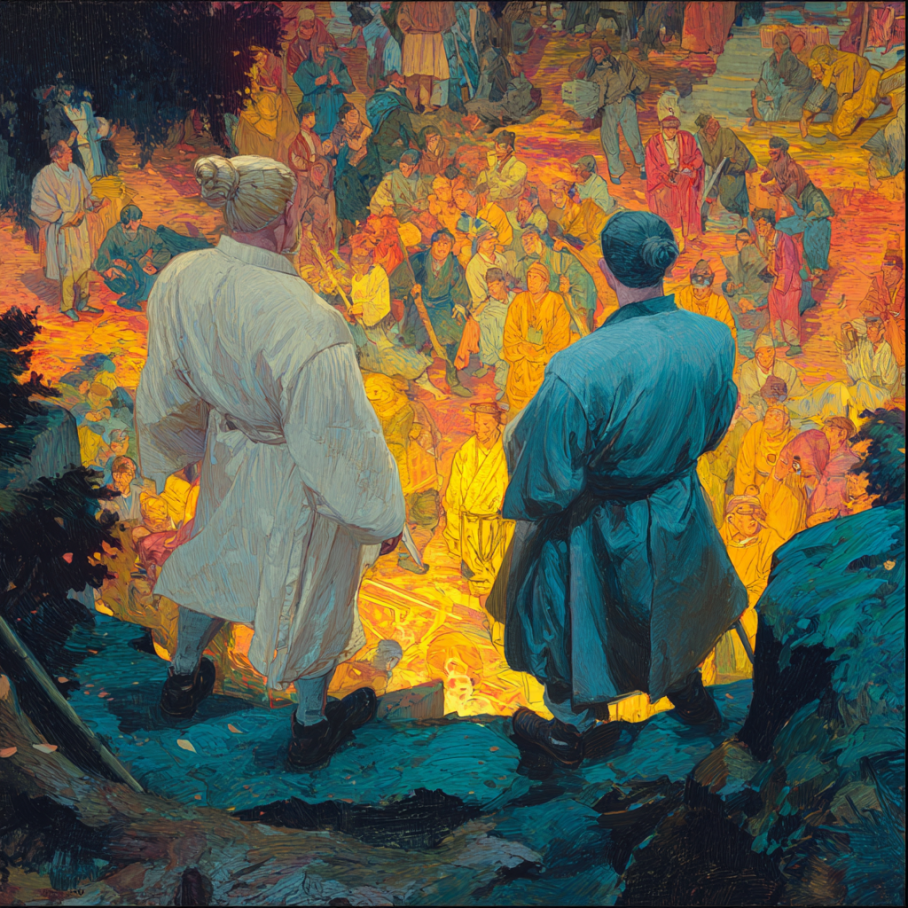
We don’t think much about just passing along some tale we know, as in “tell us the story about so-and-so”. Whether or not it’s fiction or rumor, we treat it as “well, I’m just telling you that’s what happened, as far as I know”.
When the story is a joke (“that’s why you shouldn’t try that at home”) or some other rueful educational homily, we typically pick a side, from an advisory standpoint but, still, we can claim “nothing to do with me, I don’t make the rules.”
But fiction, now… that’s on us. To the degree that we want our stories to be “realistic” (people are people, not puppets), maybe we can claim we’re just showing what happens. But you know and I know… that’s not really what’s going on. We’re choosing the whole thing — the setup, the predispositions, the contingent reactions, the errors, the capricious odds, the outcomes — all of it. It’s on us.
There are authors who seem to relish beating up on their characters, while others wince when even a theoretical puppy comes to harm. But you can’t have much of a story without a problem that must be painful since it requires a solution, and an actor, who cares about the problem and must act accordingly, thereby encountering pain himself. No pain, no story. Not even in storytime for 3-year-olds, however watered-down.
Despite the “god” reference in the title of this post, deities in their instructions seem to have no hesitation about encouraging the “no pain, no gain” aspect of stories/advice, even if they add the sugar-coated reassurance of rewards for recommended behavior. But it can be hard to adopt that attitude as god-emperor of your own little fictional world, can’t it?
I’ll admit, I do enjoy some aspects of dumping my characters in the soup. I’m hard on them sometimes, not to be sadistic, but to (as it were) get their attention about what their priorities and plans should be, and how to carve their way back into the light. I make them worry, and the readers worry along with them and root for them to triumph.
I’m still enough of a softy that I loath the unnecessary sadism of G.R.R. Martin, and I’ll defend my fictional pets from harm (if not the people) because I’d rather impose pain on the people under the light directly, than thru miscellaneous innocents, just for the motivational lever.
To some degree, if I can’t keep my important characters alive, even if suffering, there’s no point to the story. The dead characters are already past worrying about things — the reader is attached to the living. But there is a point at which too much is too much, and it probably differs for all of us, like the level of heat in chili sauce.
Do you think of these things as moral responsibilities relevant to your own behavior, or just as part of the story-telling art?



6 responses to “Are you really suited to play god with imaginary beings?”
There are places I won’t go, partly because I do not need to encourage that part of me, and in part because there’s enough darkness in the world without me adding to it. GRRM’s approach makes me a little queasy.
Characters are going to stumble, fall on their noses because they tried it at home, or didn’t read the instructions, or thought they knew better. They would not be believable if they didn’t. They will also run into things they are not ready for, and get thumped. I”m not doing it just to be vicious, but because that’s what the story demands. Actions have consequences, being mean may come back to haunt someone when he doesn’t expect it, and stupidity usually hurts. So characters learn, and grow, and do better, even if they have pounding headaches and a lot of explaining to do when they need a sick-leave day off from work after defeating the Big Bad.
Definitely relevant. I see enough things trying to drag people down and say heroes lose everything in real life. We need some heroes to win, or at least make it so that which they were protecting survives.
Aristotle’s theory of art was that it was to experience things at a safe remove so the viewer can better prepare viewer to handle it if it happens to them.
Under that model, victories at terrible cost, or even losses that can be learned from have value.
The misery porn that teaches only learned helplessness is evil.
“That’s right: I’m the god! I’m the god!!! … would you like fries with that?”
I’m pretty much of a plotter for the big overarching story, planned out in advance, but a pantser when it comes to the day to day scribbling of the story – so I have pretty much already planned out who is doomed from the start. It’s a sad necessity for the plot, and several of them have been created as engaging, likeable or heroic characters. I don’t like doing this in wholesale lots, the way that GRRM apparently does. The deaths of those characters in my own books has to serve a serious purpose. I guess my principle is that a writer has to be responsible in creating and disposing of characters.
Having taken up writing, I find that I understand the Deity getting pissed at his creations running amok, and drowning them all.
And saving a few . . . and then they go off and . . .
I don’t remembering giving mine free will, but sometimes they sure act like it!
Or, to answer the question, no. I do not like killing my characters, and avoid it as much as possible. Even killing named animals had better have a very good plot purpose!