How much education are you really gonna want to be responsible for when Joe or Susie Public opens your book and settles down to read?
As so often, my post today is inspired by disappointment, this time in reading a unexpectedly low-brow book after gulping down three terrific ones.
The terrific books: Simon Winder’s 3 excellent ruminations on European History: Lotharingia, Danubia, Germania. (I recommend that order).
My weak spot in general knowledge is History. I’ve filled in a lot of it since gagging in grade school, especially in specialized areas such as linguistics, evolution, migration, geography, cultural impacts, etc., but I never had that fascination that, say, military enthusiasts often exhibit — I care more about the ins and outs of historic mythology transmission or cultural exchanges than the actual conquests on the ground. That said, if you read as much as omnivorously as I do, you can’t avoid filling in enough of the blanks to make up for early educational failures.
It’s not easy to tell coherent stories about the intertwining of civilizations and the ways in which they collided or influenced each other. On the other hand, History is certainly full of interesting things. But you can’t just jump into the pool most of the time — you need to know what happened before the event of interest, and why things worked out the way they did, and for that to work, you need to know a lot of preliminary information. The three books by Winder are at just the right level (for me) — they assume an adequate if undetailed general knowledge of his subjects, with an idiosyncratic fascination for the coincidences and unpredictable occurrences that actually moved the historic consequences along. I find that the things that fascinate him fascinate me, too, so I appreciate the guided tour he offers and value his judgments.
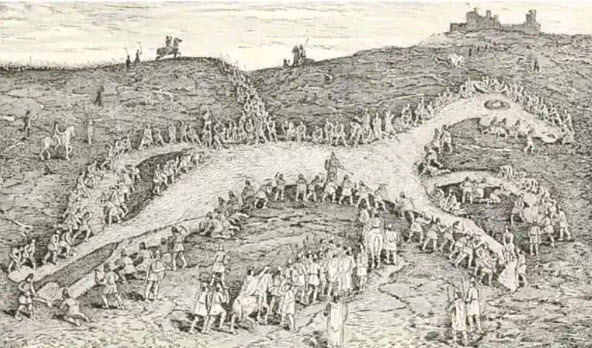
The disappointing book: a history of Alfred the Great. No point naming the author — that’s not the issue. The problem with the book is a very common one in non-fiction like history — an inability to balance a reasonable version of “what everybody knows (maybe even sub-adults)” with the clues for “the oddities I’ll tell you about” without boring the reader to tears with the “well, duh” response to deplorable and obvious unnecessary (and repeated, and error prone) side remarks (an editor in the subject being regrettably missing). Think of the sort of book that presents itself for sale when you get off the tour bus to visit an historic sight (say, the Uffington White Horse), a famous location associated with Alfred. I happen to know the tribal movements of the surrounding periods and the context of the older mythology and prehistory and archaeology, etc., but while I realize a book focused on an historical personage has to provide at least a little explanation about these sorts of things, I expect better fleshed-out detail and at least defensible accuracy). Seems like the temptation for this author is to either over or (especially) under-explain the ancillary background of these sorts of bits in ways that remind me of grade school texts — filled with random educational tidbits for the benefit of the uneducated reader without any useful context to build upon, and typically not really accurate either, without making clear what they’ve gotten wrong (though the naive would do well to suspect).
So… how to avoid this sort of thing, as a writer? How much can you count upon being adequately general knowledge for your readers? The “everybody knows” quotient is rather unpredicatible and varies strongly by target age and specialized education. As fiction writers, we understand how to clue a reader in to a new term or alien definition or cultural artefact… but that’s limited to the world of the book itself, which we control. When you approach non-fiction, the assumption of knowledge on the part of the reader is easy to get wrong (at least I am frequently disappointed by either too little, too much, or too weak (e.g., wrong or at best unsophisticated) settings and explanations. Falsus in uno lurks for the unwary author who doesn’t get it right, or at least, plausible.
The Simon Winder books were delightful — they get it just right, reveling in the “as you know” jokes in the history he recounts which stand repeating and analysis, and rewarding the reader with the crosslinks and causations that may have escaped the reader’s prior knowledge, to his improved delight.
How do you treat “assumed reader knowledge” in fiction and non-fiction differently? Or do you, as reader or writer?



13 responses to “Showing vs Telling vs Shrugging”
As a reader I rather like info dumps as long as it’s a topic I’m interested in. Moby Dick was not my cup of tea, but Tom Clancy novels I find wonderful. I don’t mind David Weber info dumps either. But really, working the info into the actual story in some way, rather than just pasting all the info in between scenes, is the best way.
In my writing I’m still having issue with incorporating the important stuff rather than just having a FAQ section in the middle of things. Something to work on.
I think i am the only person on the planet that thinks the mechanics of whale processing are most interesting than Ahab and his crew
I might agree with you now, but that book is a hard row to hoe when you’re reading it young, and don’t realize that most of his audience would know nothing about whales and whaling at all, and so this information would be interesting to them and probably necessary to understanding the rest of the book
Mostly it’s a measure of how indifferent I am to the humans in the story, see also my comments about On Basilisk Station below. 😉
You are not the only person I’ve heard say so.
Relating to the post above: My real-life example with infodumps is my experience with organic chemistry in college. I found the subject excruciatingly dull and did poorly (not helped by the fact that the professor was terrible). But when I got to medical school and saw how organic compounds tied in with reactions taking place in the body? And the way in which many diseases were affected by said chemistry? Completely different. I kept thinking, “Why was Org Chem taught in a vacuum?!” If only that class had related it to issues such as health, workplace safety and so forth.
Tom Clancy is a good example. I tend to blip over a lot of his infodumps, but I remember “The Sum of All Fears” in particular had one entire chapter describing the reactions that go off inside an atomic bomb. One. Entire. Chapter – but it was very relevant to the plot, as in this case there was a flaw in the bomb. So I’d have to say that the tighter the author can relate said infodump to the plot, the more readable it is.
That’s the thing about David Weber. His infodumps are legendary…. but they usually contain essential background for the current book.
Weber’s infodumps also tend to be well presented and interesting.
I just put 3 infodumps into a story I’m writing, presented as messages written in the past. One of them takes up most of a chapter. I think they’re well presented and interesting. 😁
That One Missile is the most interesting character in On Basilisk Station.
Not just the current book – often the current scene. He also seems to subscribe to Sanderson’s Rule wrt superscience instead of magic: “If the audience doesn’t understand the capabilities and limitations, it’s not useful as a component in solving the story’s problems”
I found it worth my while to write this:
https://writingandreflections.substack.com/p/dumping-with-style
The one I remember is The Maze, the Manor, and the Unicorn. I thought I had to slither in the knowledge that the unicorn can purify poisons with its horn, however classic it is.
I also had a maiden think she was safe in the unicorn’s wood. One beta reader thought that I had omitted a “not” in there.
[…] Over at Mad Genius Club: How much info is too much, or too little? […]