
Hi there. I understand most of you write.
And my question to you is: why?
It is not “why” in the sense of “are you nuts?” We are, goes without saying. As it goes without saying that we write because we have to.
The “why?” here is more “What do you want to achieve with it?” or “If you had your wildest dreams, what would you like to be seen as?”
Or in other words, are you looking for fame or fortune, or both or neither?
I’ll lay my cards on the table right here and now: What I wanted was to make some money, help my family or maybe even match Dan’s income so he could quit and do something else that he wanted to do. I did not want fame. I actually didn’t want fame with an explosive sort of not wanting. I didn’t think this through. But anyway…
Eh. You could say I’m close to achieving this. If everything goes well and I stop getting sick all the time. Maybe. And it’s only been close on to thirty years.
The one thing I didn’t want and don’t particularly care about is …. prestige. I never imagined, say, being studied in school. No, wait, I imagined it a couple of times and laughed so hard I almost choked.
Anyway, the reason I ask is this: it’s important, apparently, for how you write, but more importantly for how you TALK about writing. Because if you want to be known as literary and special, you need to curate what you say.
At least that’s my only explanation for continuously running into grown ass adults who say completely stupid stuff like, I swear I’m not making it up, though I don’t remember where I ran across it: “of course, genre literature is written in a simplistic style, without metaphors or imagery that challenges the reader, so it attracts a different type of reader than literary fiction.”
They are paid to say that, right? They’ll get kicked out of the literary club if they don’t say that, right? Like Margaret Atwood saying she didn’t write science fiction because she didn’t write aliens and… what was it? big breasted women? something like that, it betrays nothing but a complete inability to understand other people and a refusal to do so much as open a book in that despised “genre” thing.
Because guys: I read everything. I’ve read the documentation for machines I didn’t own in a language I was only marginally functional on when I was out of other reading material. But I don’t as a rule read “literary” fiction. Note “Literary fiction” (with no other genre) is its own genre, and yes, I’ve read one or two dozen of them. I read them because back in the day before KU and when I was broke, I read everything I could get for free or very cheap.
So I read one or two “literary” titles a month, usually because they were in the library sale or out on one of the “these books are free because we can’t sell them” shelves outside bookstores. And sometimes I borrowed them from the library because they were recommended on newspaper review (Hey, I grew up, okay?)
So, I read a lot of them. Why don’t I read them anymore? Is it because they’re too difficult for my poor, simplistic, genre-reading brain?
ARE YOU ACTUALLY AND FOR REAL KIDDING ME RIGHT NOW?
The fact is that SF and fantasy — and hoo boy, mystery — have writers who are all about the similes, the metaphors and the difficult language. If what you want is to get drunk on language (eh. Sometimes) there are writers to suit your needs. Heck, even my first series.
But me? I read all levels. I get kind of bored by something that is extremely simplistic, but I also get bored by things that seem to be ABOUT the language and nothing else.
Neither of those has anything to do with not liking so called “Serious” and “literary”. No, the reason I don’t read those is that they are by and large “stories about despicable people doing despicable things in a boring way.” I mean, I can read thrillers or mysteries about despicable people doing despicable things, because they’re interesting. What I have found about so called “literary” books is that they are “plausible” to the kind of nebbish people who adore them — most professors I think — which means they are about upper middle class people and their neuroses, or what upper middle class people think the lower classes are like.
B-O-R-I-N-G.
I figure the only reason people read those, much less talk about how much more they love them than genre is for social display. Which means that if that’s the path you want to take, you need to start practicing those mouth-noises early and often, and never ever ever hint that you have read one of those simplistic “genre-trash” books.
And you should practice telling lies about what is in the “genre” books.
Fortunately I don’t have those problems. All I want is to make enough money that Dan can retire and make his music and write HIS books for a change.
So, you see, I’m one of those trash genre writers, and all I have to do is write things people want to read. Which is hard but not that hard.
So you might decide what you want to happen with what you write, because I can’t decide for you.
Do you want to write things people enjoy?
Or do you want the accolades of the cogniscenti?
….. I can honestly say I want the first. Very, very badly.
Oh, yeah, and in proof of this, and since this is the year of finishing all the things I have this on pre-order:
Witch’s Daughter (Empires of Magic Book 2)
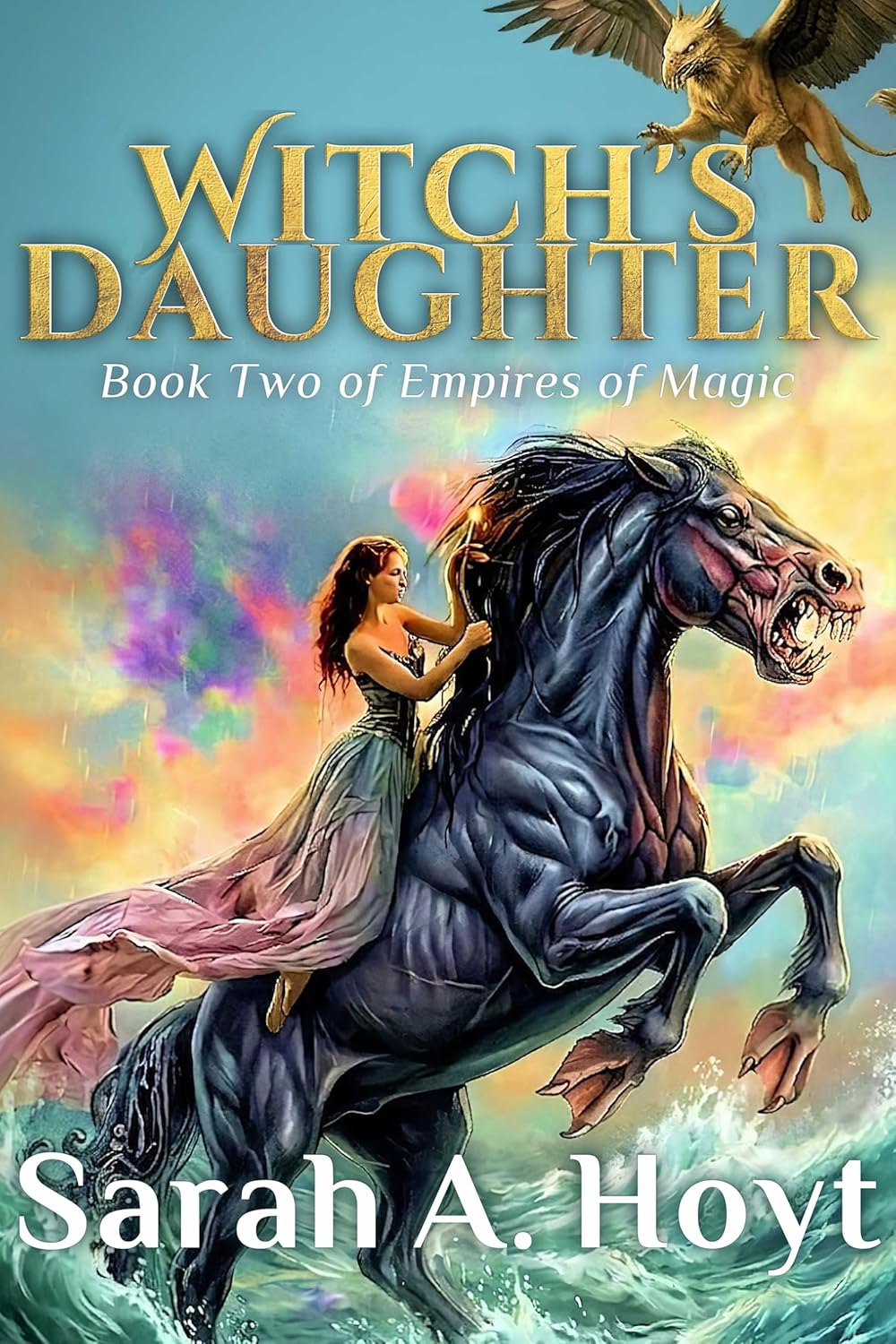
Some letters come from the living. Some come from the dead. This one comes with a formula that turns a rowboat into a miracle.
Seventeen-year-old Lord Michael Ainsling — youngest brother of the Duke of Darkwater, builder of mechanical marvels, survivor of fairyland — receives a letter from a man sixteen years dead. The inventor Tristram Blakley has not perished; he has been imprisoned by his own genius and begs the one mind in all of Avalon brilliant enough to understand his work to set him free. All Michael has to do is find seven missing brothers first and walk a magical path..
Fifteen-year-old Albinia Blakley has spent her whole life under her mother’s iron thumb — and her mother is a witch. The day Al finally escapes down a rope of knotted sheets, she lands in a world she doesn’t recognize, with no money, no magic kit, and no idea that the stranger who catches her is about to become her greatest ally.
Together, a girl with more secrets than she knows and a boy who builds machines that try to murder him must outwit a sorceress, navigate the treacherous courts of Fairyland, and unravel an enchantment years in the making — before a family is lost for good.
Witch’s Daughter is a gaslamp fantasy brimming with wit, warmth, and wonder, for readers who love their magic wrapped in velvet and their adventures served with morning tea.




 Mad Genius Club
Leave a reply to Imaginos1892 Cancel reply