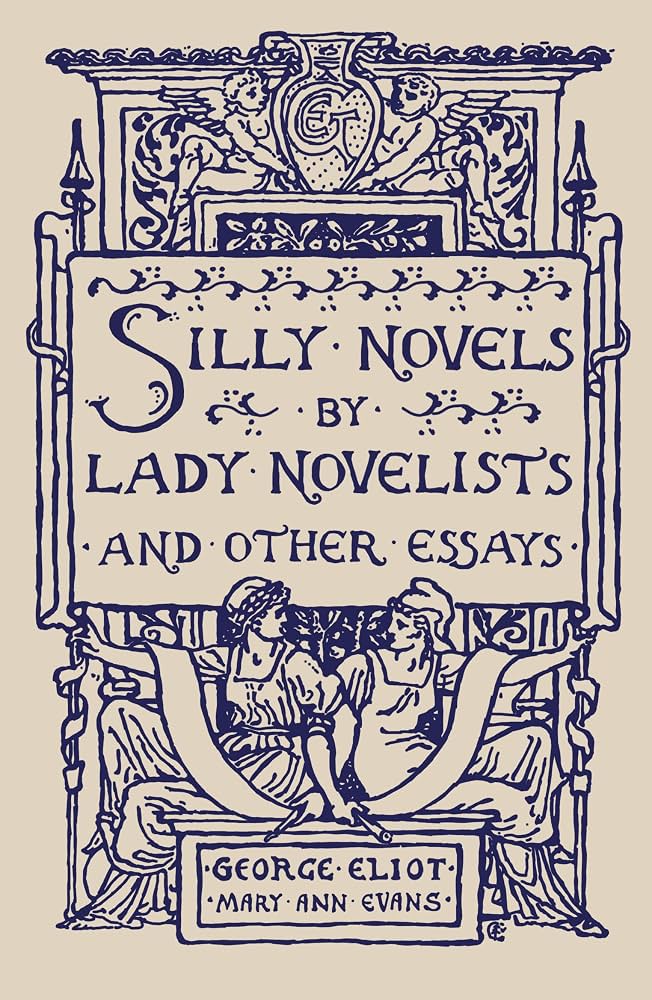
Link to the original essay by George Eliot. I recommend you go there now…
(20-ish pages, far more eloquent (and humorous) than anything I can say.)
I do periodically read in the “Romance” genre, mainly but not exclusively in “period” versions as well as the occasional contemporary. There are many flavors of this overproduced genre that I dislike or disdain, but the specimens I like best do a nice job of dwelling on the various moral responsibilities and uncertainties of two individuals striving for a lifelong accommodation and support — in other words, a variant of the sort of “career” novel that I enjoy in other genres, just concentrating on one specific part of that “career”.
That said, it is undeniably true that there is an awful lot of, um, tooth-grittingly silly/indulgent/absurd/impossible/repellent/story-plotting and exposition in the current production stream. The genre does seem to attract occasional authors who seem over-fascinated by mere pornography and low on story or worldbuilding setups and/or normal human mating behaviors.
It’s a pleasure to read George Eliot’s commentary on some of the same issues from a different and amusingly sardonic point of view in her day. Her target is the class of authors of her period who are burnishing their own reputations. Our contemporary authors are perhaps less troubled about showing off their knowledge of Classical languages and other items calculated to shed social approbation upon themselves, to claim a social limelight. Not to say that the mediocre moderns are above that, necessarily, but some of their offerings are simply inept or even downright repellent in addition to their pretention.
There is no substitute for reading the original essay in full spate, but I will amuse us here with a few choice remarks:
“In her recorded conversations she is amazingly
eloquent, and in her unrecorded conversations, amazingly witty.
She is understood to have a depth of insight that looks through
and through the shallow theories of philosophers, and her superior instincts are a sort of dial by which men have only to set
their clocks and watches, and all will go well.”
There are few women, we suppose, who have not seen .something of children under five years of age, yet in “Compensatio”
a recent novel of the mind-and-millinery species, which calls
itself a ” story of real life,” we have a child of four and a half
years old talking in this Ossianic fashion-
“‘ Oh, I am so happy, dear gran’mamma ;-I have seen,-I have
·seen such a delightful person: he is like everything beautiful,-like
the smell of sweet flowers, and the view from Ben Lomond ;-or no, .
better than that-he is like what I think of and see when I am very,
very happy; and he is really like mamma, too, when she sings; and
his forehead is like that distant sea,’ she continued, pointing to the
blue Mediterranean ; ‘there seems no end-no end; or like the clusters
of stars I like best to look at on a warm fine night …… Don’t
look so ….. your forehead is like Loch Lomond, when the wind
is blowing and the sun is gone in ; I like the sunshine best when the
lake is smooth …… So now-I like it better than ever …. .
it is more beautiful still from the dark cloud that has gone over it,
when the sun suddenly lights up all the colours of tlie forests and
shining purple rocks, and it is all ‘reflected in the waters below.’”
We are not surprised to learn that the mother of this infant
phenomenon, who exhibits symptoms so alarmingly like those of
adolescence repressed by gin, is herself a phoenix. We are
assured, again and again, that she had a remarkably original
mind, that she was a genius, and ” conscious of her originality,”
and she was fortunate enough to have a lover who was also a
genius, and a man of “most original mind.”
This lover, we read, though ” wonderfully similar” to her ” in powers and capacity,” was “infinitely ·superior to her in faith and
development,” and she saw in him the ” ‘Agape’-so rare to find
-of which she had read and admired the meaning in her Greek
Testament; having, from her great facility in learning languages,
read the Scriptures in their original tongues.” Of course! Greek
and Hebrew are mere play to a heroine; Sanscrit is no more than
a b c to her; and she can talk with perfect correctness in any
language except English. She is a wolking polyglott, a Creuzer
in crinoline. Poor men! There are so few of you who know
even Hebrew; you think it something to boast of if, like Bolingbroke~, you only ” understand that sort of learning, and what is
writ about it;” and you are perhaps adoring women who can
think slightingly of you in all the Semitic languages successively. But, then, as we are almost invariably told, that a
heroine has a “beautifully small head,” and as her intellect has
probably been early invigorated by an attention to costume and
deportment, we may conclude that she can pick up the Oriental
tongues, to say nothing of their dialects, with the same aerial
facility that the butterfly sips nectar. Besides, there can be no
difficulty in conceiving the depth of the heroine’s erudiction, when
that of the authoress is so evident.
I find the occasional sardonic asides after a lengthy quote give me a strong wish that she were alive today to comment on so many things:
(The italics and small caps
are the author’s, and we hope they assist the reader’s comprehension.)
Summing up her head shaking ridicule:
Such stories as this of ” The Enigma ” remind us of the
pictures clever children sometimes draw “out of their own head,”
where you will see a modern villa on the right, two knights in
helmets fighting in the foreground, and a tiger grinning in a
jungle on the left, the several objects being brought together
because the artist thinks each pretty, and perhaps still more
because he remembers seeing them in other pictures.
Her precise topics no longer trouble us directly, but we are consumed with just as much fantastical and wishful and fashionable thinking in the sub-par Romance offerings, worsened additionally by the removal of taboos over dwelling on sexual matters or criminality.
Authors still (understandably) seek fame and are not necessarily deterred in their methods of achieving it. It behooves us to continue a growing tradition of unfettered and intelligent review and commentary, and to reflect upon our own choices under those lights.
O Tempora, O Mores, etc. Commentary on the current state of the Romance genre at its most, um, repellent? One is tempted to simply throw up one’s hands at “different strokes” permissiveness, and no doubt there are audiences for all, but how about a little comic ridicule as balm for the soul? I do note that Elliott was not afraid of “offending” the subjects of her critique.
Or has that become socially impermissible these days, not just rude?






Leave a comment