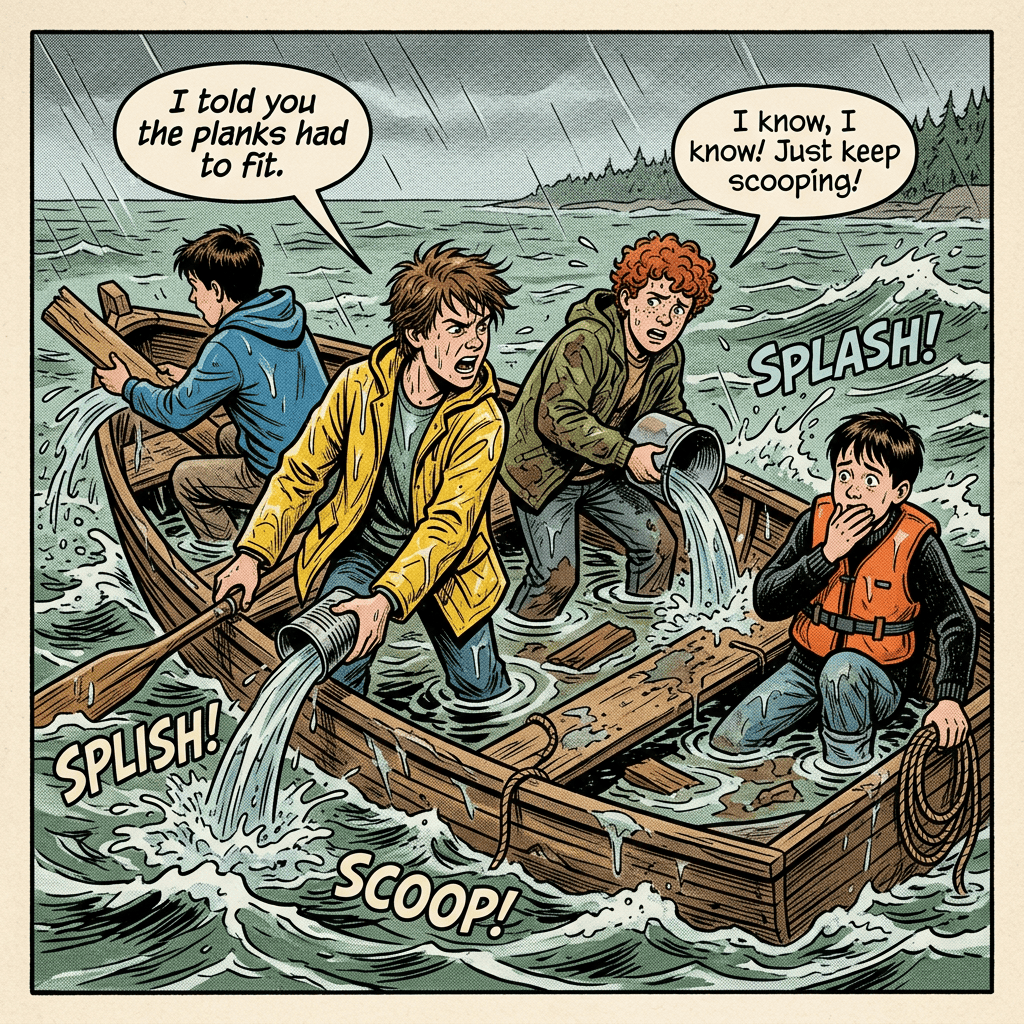
I am writing about teen (low teen) protagonists. They’re problem-solving with science, mechanical skills, technology and thought. I have no real idea if this will appeal to anyone, let alone teen/MG readers. All I know is it would have appealed to me. A LOT.
There’s a lot of technology that the protagonists have had first-hand witness to. There’s a lot less that they have actually done.
Mick put it into words. “The edges aren’t strait, Johnno. And I think it might take us a month of Sundays to make them straight, so they don’t leak water through between them. I mean, I suppose I could make a plane…”
“We don’t need to fly, just sail,” put in Titch
“A thing for shaving wood, you brat,” said Johnno. “And don’t tell me it hasn’t got a beard. They’re called splinters.”
“Although flying…” started Mick.
“Let’s stick to boats for now,” said Johnno hastily. “I want to clinker-build them.”
“Out of coal-waste?” asked Mick, faint but pursuing. “They make bricks out of it. And I want to work on bricks. Pre-grooved so the tentacle-monsters can’t stick. I think I saw a concrete boat once.”
“Yes,” said Johnno. “You can make them out of concrete, but we can’t. What I mean is wood lapped over wood, attached to a frame.” He showed them the overlap. “And you keep going like that until you have built up the hull. They have races with them back on my homeworld. My uncle Sammy was forever building one.”
“So… he made a lot of them? They’re easy?” asked Tal.
“Er. No. I mean he was busy building that one for years. I think it was to get away from my Aunt. You’d understand, if you met her. But I don’t think we need to be that perfect.
A large part of what I am doing is introducing ideas, solutions to the situation they find themselves in. Personally, I find it fascinating. I’m trying to intersperse it with action and disaster. It’s also a real challenge as I am constantly hitting up against: ‘would the character know that? would they understand (or be able to derive why) something works – or when it fails — several of their ideas — doesn’t. Being a writer constantly means — for me anyway — putting yourself in someone else’s head. And for me, writing this kind of book, it means heads that don’t know the chemical formula for malachite. They just know copper is involved in it. So: because I do know the chemistry, I have to manipulate getting copper out of it without knowing what they’re doing, and hopefully making it seem plausible, so if smart-Alec reader looks it up, he’ll find yes, it would work, and yes, that is why it would work. If the reader doesn’t, it’s not going to bore him to tears.
I’m getting a lot more respect for anyone who can write a school science text-book without boring the reader. I’m not trying to do that, just provide a series of inventive solutions to technical issues in a primitive setting. Of course, for some kids, I hope it will provide a million ideas for backyard inventions – most of which will fail, some spectacularly, and all educatively in a way no school will duplicate. Yep. I have lots of disasters. Hopefully the idea that this stuff can go dangerously wrong, is harder than in a novel is actually part of the story. And if it gets one kid to make clinker-build boat – which promptly sinks because yes, it is skilled labor, and it does need to be fairly perfect, I will be proud… not as proud as if the kid goes on to make one that doesn’t sink, but pleased.
The key, however, that I wanted to talk about is that I’ve just reading a book where the protagonist knew… what the author knew. Which, in reality as the protagonist lived a couple of centuries ago, they could not know… It threw me right out of the book. Always remember: if there is something a character should not know and you need them to… you have to explain how they do. Uncle Sammy is boring his nephew and making him hold the tree-nails (dowels) for a reason.
On another tack, that fascinated me: I ran a poll on X – too small and too selective (my followers) to be more than a curiosity, asking readers of both sexes if they would consider a non-reader as a life-partner. I was kind of taken aback to get 17% of men think it OK, and 30% of women. That just shows how wrong I can be, because I would have thought both smaller, and if anything women would find it more off-putting than men. It does go some way to explain how unconcerned many female writers are about the collapse of male reading: They don’t see the necessity of a reader for a partner or their female kids’ partner. Um. It sounds dreadful to me.



Leave a Reply