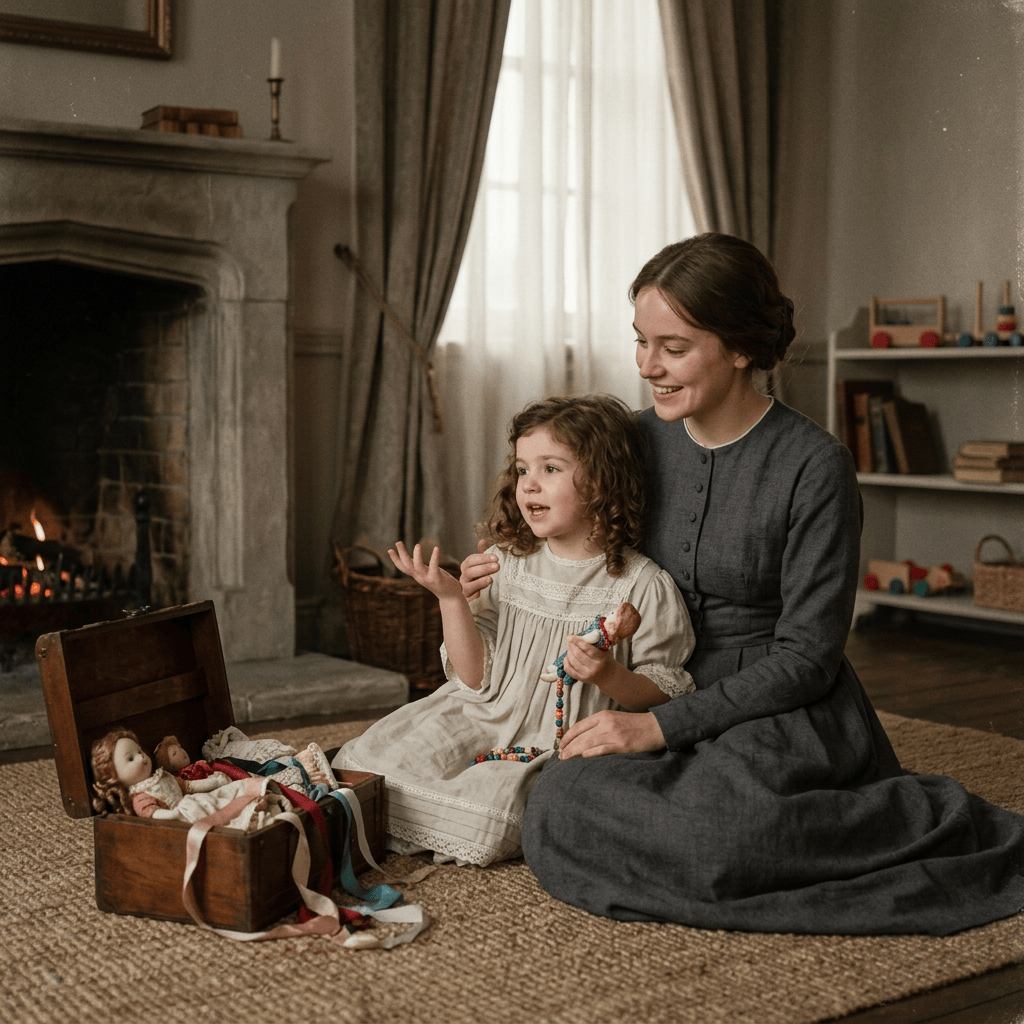
An internet friend who edits costume romances has a lot to say about children in fiction, and now I’ve got a few thoughts on the subject, too.
Historically, people had larger families, because children were economic assets, not liabilities; and high rates of child mortality meant that it was sensible to have as many children as possible, so the entire family wasn’t wiped out by one random illness.
This real-life phenomenon leads writers of historical fiction to assume they need to add a bunch of child characters to their books. Fair enough. A book where no one has any parents, siblings, or children will feel subtly ‘off’ to most readers. But adding more characters is always tricky, no matter their age, and there’s a strong temptation to use a cute child as a plot device only- the adorable little moppet who asks, ‘why are they kissing?’ at the exact right- or wrong, depending on your point of view- moment in a romance. Children, because they’re small and vulnerable, are also great favorites when a person needs to be rescued or succumb to a dangerous illness to move the rest of the plot along. Reading about a child in peril quite rightly tugs at the reader’s heartstrings and helps paper over gaps in the rest of the story- it’s hard to be critical when little Timmy’s fallen down the old well and needs to be rescued now.
There’s also a trend, particularly in costume romances, to have one of the main characters take charge of a child, find out that they’re overwhelmed by the responsibility, and require the other main character to assist. The rest of the plot follows from there. This makes sense in certain settings like westerns, where the characters are fairly isolated from civilization. If they don’t take care of the child, no one will.
It makes no sense whatsoever in regency romances where the main characters are all aristocrats; a duke faced with caring for a child is going to hire a servant to take care of it (governess romances, like Jane Eyre, are a slightly different type of story, and tend to focus on the attraction between a well educated woman in reduced circumstances, and a man who is far above her in wealth but might be her intellectual equal; the children are a plot catalyst, but aren’t the only reason the characters fall in love). And an upper-class woman who spends all her time volunteering at an orphanage- another common trope in costume romances- is going to be viewed with some skepticism by the male main character. He’s going to wonder if she’ll turn all that energy toward her own family once he marries her, or is she going to neglect her own children because she’s too busy with her charitable works? No matter how much he admires her work ethic or sense of Christian charity, he’s probably not going to fall head over heels in love with her once he sees her playing with the plot moppets.
The children in these costume romances are plot devices, not characters. Now, not every character can be a major character, fully fleshed out with a complete history and minutely detailed personality. But they can be minor characters, and that’s the role most child characters should play- human beings who don’t get as much page time as the human beings who are the main focus of the story.
If you want the verisimilitude of a large family without having to juggle a zillion characters, there are historically accurate situations available to you. Fostering, adoption, apprenticeships, and boarding schools were common enough at various times and places in history that no one’s going to bat an eyelash if most of a family’s children don’t actually live in the same house as their parents. The idea of a husband, wife, and their genetically related children all living together until the last child reaches adulthood is an ideal, and only in certain cultures; real life often fell short for a variety of reasons. The kids don’t all have to show up on-page. If they do, treat them like real human beings, because they are.
I find the child-as-plot-device trope especially jarring because children tend to have more obvious personalities than adults. You might talk to an adult for an hour and not learn very much about them. Talk to a child for an hour, and you’ll know everything about their lives- what they like to eat, which are their favorite toys, that they got new shoes last week and what Mommy said to the sales clerk- all the things they think are important. Treating such an expansive personality like a mere plot device feels weird.
It’s possible to treat a child as both a plot device and a real minor character. Continuing with the examination of Jane Eyre, Adele starts out purely as a plot device- she’s there to give Jane a reason to be at Thornfield. She also sparks exposition about Mr. Rochester’s personal life, when Jane asks where she came from. But she’s not just a plot device- Jane plays with her, talks to her, listens to her chatter on about gifts and pretty dresses- all the things that an orphaned servant would do with her equally lonely charge. Adele falls back into being a plot device when Jane runs away; Jane barely thinks of how her actions will affect Adele, and comforts herself with the thought that the child has other people like her nurse, to take care of her. Adele returns to being a character in the epilogue, when Jane mentions that she had to take her out of an unsuitable school, and find another way to educate her. This changing role works well because Adele is a fairly ordinary child, not a genius in the way that so many plot moppets are; and because Jane and Rochester would’ve fallen in love if they’d been thrown together in other circumstances; Adele’s presence isn’t strictly necessary.
If your characters’ only reason for falling in love is that they babysat the same kid for a while, that’s a shaky foundation for a romance. They can meet that way, but the author ought to give them some other reasons to fall in love. The story’s supposed to end with, ‘and they lived happily ever after,’ not, ‘and they lived happily until the kids grew up and moved out.’
How do you treat child characters in your writing? What are some other examples of child characters being handled unusually well?- or unusually badly?





Leave a comment