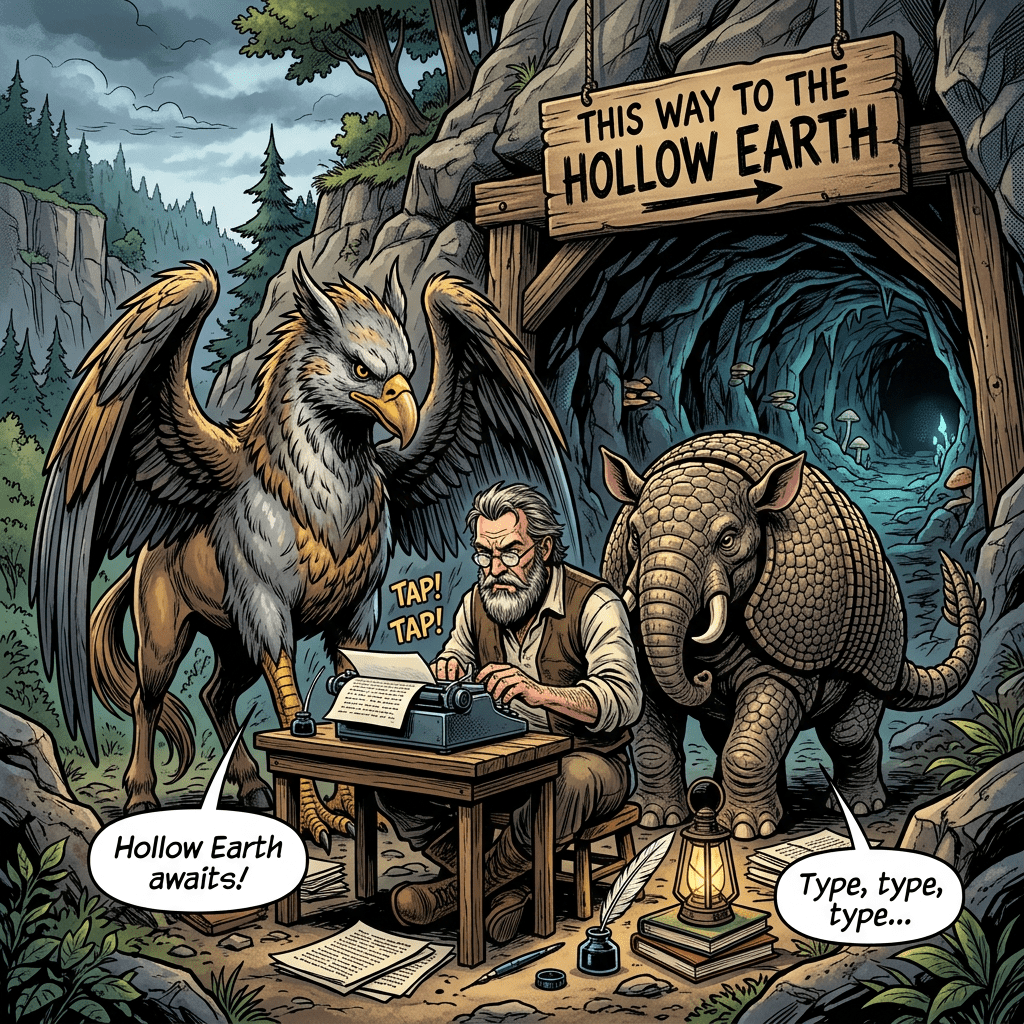
Atlantis, Lizard People, the hollow Earth and other charming tropes… The Fortean Times was a great source of excellent pulp sf tropes.
I recall reading that Eric Frank Russell was behind the belief in spontaneous human combustion. He was a great sf writer, but would probably not be the best guy to buy a bridge from. Humans, like cows, are soggy and do not catch fire all that easily. The fat ones can probably be got to burn, in much the same way diesel does, but the idea of them suddenly igniting for no good reason except to provide a frisson of horrified fascination is… optimistic.
And yet… people were willing (if put to it by a great snake-oil salesman) to suspend disbelief. One merely has to look at politics! But even in the far more rigorous field of writing sf/fantasy people want to believe. You just… like the snake-oil salesman, have to make it not an unpleasant experience. People picking up a fantasy novel may be tossed out of it because you got a gun or sailboat or worst, horse detail wrong – but that’s because those are real things, which at least some of your readers know are wrong and not possible.
The armadillo-elephant (which defies even the most inventive to actually work out how could cross-breed) will be greeted with delight, and the reader will reach the conclusion it is not really a cross between the two but some magical creature that looks like the result of that. Likewise: Hippogriffs. (an aside, I spent some youthful years firmly under the impression that these hippopotamus x eagle, and was very disappointed to find it merely a horse).
The point is the reader wants to suspend their disbelief. They just don’t want you to use an ordinary horse like an automobile because the writer has never ridden or saddled or fed a horse, and the reader has. In short, the impossible they’ll eagerly accept. The possible, but wrong… they won’t.
The hollow earth and the UFO buried at the South Pole is of course perfectly good story material.





11 responses to “Spontaneous Human Combustion”
A lot of people want to believe that there’s something hidden that they can find out about, and carry around that “secret knowledge.” At least a decade ago, Bill Whittle had a fascinating essay about when he was into some of the JFK assassination conspiracies, and the appeal of that kind of gnosis, knowledge limited to prepared initiates.
I’ve toyed with the idea of “what if some of the Chinese ‘dragon bones’ really were genetically ‘wrong’ for dinosaurs, and then an old, lean gentleman meets with the paleontologist and politely requests that further information not be published. A gentleman with a dangerous air about him and odd eyes …
Mr Smith’s cousin….
Yes! I wanna read this one.
Dickens depicts a case of spontaneous human combustion in Bleak House, and when challenged by his contemporaries on the subject, cited accounts going back to 1731. Doesn’t make any of it true of course, but it makes Eric Frank Russell rather late to the party.
As far as the hippogriff goes, he first appears in literature as the property of a wizard who has also apparently invented a kind of flash grenade in shield form, so the idea that the hippogriff is a product of Mad Magiscience rather than a cross-breeding program makes sense.
There’s also thoughts that it, symbolically, is a wink and a nod to the reader — oh, yes, this is really entirely imaginary.
Literature was, after all, still pulling the idea of fiction loose.
It was another SF writer (Randell Garrett I believe) who invented “May you live in interesting times” and convinced the world it was an ancient Chinese curse.
There is a mechanism that can reduce a human body to remains associated with spontaneous human combustion. It requires an overstuffed chair, a overweight (generally elderly) person and liberal amounts of alcohol and tobacco.
The victim, overindulges in alcohol sitting in a overstuffed chair while smoking. He or she passes out, stupefied by the booze. Lit cigarette drops onto the upholstery of the chair, which catches fire. The victim is overcome by smoke inhalation. and dies.
The fire eventually ignites the body fat of the victim. Rather like the wick of a candle melts and consumes the wax around it. The fire eventually becomes intense enough to consume everything but a few bones and the metal bits of the chair which are left on the floor when everything is over. And leave a sooty residue on the ceiling.
Note the floor needs to be dirt or stone. Hardwood also works, because the heat is going up. But there cannot be carpeting or curtains nearby or they would catch. Back in the day when this happened (call it 1850s to 1930s) that was pretty typical. Otherwise the whole house caught fire and you had no mystery.
And you had to be pretty drunk to begin with. Drunk enough the heat from the upholstery or your clothing catching fire did not wake you. From what I read, the process took 6-8 hours. Hardly “instantaneous” or “spontaneous,” but there were no witnesses to gainsay. Generally because whomever this happened to lived alone.
It must have appeared grisly and mysterious to those who first happened on the scene. It require a rare set of starting conditions, but it created enough stories to produce the spontaneous human combustion myth.
Conspiracy theories make for great story fodder. One of my best short stories, IMHO, came from a story about a couple who thought they saw a UFO…but that’s not the interesting part I didn’t think. The scary part of the story for me came about an hour later, when they pulled into a restaurant to get something to eat and calm their nerves, and one of the other customers in the restaurant came over to them and kept demanding to know what they’d seen.
One place I could wish is a little less full of conspiracy theories, though, is the study of ancient civilizations. It feels like the books on that fall into two camps: anything that doesn’t fit the current archaeological paradigm is a fraud, and probably a malicious fraud; or anything that doesn’t fit the current archaeological paradigm is proof that aliens built the pyramids from the base in Lemuria for the purposes of waging war on the lizard men of Atlantis.
Of the two, I prefer to read the second type. Not only are they far more entertaining than the first, but occasionally they stumble on a nugget of truth. “Okay, yeah, Atlantis was actually in the middle of France, sure, whatever…the pyramids line up with these particular stars in the Orion constellation, someone really needs to teach these guys about multiple hypothesis correction…crystal skulls are ancient supercomputers, mmm-hmmm…there was an advanced civilization in South America dismissed by archaeologists because they were basket-weavers rather than pottery-makers, hey, that one’s actually real!”
Anyone who wants some good old-fashioned pulp adventure ideas for their fiction needs to go and look at the books published by Adventures Unlimited Press. Especially the ‘Lost Cities’ ones by David Hatcher Childress. Any man with the chutzpah to write about dinosaur-riding diamond-mining Babylonians in Central Africa – well. he’s got something there.
And a bit OT but something I’ve read about more than once with real-life witnesses to paranormal events, whatever they may be, is how badly they get harassed by both the true believers and the true anti-believers after they go public. Nobody seems willing to accept the possibility of someone being sincerely mistaken. They either had an actual paranormal encounter which must be shoe-horned into the individual’s personal mythology, or they’re lying frauds who are out for money, even if they never try to make a penny off of their account. No one grants for a position in-between those two extremes.
Speaking of dinosaurs and chutzpah: https://www.kickstarter.com/projects/sparkefilms/dinosaurs-of-the-wild-west-series
On the paranormal, my opinion is that it’s all bunk but if I happen to encounter something, I’m perfectly willing to change my mind. I don’t believe ghosts exist. However, if one pops up in front of me, I will reconsider. I’d absolutely love to be abducted by aliens.
In A Diabolical Bargain, one class teaches that such mixes are not hybrids but the result of partial transformations, which can be tricky because the transformation has to be compatible with life at every stage.