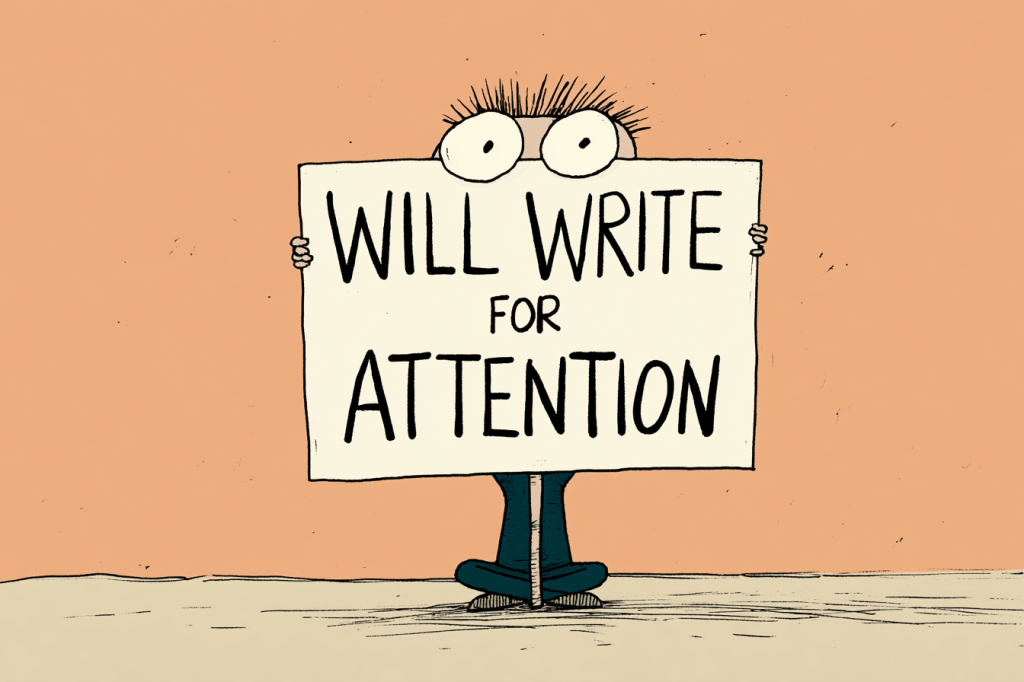
We were all taught early and often not to seek out attention. Children should be seen and not heard didn’t end with the Victorians, and children throwing tantrums for their adults to look at them is abhorrent. However, the premise today for the purposes of this article is that, like most things in life, you can take a good thing too far.
I am, nominally, the leader of the local writing group that meets at our library1. This month, a new guy showed up, and we didn’t scare him off! In fact, he was very happy to not find that we sat there for an hour writing silently. Instead, we did a sort of round-table discussion on marketing, since that’s what the group had asked me to do the month before. The new guy listened and took notes and asked good questions. One of those was “If I start writing a blog, how do I get more people than my friends and family reading it?”
The answer to that is complex, and part of it comes back to the problems most Indie authors have with marketing and self-promotion: calling attention to oneself feels wrong. Furthermore, if you call attention to yourself, part of your audience will treat it like that child having a tantrum and be repelled. It’s a conundrum. There are ways to do it, I think, and I suspect the comments will have even more ideas.
- Be Interesting
- Craft a good hook
- Ask Questions
- Be Controversial2
- Be Consistent
- Cross-pollinate and collaborate
- Give first, sell second
- Find Readers
Now, being interesting is fairly broad. I’ll suggest that you consider your potential audience, and that they are interested in the same things you’ll be passionate about on the page. If you aren’t passionate, you won’t be able to keep this up in the long run. Writing is not a high-reward result, so you might at least deeply enjoy what you are doing.
If you can be interesting, first you have to capture their interest, which is where the hook comes in. These days the maligned click-bait is notorious, but the origin was the hook that snagged attention. Find a path that threads the needle between bait and ‘hmm, that is intriguing’ and you’ll be on to something.
If you can get your audience to have some skin in the game, it helps enormously. Asking them questions they are interested in answering will increase what is called ‘engagement’ these days. By doing that, you’ve jolted them out of their glazed-eyed scrolling and into giving you their precious time and attention. You’ll be remembered.
Which brings me to the controversy. This can potentially get you remembered in ways you do not want. Personally I find riding controversies to the top of people’s minds to be unpleasant. However, there are times you can spark a controversy inadvertently, which I did recently by sharing a snip-quote from one of my books with a relevant comment. The amount of response I got to that startled me. So this can be useful, if done judiciously and with due caution.
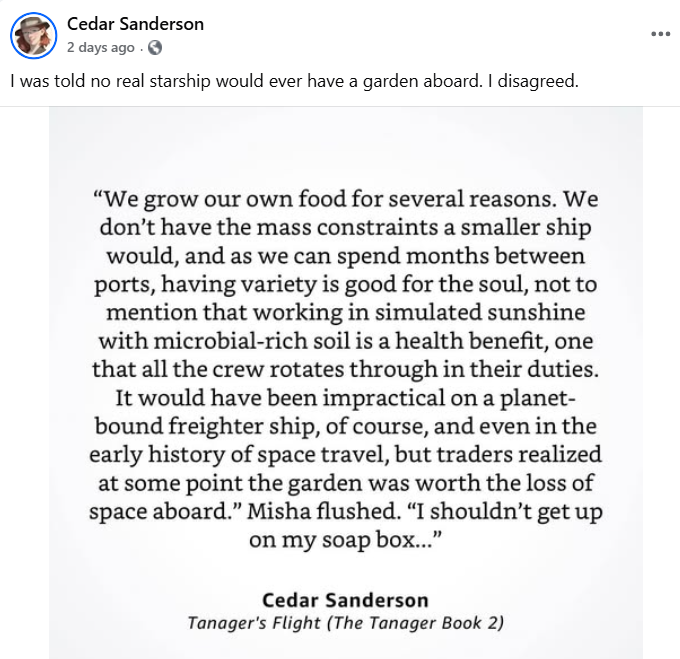
Consistency applies to more than picking a day of the week to drop a new blog post, although that is also important. I don’t recommend daily because you will burn out. Ask me how I know. Yes, I’m currently posting six days a week, but a lot of that is scheduled ahead of time and most of it isn’t really writing related. Making my blog all about writing is absolutely the wrong way to do it. You aren’t marketing to writers, you want to have readers find you, like you, and buy your books. Otherwise, why are you doing this? Consistency also applies to the expectations you set up, for tone, quality, and location.
Cross-pollination leads to learning where your audience is. Working with other bloggers in collaborations can lead to you picking up new readers, through guest posts, for instance. Substack’s recommendations are great for cross-pollination. However, there’s something else to consider, I told him. It might be that they aren’t reading blogs. They may be listening to podcasts. A lot of the younger set are rediscovering blogging by way of Substack, but more are finding interesting voices through short videos, which link to longer videos, or by way of podcasts they can listen to on a commute. There’s nothing stopping you from turning a blog into a podcast, as well. This broadens the pool of potential readers.
When I started blogging for marketing (my blog started as a mommy blog to let my family follow along as my children grew) I latched onto the concept of content marketing. Unfortunately, this has gotten twisted and a bad reputation, but at the time the idea was, like Baen’s Free Library, that if you gave something away, you showed the reader what they could expect from you. It was an introduction, and a trust-building exercise. Then, when you did launch a book and announce it was available to buy, your readers were primed to pick up a copy because they knew what to expect from you and that they would like it. Putting up short fiction, snippets, interesting research articles, all those get reader appetites whetted without getting too deep into the weeds of technical how-to-write details.
Finally, as I told him, figure out where your audience is, and meet them there. How do you know all this? Ask readers. You can ask on social media, but more and more that is becoming something of a ghost town. The younger – and by this, I mean twenties – are not on Facebook or X. My kids aren’t. For this young man, he’s likely looking at Tik- Tok, Spotify, Discord, and other places I don’t even know. And conventions are another place. But not literary conventions, because the ages there skew far away from the young’uns. Comic cons, anime is huge, look at where books are selling, and be there.
As much as it dismays many of us to draw attention to ourselves, this is something we need to do if we propose to sell our works. Doing this slowly and steadily is, fortunately, far more reliable than going viral. Take your time, realize it may be years, and don’t be afraid to learn as you go. It doesn’t have to be perfect at first. It just needs to start happening. Not with loud fanfare like a child’s tantrum, either. Figure out what gets eyes on your books, and do more of that.

- The library benefit anthology is open for story submissions! Find out more over at JL Curtis’ blog. ↩︎
- Note that I am NOT recommending this approach for politics and such, but it is certainly effective, if limiting in some ways. ↩︎




6 responses to “Attention-Seeking Behaviours”
I tend to toss a variety of things out. Recipes that worked (important detail!), story excerpts, cat posts, garden posts, history stuff, the occasional engineering thing that catches my eye, aviation whatever, travel, “ooh, shiney!” and sometimes a bit of opinion usually related to history. I try very hard to avoid current events and politics, unless I can take then in different, less controversial directions. People come to my blog to relax, not get their blood pressures raised.
And it’s a very engaging blog! I know I enjoy it. I particularly like when you do research book reviews, but that might just be a me thing 😀
What she said!
I was actually just thinking about this last night, and the story about how, when Weird Al was first starting out, he would repeatedly disguise his voice and call his local radio station to request that they play “I Love Rocky Road.” If they played it, all well and good, but his real goal was to get it on the “Top 10 Most Requested Songs” at the end of the week.
The point is that the hustle has always been part of the arts, and if you want to make a living at it, you have to find ways to draw attention to yourself. It’s a skill, unfortunately, that I’ve never had, and I doubt I’m likely to develop it in middle age.
I think you’re right also about videos and podcasts being “where it’s at”; whether it’s organic or the result of YouTube really pushing the line “the only ads that work are video ads” isn’t really relevant at this point. However, I’m firmly of the belief that Tik-Tok is evil, and everyone puts content on it is complicit in that evil, so that eliminates BookTok as a marketing option. I have a face made for radio, and a voice made for print, so other video and audio options are largely out as well.
I have a tiktok account because I was paying someone for a year to put promo stuff there. It did not have a reasonable return on investment so I discontinued the effort. I am, however, tinkering with Youtube not as a monetization effort but again, part of the marketing reach. I enjoy doing eclectic content. That’s more than most people want to get from one channel, but the ones who remain? Those are My People.
Blogging is not dead. I have been absolutely delighted with the move to Substack and the community there.
I follow cruising vlogs on youtube. One of the good ones always has a midpoint survey that’s related to the topic at hand. Then he does the responses to the previous survey. Then he rolls with the news. Good subscriber engagement there.