As writers of fiction, many of us deal with moments of crisis and threats to mortality on behalf of our characters. We have to imagine what that feels like.
Then there’s the real world…
A couple of nights ago, there was an outburst of tornados and related weather in my part of central Pennsylvania in the mountains. Now, I grew up in Kansas City and there’s nothing I like so well as extreme storms and especially tornados. I’ve seen lots of them reasonably close up, and they’re terrific! Typically, if you’re outdoors you can sense the exact sort of weather that’s indicative of the possibility (color of sky, liveliness of the air, temperature, more ominous than thunderstorms), and you can see (or sometimes hear) them coming (sparks of powerlines blowing down, sounds like a choo-choo train). In the old days, with more primitive television, you could even spot them as they formed as an electrical disturbance on an unoccupied broadcast TV channel. Great stuff!
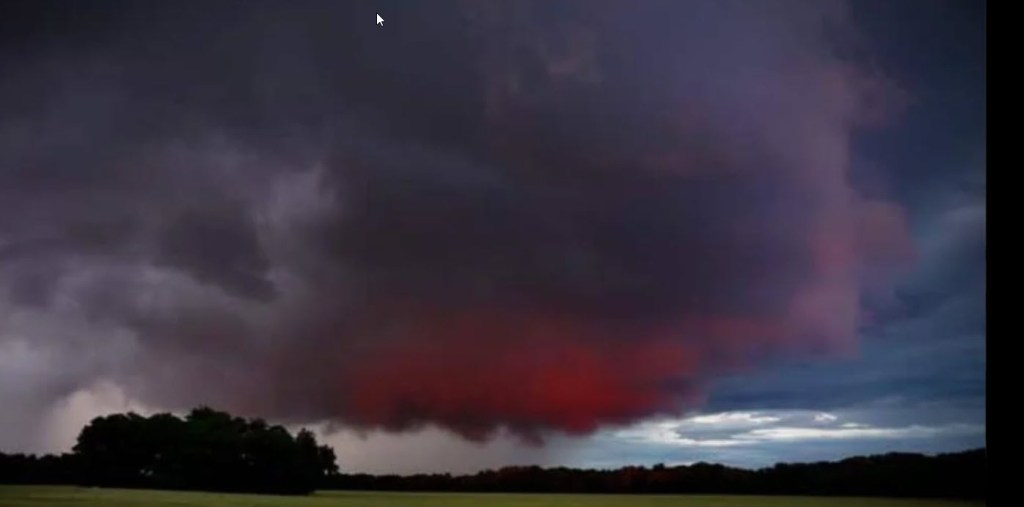
So there I was with my hubby in our 1812 cabin on our farm near the top of one of the hollows. There had been thunderstorm threats, but nothing materializing yet, in the twilight. A weather alert sounded off on my phone, I glanced out at the sky, recognized the incoming storm look-and-feel of the part I could see, and hastened out the front door to the cabin porch to get a better view. Didn’t have my phone on me, so no pics, but the illustration I’ve borrowed for this post is pretty accurate. Just picture a small cabin directly underneath the rosy cloud, remove the clump of the green trees, tilt the landscape on a mountain slope in a hollow, and add enclosed emptiness all around. Keep the lighting.
There, looking almost close enough to touch, was a wall cloud, colored in dirty pink and brown, dimly lit, revolving noiselessly and sedately not far above me out in the front yard as it sucked in the moisture from the ground and fed it into the storm cell above. It hovered not far over my head, just a little way out into the front field rather than directly over the roof. It stayed in place as if pinned there.
Where I grew up, we referred to a wall cloud like that as a “mother of tornados”, since that’s what feeds the actual funnel clouds that form and then touch down to bounce back up or persist along the ground. I’d never been that close to one before, and it was mesmerizing.
Like all such existential things, it concentrated the mind. 🙂 There was, of course, nothing you could do about it. There are no basements in 200-year-old cabins and, while there was a root cellar, it wasn’t all that close and my husband wouldn’t have been able to walk there quickly enough. Though all the silent movement was up and around (rotating and pulling up moisture), that wasn’t going to persist. It would either rise back up and dissipate as it ran out of energy, or it was going to start spawning emerging funnel points and setting tornados down through the wall cloud. That’s how it works.
So. I called my husband over to take a look at it, on the grounds that he would never see something like that again, up close and personal, then I made sure the dog was inside, and watched.
As it happened, the wall cloud disintegrated into pounding rain (that’s not unusual) and moved down slope further away and out of sight, where it then proceeded to spawn some funnels and break trees capriciously all the way down the hollow. No one was hurt, the damage was relatively minor all around once it was done, and everyone was grateful, if a bit shocked (this not actually being Kansas, after all).
I was moved by the vividness of my own personal reactions to what was, after all, an existential crisis, after a fashion — it could easily have been fatal to us, if the funnels had emerged. As I reviewed my own actions, I tried (as one does) to decide if I could have done anything differently, or what I would have done if…
I wasn’t sorry to have encountered the wall cloud so closely — in fact, I was fascinated — and I knew there was little effective I could accomplish to mitigate whatever was going to happen (like those car accidents that give you subjective hours to think about what’s coming) so I embraced the opportunity to thrill over the unique experience (the scare of a lifetime). I may not have a photo of my own, but the mental image I have of that silently revolving wall cloud will be hard to erase (and me, I’m glad about that. I got away with it. Makes me smile).
And that’s the point. This is what your characters may feel, after an existential crisis. This is the sort of thing they may muse about, or regret, or rebound from. They’ll bore others with the story. They’ll pat themselves on the back for their sang-froid, or they’ll obsess over their hesitations and missed opportunities. It has to feel real to them, with all of its ups and downs — true to their character, revealing to the reader.
How do you mine this sort of thing for your own creations?





9 responses to “Existential moments”
Growing up and currently living in North Dakota I’ve seen a few. Luckily I’ve never had to be in one. My paternal grandfather used to like to go sit on top of the hill whenever there was a warning for our area to see if one was coming. My wife’s family has been hit a couple of times. Her maternal aunt/uncle were in bed when a tornado tore the roof off their house leaving them staring at the sky back in the late ’80s. And a paternal aunt in KC had a 2×6 come through the wall and slice her leg from hip to knee as one swept through development, wiping out the houses along the street directly behind them and (only) blowing out the windows and tearing the deck off their house. Her uncle had just pulled into Minot about 2 hours earlier for a visit, so her dad drove his little brother the 12 hours back that night.
Where I currently live/work, if one town in our little metro sets off their sirens all the towns set them off. Once, decades ago, I had an old man call 9-1-1 after we turned the sirens on because there was an _observed_ tornado just west of town. He insisting on knowing if the tornado was going to hit his house or not, and was not happy with me when I told him to take shelter and turn on his radio, then hung up on him to take more calls. That was one of the few times I’ve had someone call to speak to the chief about me.
I remember being startled when watching some miscellaneous “how things are done” TV show where I discovered that one of the tests for sturdiness made for external wooden wall home construction was to fire entire 2x4s at it from a sort of cannon, like arrows, to make sure they couldn’t penetrate the wall. This was for a tornado survival test. (Seemed like an accurate simulation to me…)
I’ve survived one tornado hit (took out 2/3 of the apartment complex, but not my third), one near miss (quarter mile away), and seen two from the ground, one while flying inside the storm (DO NOT TRY THIS AT HOME). I don’t really care for thunderstorms any more. Little pop-ups are OK, high-base storms are mostly OK, but not tornadic and/or severe storms.
Which is another thing that can happen. Your character will get twitchy, will perhaps avoid places (I won’t drive through a particular intersection on Saturday mornings, after having been T-boned there), and may do things that other people puzzle about.
There was an intersection i avoided for years after being t-boned there; passed through it for maybe the third time in twenty years recently and remembered the incident.
Wasn’t quite that severe but I did have to work to go around a corner where I skidded into the guardrails once.
Oh. G*d yes – there is a stretch of the main boulevard through my part of town, and I was T-boned by a big pickup truck, bombing out of a parking lot. I was driving my daughters’ car, just coming back from the corner HEB. I avoid driving along that block as much as I can now.
Another curious thing to get twitchy about – having been made sick (to the point of vomiting) by a particular dish. Will avoid ever eating that food/dish ever again.
The food thing is something we have extra mechanisms for.
Gut inflamation increases paranoia and stuff.
The more sick you are after eating something, the more the memory associations tend to strongly correlate to ‘do not want’.
Sometimes they won’t talk about it, just shift their priorities, what they care about. And it becomes one of those influences that is only visible in its shadow.
I’ve seen that handled well a few times, especially in long running series, where the reader can see both the before and the after, and was there when the inflection point happened.
My “attachment” to things tends to be fairly short. Even “seeing red” level anger only affects me for a couple of days. I’ve only had a couple of existential events in my life and, as far as I can tell, they no longer affect me.
I have no idea if this would apply to something more serious (e.g. PTSD from combat) or if it reflects my (thankfully) mostly boring life. I hope to never find out. (Anyone want to weigh in on that split infinitive? Seems fine to me.)
As for characters, I will keep this in mind. There’s lots of fighting. _Someone_ is going to be traumatized by it, even if it is not my intrepid hero.
There’s a (very minor) character in Primal Hunter who is all excited that he’s a mage and happily practices fireballs. Then he actually uses one and burns someone alive (completely justifiably). He quits (and becomes a sculptor, of all things). That seems perfectly reasonable to me.