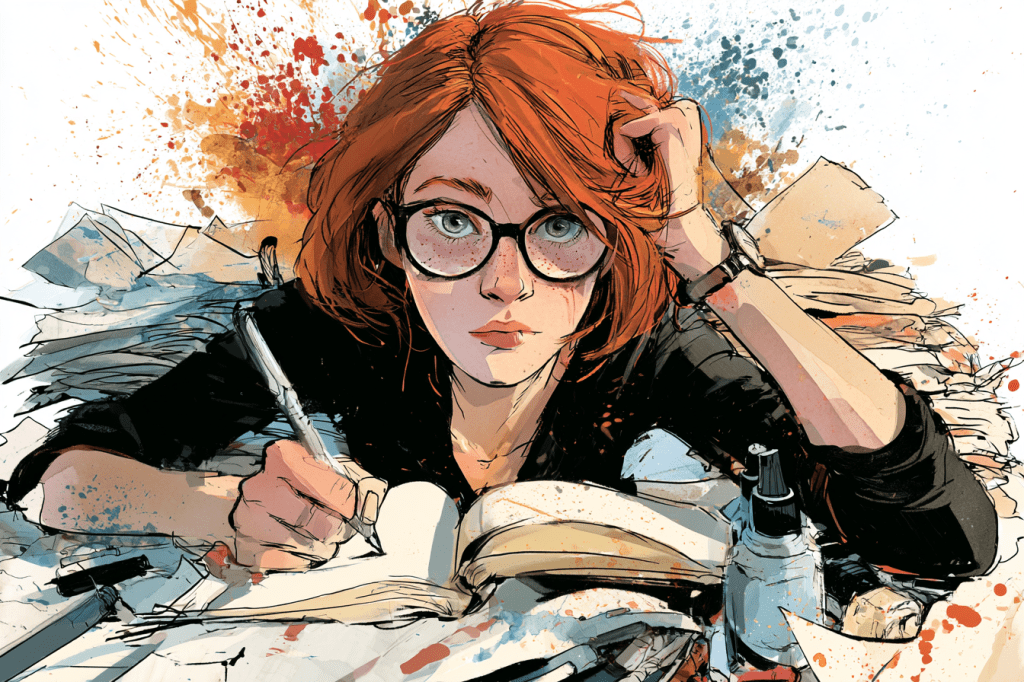
Sarah Hoyt, one of my writing mentors, was talking about an article on writing and literature that was making the rounds, and commented “to this person it was 1999 and there was no indie publishing.” I remember 1999 vividly. It is the year my oldest daughter was born, and the year I discovered the pleasure of reading online while I nursed a child.
Books take two hands, turning a digital page only took one, making it possible to read while supporting an infant in the other arm. Ebook readers were a bare rumor of something they were calling electronic ink displays. I have always read voraciously, and if Project Gutenberg existed, I didn’t find it just yet. I read through UPenn Online’s digitized public domain books, and went looking for something else to read, like any hungry hungry bookworm. I found, at some point in 2000, pregnant with my second and wrangling a just-toddling little lady, the Baen Free Library.
Finding the Library brought me to the forum, where I met Sarah, Dave Freer, and many others. Including the man I would wind up marrying many years into the future, although neither of us had even the smallest inkling of that at the time. We barely even spoke. I was wrapped around babies – my second arrived in 2000, my third in 2002, and then there was a short break before my fourth and final in 2005. By that time, I was running the family business, managing my father’s farm, and frankly too busy to think about writing or even reading much. There was other stuff going on, too, under the surface.
Fast forward and find me again in 2010. I was undergoing a creative rebirth, as my life emerged into sunlight again. Very much like the caterpillar who had become a slurry for a while before reforming into a winged creature. Felt like it, anyway. I started to write. Again. I’d written in my teens, stopped when my first husband told me that I needed to learn ‘how to use words’ instead of writing my thoughts and feelings down on paper. Which makes no sense at a distance, but at the time I’d put away or destroyed all my notebooks, dutifully, and tried to be what I was supposed to be. Being a writer never fully crossed my mind.
And yet, when the Indie Revolution bloomed into growth, there I was with my little stories that were the first baby steps, publishing them on Amazon because I could. No one left to tell me I couldn’t. No gatekeepers, not the private ones, nor the public ones. I could write. I could share what I wrote. People liked it! It doesn’t take much to encourage me, and I kept writing.
Over more than a decade of indie publishing, a handful of my titles have moved more than twenty thousand paid ebook copies, generated tens of thousands of dollars in royalties, and accumulated millions of pages read through Kindle Unlimited. That is not “bestseller” territory in the traditional sense, and it is only a fraction of my catalog, but it is also not negligible. It is the result of being able to put books in front of readers without first securing a traditional contract. Articles that discuss literature, sales, or the state of publishing while ignoring ebook numbers and the indie layer are therefore describing only part of the market—the part that still runs through the older, gatekept channels. The rest of the readers, and a large share of the commercial fiction they actually consume, moved elsewhere years ago.
The scale of the shift far more than just my sales numbers. In 2025 the Association of American Publishers reported that digital formats (ebooks plus digital audio) accounted for 21.5 percent of U.S. trade revenue, with ebooks alone generating roughly $2.2 billion. Those figures understate the digital and indie layer, because the AAP data primarily capture traditional publishers and do not fully include self-published titles or Kindle Unlimited payouts. Amazon, which holds an estimated two-thirds of U.S. ebook unit sales and closer to 80 percent, once Kindle Unlimited borrows are included, sees roughly 30 percent of its ebook sales come from self-published titles; within Kindle Unlimited itself the share of self-published books is substantially higher.
We know the volume of self-published work has grown far faster than traditional output. Bowker data show more than 3.5 million self-published titles registered with ISBNs in the United States in 2025, against roughly 640,000 titles from traditional publishers. Kindle Unlimited’s monthly author fund has settled in the $50–67 million range; the first eight months of 2026 alone paid out more than half a billion dollars to authors. In August 2026 the per-page rate reached $0.005170—the highest tracked figure in recent data—while the fund itself remained near record levels at $66 million. A high rate with a still-large fund simply means that month’s total pages read were somewhat lower relative to the pot Amazon set aside; it does not signal either a sudden boom or a collapse. What the sustained fund size does confirm is a mature channel that continues to route tens of millions of dollars to authors every month. About 30 percent of American adults now read an ebook in a given year.
None of this makes every indie title commercially successful, any more than traditional publishing guarantees an audience. What it does mean is that a large, durable, and measurable portion of commercial fiction—most especially genre fiction—now reaches readers through channels that barely existed in 1999. An article that discusses literature, sales, or the health of publishing while treating ebook numbers and the indie layer as invisible is therefore describing only the older, gatekept crumbling slice of the market. The rest of the readers, and a substantial share of the books they actually consume, have been elsewhere for years. The pie is more than a single slice. The pie is, in fact, growing larger.



Leave a Reply