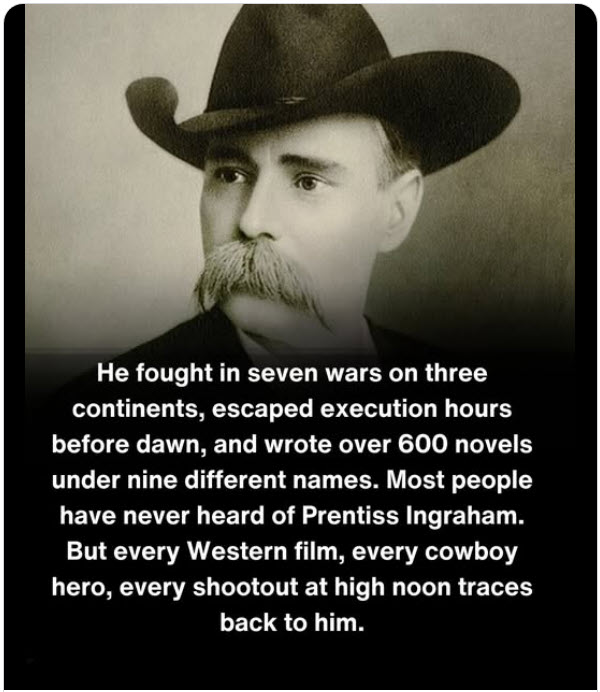
Just came across this, and thought y’all might enjoy it.
Prentiss Ingraham
Secret History of America
onroetdpsS7710iu5eiMhA5f2J h34auuc7a7 36htm 75t7an 76g3t34g: ·
In 1843, a boy was born in Mississippi to a writer and a minister. His family had reasonable expectations for him: education, medicine, a respectable life.
Then the Civil War began, and Prentiss Ingraham’s reasonable life ended before it had properly started.
He left medical school to join the Confederate Army, eventually rising to Colonel and chief of scouts in a Texas cavalry brigade. By the time the Confederacy fell in 1865, he had developed skills in reconnaissance, survival, and improvisation that most men never acquire. He was 22 years old and had no interest in going home.
He went to Mexico instead, joining Benito Juárez’s forces fighting the French occupation. When that campaign ended, he went to South America. Then, in 1866, he was in Europe — on the staff of a German general during the Austro-Prussian War, at the Battle of Sadowa in Austria, watching the balance of European power shift in real time. When that war concluded, he went to Crete to fight against the Ottoman Turks. Then to Egypt, where he joined the army of Khedive Ismail the Magnificent.
Mississippi to Mexico to South America to Austria to Crete to Egypt — all within a handful of years, with no particular plan beyond finding the next conflict and the next horizon.
By the late 1860s, he surfaced briefly in London, where he began writing about his experiences. But the pull of action was too strong. He went to Cuba, where a rebellion against Spanish colonial rule was gaining momentum. He became a blockade runner, commanding a ship called The Hornet, making successful runs through Spanish naval forces to deliver supplies to the rebels. He rose to Colonel in the Cuban Army and Captain in the Cuban Navy simultaneously — dual ranks in two branches of an insurgent military — which may be unique in military history.
Then his luck ran out.
Spanish forces captured him. He was tried by a military court and condemned to death.
This is where the story of Prentiss Ingraham might easily have ended: a Confederate veteran turned international soldier of fortune, executed in a foreign rebellion. A footnote.
He escaped hours before dawn on the morning of his scheduled execution. Accounts vary on the details — as they tend to with Ingraham — but he made it out of Spanish custody, out of Cuba, and back to the United States, carrying stories that would have been unbelievable if they hadn’t, demonstrably, happened.
Now approaching thirty, having fought in seven wars and narrowly escaped death more times than he could comfortably count, Ingraham headed west. There, he met Buffalo Bill Cody and Texas Jack Omohundro — scouts, performers, living legends in the making — and recognized in them exactly the raw material he needed.
He had extraordinary experiences of his own. What he also had was the literary skill to understand what made a story endure. He saw the American frontier not just as a place he was passing through, but as a mythology waiting to be written.
He wrote it. At staggering scale.
Over the course of his life, Prentiss Ingraham wrote more than 600 dime novels. He published under his own name and under at least nine pseudonyms — Dr. Noel Dunbar, Dangerfield Burr, Major Henry B. Stoddard, Colonel Leon Lafitte, Frank Powell, and others — each identity allowing him to write in different registers, appeal to different audiences, and maintain the pace his publishers demanded. Some scholars believe many of the novels published under Buffalo Bill Cody’s name were actually written by Ingraham. He likely assisted Texas Jack with his literary efforts as well.
His stories featured Buffalo Bill, Wild Bill Hickok, Texas Jack, and dozens of other frontier figures — some historical, some invented, all rendered larger than life. Through these hundreds of novels, he assembled the template: the cowboy hero with a code of honor, the lone rider arriving in a troubled town, the gunfighter who is dangerous but just, the vast landscape of possibility and danger. These were not simply entertainment. They were the foundational myths of American identity — the stories a young nation told itself about what it was and what it valued.
One scholar observed that Ingraham “helped start what was to become the most powerful and characteristic of American myths.” The Western — as a genre, as a set of images, as a moral universe — was built as much by Ingraham’s imagination and output as by the actual historical events his novels claimed to depict.
He also worked as an advance agent for Buffalo Bill’s Wild West Show, traveling ahead of the troupe to generate publicity. He knew these performers personally, understood the fine line between reality and performance, and helped manage the boundary between the two — a boundary that was always thinner than audiences suspected.
He maintained particular affection for Texas Jack, who visited him at his home in Gettysburg, Pennsylvania. After Texas Jack died in 1880, Ingraham kept including him in his stories, keeping his friend alive in fiction long after history had moved on.
In 1904, at age 60, Prentiss Ingraham died of kidney failure at Beauvoir — the former estate of Confederate President Jefferson Davis, converted by then into a home for Confederate veterans. There is something quietly fitting about it: the man who had traveled the world and fought on every continent ending his days at a place connected to the war that had first set him loose. The journey that began with the Confederacy’s defeat ultimately circled back to a house named for the Confederacy’s leader.
His name has largely vanished from popular memory.
But his work is everywhere. Every Western film. Every cowboy story. Every shootout at high noon and every lone rider on the horizon. Every narrative about the frontier as a place where character is tested and the right man prevails. These didn’t emerge naturally from history — they were constructed, refined, and popularized by writers like Ingraham, who understood that mythology requires a craftsman, not just raw material.
He lived ten lives and gave America the story it wanted to tell about itself.
That story has outlasted him by more than a century, and shows no sign of stopping.
As a side note, I’ve always been fascinated by the way that the early “classically educated” American and British authors of American Westerns used their classroom Greek (and other sources), most famously from Samuel Butler’s translation of the Iliad, where Trojan and Greek warriors who die in battle literally “take the dust between their teeth” from Homeric Greek, rendered famously for all of us colloquially since then as “bite the dust”. Lots of these little ad hoc classical usages fill the early dime novels.
I first realized these sources when I got to college, bailed on a math career, and took Intensive Greek to get myself more of a classical (no pun intended) education. I read the Homeric Greek passages myself in the original language, and cracked up.


6 responses to “Prentiss Ingraham, Cowboy Writer”
He’s Shalako, the title character in Louis Lamour’s book!
It looks like at least some of his stuff, mostly related to Buffalo Bill, is on Project Gutenberg.
https://www.gutenberg.org/ebooks/search/?query=Prentiss+Ingraham
The soldiers of fortune and gentleman adventurers of the 19th Century are like figures out of legend. If what they did was not so well documented, nobody would believe they were real. Another favorite of mine, who did not live long enough even to think of a literary second career, is Frederick Townsend Ward.
Another is Sir James Brooke, the White Rajah of Borneo. He used to be a big hero in England but now of course they hate him as an imperialist oppressor. He stopped local slavers and pirates from brutalizing people so that made him a very bad man.
There are dozens more like him listed in George MacDonald Fraser’s “Flashman” novels.
For a moment I confused him with General Sir Charles James Napier, the fellow to whom the famous, widely circulated historical quote is attributed on the subject of suttee. When religious leaders in India asked him to respect their cultural tradition of burning widows, he reportedly gave this iconic reply:
“Be it so. This burning of widows is your custom; prepare the funeral pile. But my nation has also a custom. When men burn women alive we hang them, and confiscate all their property. My carpenters shall therefore erect gibbets on which to hang all concerned when the widow is consumed. Let us all act according to national customs.”
Wonderful to know! As a Christian it’s important for me to know the true significance of some of the ancient Greek since both the Septuagint and the New Testament were written in Greek. Logos, for example, is not simply “word” as it is usually rendered in English.