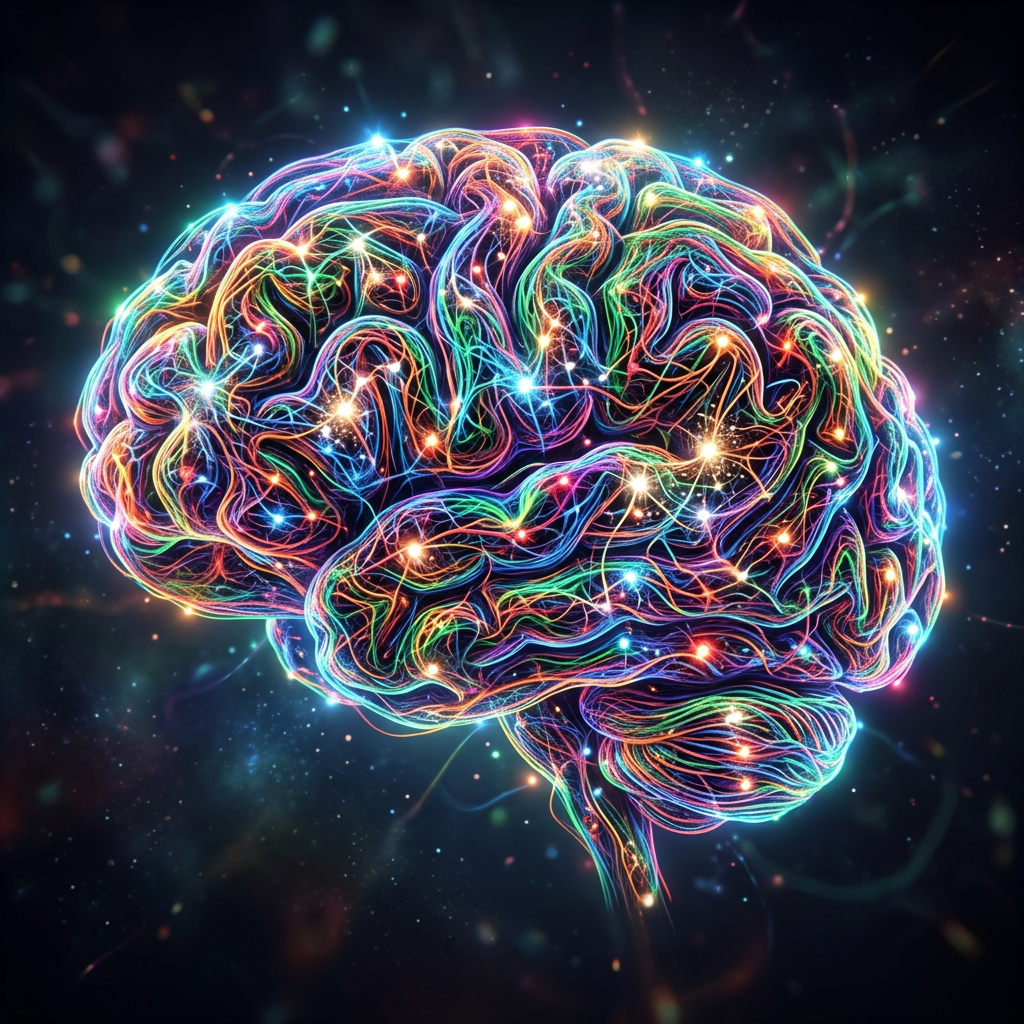
Does it matter if people read? By ‘read’ I definitely include audiobooks, possibly comics or graphic novels — but specifically where the consumer of the media needs to translate the information carried in something that is just squiggles or sounds into images. Entire worlds, a movie in your head, if like. It’s quite a tricky process because, to put it AI terms, books often really heavily on ‘prompts’ or a ‘framing’ where the reader creates the entire picture — a moving picture at that — in their head. It goes beyond that, in fact. They’re creating a world outside of that frame for the story to ‘fit’ into.
It is anything but a passive neural process. Watching a video production doesn’t have to be, but in my opinion, often is.
Now – the ‘work’ involved for your brain to process the information carried in words into understanding what they mean… is pretty easy, if you start young enough. It’s apparently a lot harder as an adult, than when the neural pathways are forming. Brains are complex linking devices, and it seems forming the links is something we do easier when we’re younger. Once those links are formed, or the brain knows how to form them, we can go on using them.
In my opinion: those linking systems are far more complex when it comes to fiction. The brain has to deal with two things: 1)this is not an actual thing. 2)Thinking of this ‘non-thing’ requires the creation of shall we say ‘a virtual hard-drive/brain’ in which non-true can follow logical extension to produce a virtual image/moving-picture AKA story, that does not exist. The brain KNOWS it does not exist. It is still ‘real’ to reader. The neural pathways to deal with these obvious conflicts have to be complex. And, hey presto… once developed we know how develop and use them. It’s not the ONLY path to imagination and inventiveness — but we know, comparing fiction reading populations to those who don’t… it is probably a very powerful one.
In my opinion, again, one that the sooner developed the more able to use it the human will be. Young brains are ‘plastic’ but setting pathways for the rest of their lives. So: reading fiction to your kids… could improve their intellect, their ability to process data in one form to be extrapolated into something far bigger and more complex. If you can’t see the value of that, both to a child and society… and indeed civilization itself, I despair of you. It also teaches them something else: to separate real from fictional.
I really, really believe in the value of reading, and of fiction. Fiction which is distant from observed reality, in particular. SF or fantasy or even historical stretch the reader far more than a contemporary and realistic novel. The younger started, the better.
Because I believe in putting my money where my big mouth is, I’m trying to write books where I think there are gaps, to the best of my ability. I have this strong belief that making them fun is much more likely to get them read than making them ‘good for you’. I remember being told that Brussel sprouts were good for me…
Giving kids the gift of books they love, is giving them a lifetime of enjoyment, comfort, encouragement and maybe so very much more. It’s worth doing.


2 responses to “Brain-power”
Funny thing: I kind of liked Brussel sprouts when I was a kid. Not so much now.
Since it is far easier to learn multiple languages when one is young, and then add more later, the idea that learning how to “live in other worlds” is easier for the young makes perfect sense. And both skill sets serve valuable purposes later on. DadRed was a slow reader. Since he had limited reading time as an older adult, he read only non-fiction. But he’d read a lot of hard scif-fi when he was young, and it served him well later.
In some ways, the past is a sort of fiction. So the mental maps and skills a child learns reading fiction can help him learn and understand history. Who is more alien? A five-legged BEM* or a Lübeck merchant in the AD 1100s, or a Chinese shaman in the 100s BC?
*Bug-eyed monster.