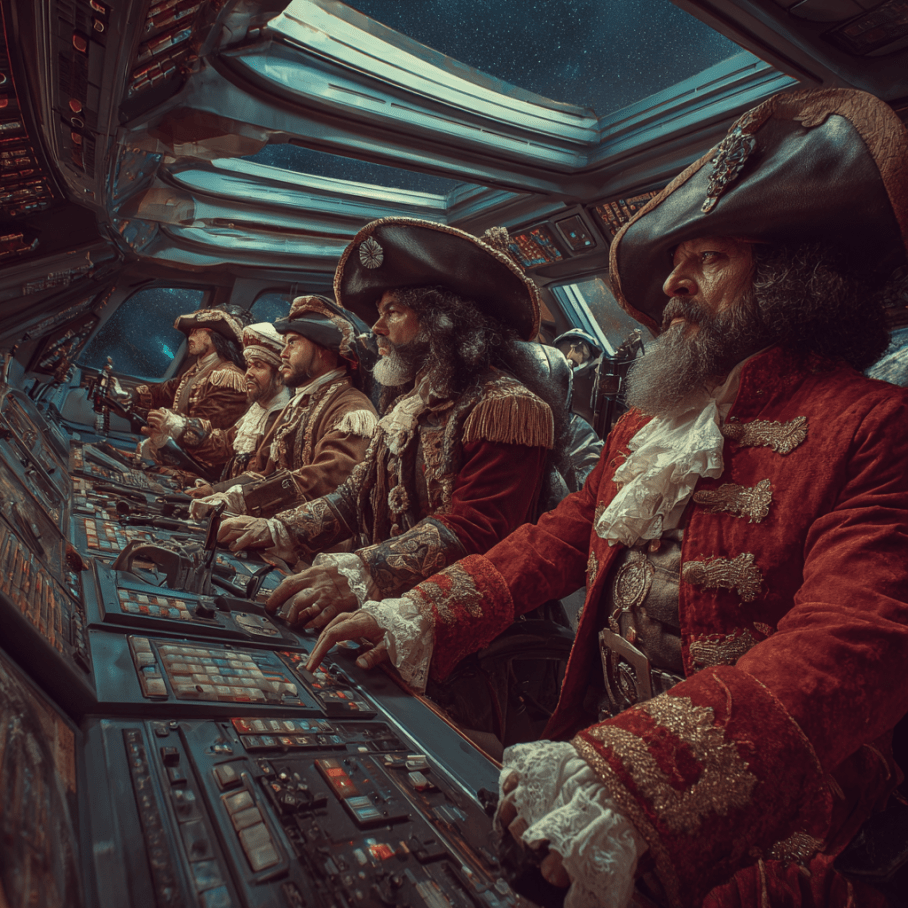
I was re-reading (for the nth time) a series of books by Nathan Lowell that are set in a common environment — a science fiction universe set some centuries after the present (the Golden Age of the Solar Clipper).
It’s an interesting setting. There’s little explicit outlining of how it developed, but one forms the impression that centuries ago explorers from (what is now) old Earth scattered widely, first into a settlement area referred to as “the toe-holds” which function somewhat like the Wild West with free trading and Heinleinian trading practices and individual life choices, and then into a separate polished and inflated respectable commercial area of confederated systems referred to as “the High Line”, a censoring body which tries to deny the existence of the toe-holds even as it continues trading with them discretely to keep their economy balanced. Most ordinary citizens in the High Line believe the claim that the toe-holds don’t really exist, while in reality the advanced technology and trade are actually in the toe-holds.
Now, unlike some scifi, the plots that Lowell builds within this setting take the setting as a given, and explicit discussions about how things ended up this way are never presented, and no character is very clear on what the sequence of events was that led to this state of affairs. No one is well versed in “old Earth” literature or history, aside possibly from a few unknown scholars. The reader forms the view that “old Earth” specialists are as obscure in this context as specialists in, say, the Age of Exploration in terrestrial Earth in the 1500s to 1700s would be to most of us. Literary quotes from classic literature of “old Earth” still exist, but their referents as not necessarily known – they’ve entered the language obscurely in their own right just as sayings.
We the readers can piece together how the history leading to this development of two separate but intertwined societies might possibly have occurred — it’s easy enough to spin out possibilities — but we don’t actually know. And it’s not important to the characters in these stories, either. They make the bald assumption that some set of events led to this bifurcated setup of two cultures long ago, the toe-holds and the subsequent High Line, and they focus solely on the present day storyline of showing the High Line communities more about the somewhat mythical toe-holders to help bring the two communities into better alignment. That’s all they (and the plot) are concerned about.
But there are clues… clues that are not quite parsable to the characters, but accessible to the readers, and the readers can read, from these fragments and suggestions, of a much more interesting backstory that remains opaque to the characters.
What sort of clues? Well, the one fact that the present day characters know is that the great historical galactic expansion from old Earth owes everything to the banking system that still rules all the economic commercial underpinnings, despite the efforts of the High Line communities to underplay that bit of historic continuity.
And what is the name of this great founding banking system, of unknown initial provenance? Glad you asked. It’s name is “High Tortuga”. This means little to the characters who have forgotten the ancient histories… but of course it implies quite a lot to the readers, doesn’t it? Piracy on the high seas, um, skyways. That one “reveal” resonates in the imagination of the readers. They will never know just what the details are that lead to that naming, and they know the implications are lost on the characters, but the reader chuckles every time it’s referenced. That’s a lot for two little words to accomplish.





4 responses to “Making just the right words do all the hard work”
Shades of The Crimson Permanent Assurance.
That song is now going to be stuck in my head all day.
Which isn’t really a bad thing.
I loved Lowell’s Trader’s Tales series. It’s low-stakes fun that makes you root for the hero from the start.
Lowell doesn’t overexplain the world, and that restraint keeps the focus where it belongs. Without a sprawling system or cosmic threat to manage, the story stays grounded in the characters. The tension comes from their choices, not from yet another attempt to save the universe.
So many stories crank the stakes up until they become abstract. Planet-killing monsters are hard to relate to. A trader wondering whether he’ll make a profit at market is not.
It’s a relief to care about the small things again. By resisting the urge to detail every system, ship, and currency, Lowell gives the reader space to do exactly that.
I do something like that in my Steppes series. Towns on Mars are named after early explorers, with the names having been altered by the passage of time from their original form.
Thus, Robinsin or Purnell or Azmof or Makkafrey.