As we saw last week, I’m a pantser whose characters don’t always mind my stage instructions loudly whispered from just behind the curtains. In a standalone book? This can work. In the first couple of books of a series, when it’s loosely constructed? Still manageable. Third or fourth book in the series? The bill comes due, and you need to know what you’re doing, or risk the whole thing spinning out of control into sheer chaos. Now is the time to apply an analytical eye to what came before, and reverse the outline. I can’t write an outline and work from it. I can look at a book I’ve already written, and figure out what I’ve done.
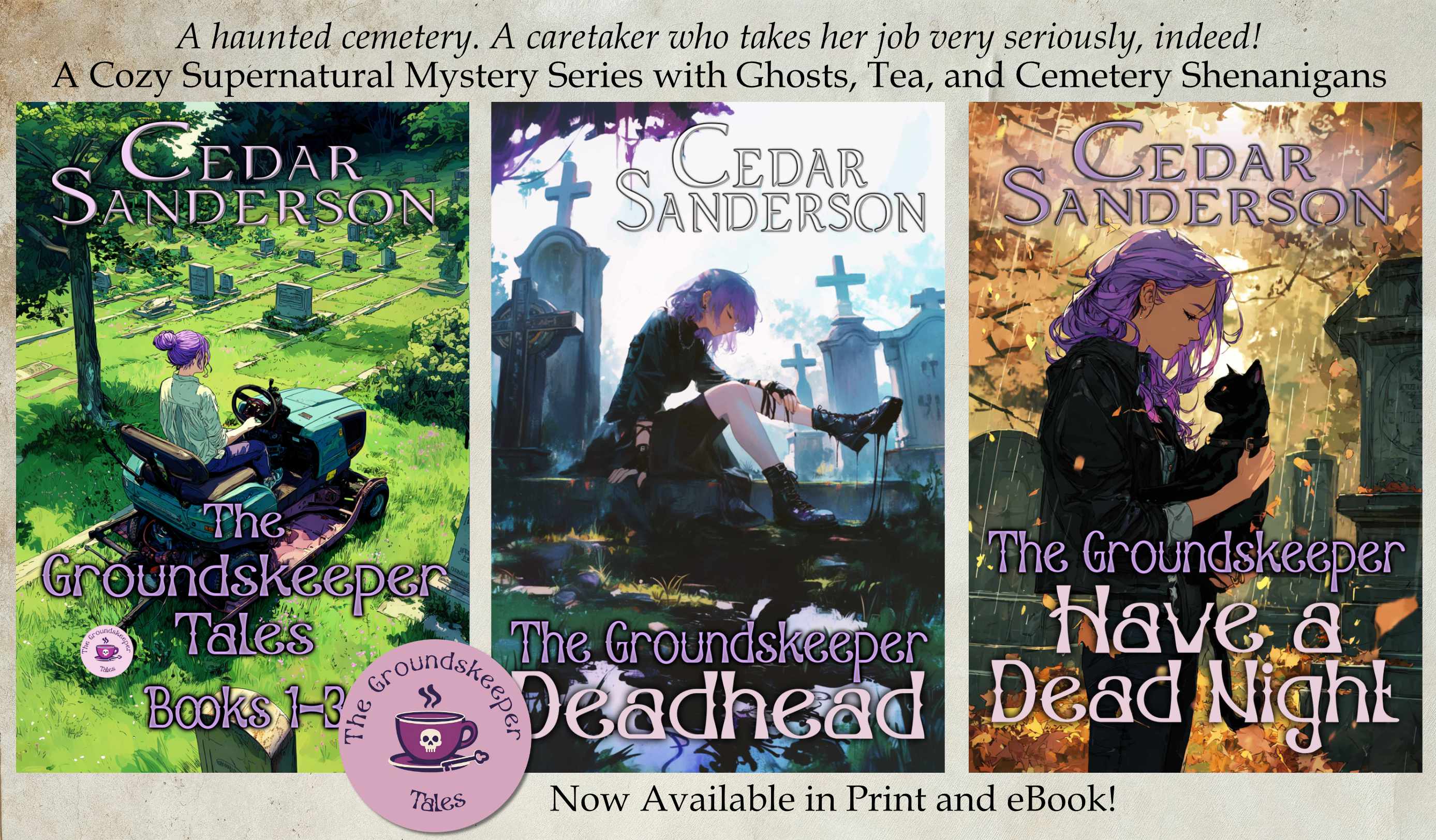
Right now, I’m working on the sixth installment in the Groundskeeper series, and over the previous two books I’ve deepened Chloe’s involvement in the shadowy liminal world between the living and the dead. She’s gained a new role in life, far more responsibilities, and I’m about to write the story of her first ‘solo flight’ into the work she’s been training for. Chloe is one of the more tight-lipped characters I’ve ever written, a true stoic, which is part of why she works so well in this setting where horror meets cozy. I need to keep in mind what she’s likely to react to – or not, as the case may be. Which means I really have to understand what I’ve built into this series.
When I started writing these stories, the first three were loosely connected, a thread of the main character, the cemetery, I hadn’t really considered building out the world and an big series arc at that point. I still, by the way, don’t intend a big series arc. I’d like each book to have it’s own standalone mystery plot, with recurring characters and settings cropping up. That makes it a little easier on the author. There is still a lot of weight resting on those early slender threads, and if I drop threads I create inconsistencies, pacing problems, missing side characters, and risk breaking my characters. Any of those, much less more than one, will aggravate readers and you’ll lose them. Get it right, and they will tell a friend and you’ll gain new readers. There’s motivation for you.
There are a number of different ways you can go about preparing a reverse outline. Notecards for each chapter, which I have done, will work. Most recently I’ve been using my friendly “Skynet secretary” as Mel Dunay dubbed it, and asking Grok to generate a reverse outline from a book. You’ll always want to check the work of an AI, particularly with a longer work, because they can and will hallucinate stuff you didn’t write in there. However, they can also pick out stuff you did write into the book, even unconsciously if you are a pantser like I am, which is kind of cool to look at and say “oh! That’s what I did!”
Here’s part of the output from The Groundskeeper: Deadhead, which was book 4 in the series, and is a longer novella. I attached it as a txt file to the simple prompt “Can you prepare a reverse outline for these two books? The Groundskeeper: Deadhead comes before The Groundskeeper: Have a Dead Night.”
The Groundskeeper: Deadhead
Overall Structure:
A character-driven origin/promotion story that transitions Chloe from groundskeeper to apprentice Mediator in the Fraternitas Mortis. It uses a slow-burn introduction to the supernatural world, interpersonal relationships, and world-building through dialogue and small mysteries rather than high action. The book focuses on acceptance, training, and ritual commitment.
Prologue
- Chloe clears invasive honeysuckle in the cemetery and disturbs a mysterious black, oily, sentient substance that swallows her pickaxe.
- She flees, tries to alert her boss (Mr. Cruor, who is absent), consults the ghoul Benny (who refuses to go near the area), then returns to retrieve tools.
- Mr. Cruor returns with Detective Murray; Chloe is drawn into a conversation about prior cemetery mysteries (bodies outside the grounds). She withholds supernatural details.
- Ends with Chloe forgetting to mention the black goo.
Chapter 1
- Rainy day; Chloe is bored with grounds work.
- Mr. Cruor announces her promotion to apprentice Mediator/psychopomp role in the secret Fraternitas Mortis.
- Extensive explanation of the organization, her unique gifts (seeing/interacting with the dead/elementals), and the dangers involved.
- Chloe signs paperwork and takes an oath of secrecy.
- Introduction to supporting cast (skeleton housekeeper Della Dear, etc.).
…
Chapter 12 (Oath Ceremony)
- Morning of the ceremony: Chloe works in the garden to manage nerves.
- John Smith (another member) gives her an encouraging pep talk.
- Formal oath in the old auditorium with the chapter members present.
- Simple celebration with cake; Chloe reflects on how life-changing events feel anticlimactic.
Epilogue
- Chloe receives the battered “Abomination” Land Rover from the Orban property.
- John offers driving lessons; Chloe jokes about haunting him if she dies.
- Light, humorous close showing integration of new role with old groundskeeping life and garden gnomes.
Key Themes & Arc: Chloe’s reluctant acceptance of greater responsibility; building found family within the Brotherhood; blending mundane cemetery work with supernatural mediation.
You can see how useful this is if you are making a series bible, need to have highlights you can pick up for the next book(s), find a plot point to reference quickly… And you can further query in the same conversation string if you want to see what else the machine can pull out of the tangled web you wove. Something like “What are the dangling plot threads I could pick up in the next book of the series as I’m working on that now?” and with Grok, at least, I get lists of major threads (and here’s where checking its work is important, because it missed that I had tied off one of these) as well as Character Arc and Personal Threads that can be extended and woven into the next works. It even has suggestions for world-building and minor or atmospheric threads. You can ignore any or all of those – and likely should never use them directly as the AI is by design highly derivative – but they can be useful in identifying elements to work into the book. Reading reviews on previous books is also a way to confirm what might work in the next book in the series. I’ve had a review point out something I missed, which I was able to pick up and stitch right into a book as a major plot point just as though I’d meant to do that!
Leaving aside the high-tech rubber ducky I’ve been bouncing stuff off of, if you are a pantser you may feel reluctant to transition from creative flow to analysis. There’s something magical about those days when the story just pours out of your soul. There’s nothing magic about cold analytical outlining. What I suspect you’re going to find, based on my experience, is that you’re better at this than you think you are. There’s going to be work to be done, sure, but the reverse outline is likely to show that you have subconsciously ‘got it’ and the story is strong. Also, the joy in finding just the right threads that spark off the idea for the next story? The “Oh, that will work!” moment? That’s worth the work you have to put into looking back at where you’ve been to start forward again.
Try this out yourself! There are software tools for it (Scrivener and Plottr, although I have not used either of them in spite of owning both), you can go full analogue with notecards and a corkboard or magnets on the fridge to organize, or you can try out a Skynet Secretary (it helps to imagine her looking over her glasses at me with that faintly skeptical look, but obediently doing what I ask. Then I know I’m off track!) to accomplish the same reverse outline. You may discover something about your story while you’re at it. Heck, it’s probably useful to do this before you finish writing something. Um. I should try that…



 Mad Genius Club
Leave a comment