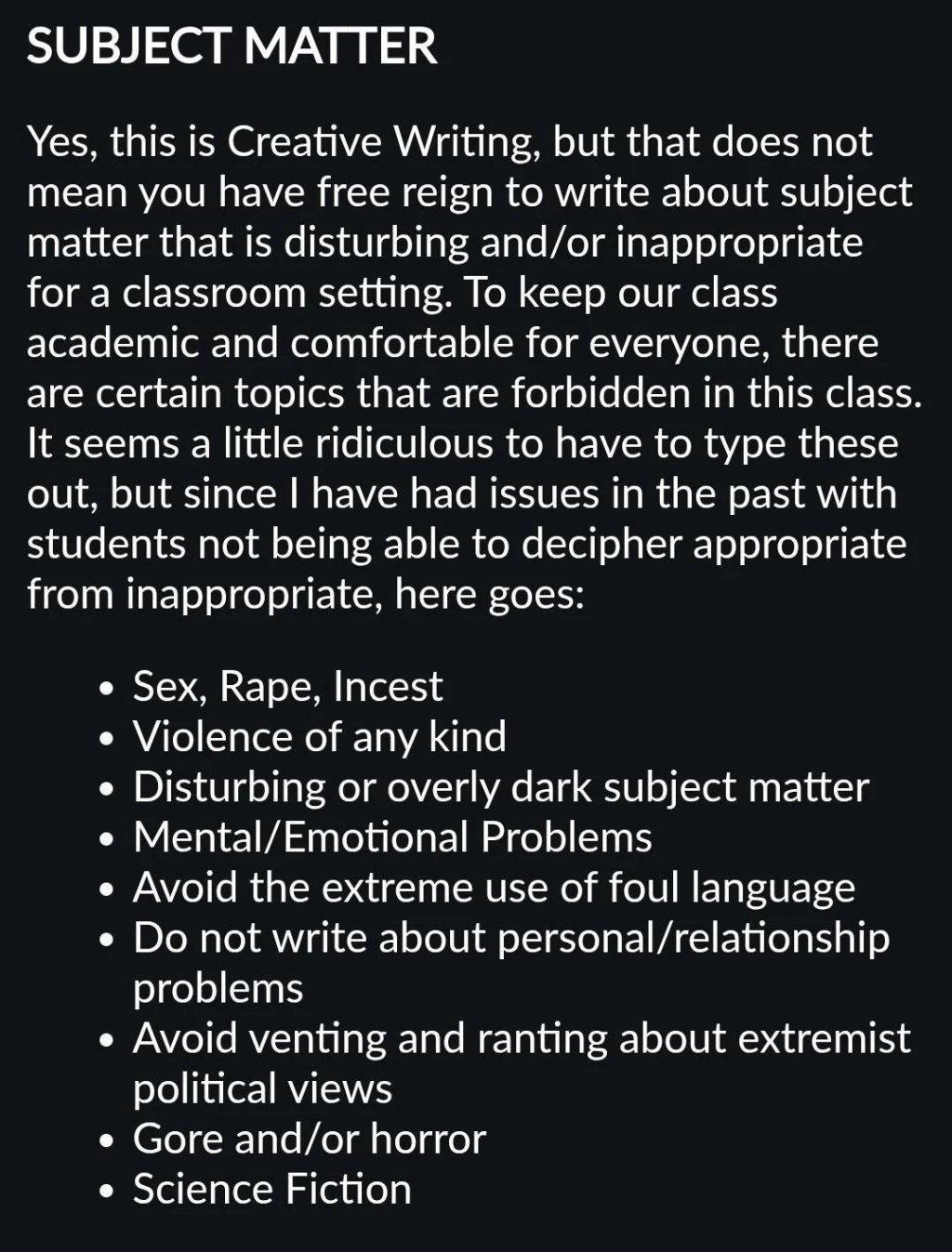
A thing went viral, or close enough, on X last week. I’d commented on it, even while I was fairly sure it was bait. Sure enough, as it blew up I went looking and came to the conclusion there was no clear provenance or origin for the original purported screenshot. Almost certainly not real.
These days, if it pushes your buttons your first response ought to be to stop and verify whatever it is. We live in a world where manipulation is near constant.
On the other paw, there was a conversation I felt was worth having about that particular bit of chum that had attracted a feeding frenzy.
First of all, most of us who know how to grammar (sic) see that someone who is ostensibly teaching creative writing has used ‘free reign’ when she means ‘free rein’ but leaving that aside… I am not sure in this modern era grammar is used when teaching creative fiction, to be honest.
Taken to it’s extreme, how do you write any kind of conflict in a story while avoiding everything on this list? My amused take was ‘why ban science fiction but not fantasy?’ I mean, are unicorns and fairies fine, but heaven forbid you have weird aliens?
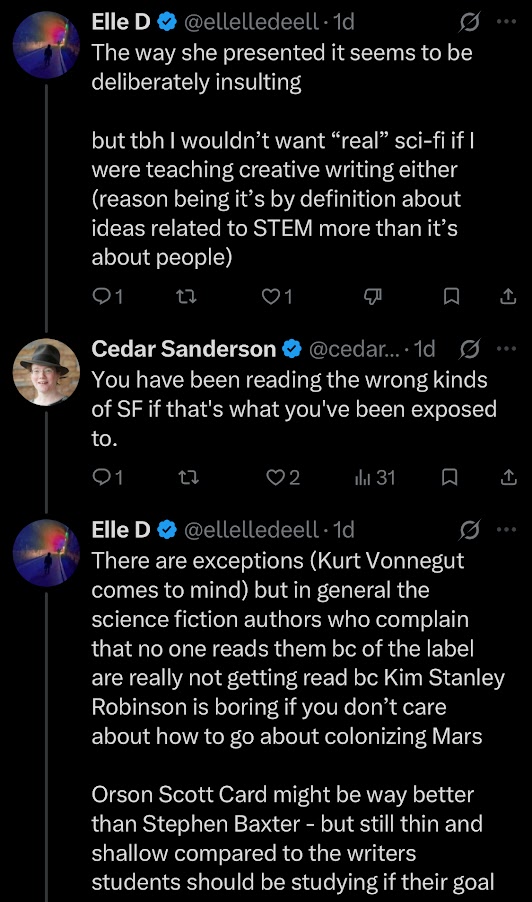
This is the take that flabbered my gaster. Science fiction is… not about people?
Oh. Oh my dear child. I have worlds of wonder to introduce you to. There are books you would enjoy, if only you would let go of those preconceptions and open them up. I gave her a short list of suggestions. James White’s Sector General books, MCA Hogarth’s wonderful aliens, H. Beam Piper’s Little Fuzzy, and of course, our own Dave Freer. She told me I didn’t have to get defensive, which means that she won’t actually follow through on exploring the amazing and expansive realm of what science fiction has to offer. Which is sad. She’s missing out.
I don’t need to defend science fiction. I am sad that apparently only the worst of it is being presented to young people these days.
There is only one way to counteract that. Write more of it. Publish more of it. Get kids reading fun science fiction.
I’m doing my part.
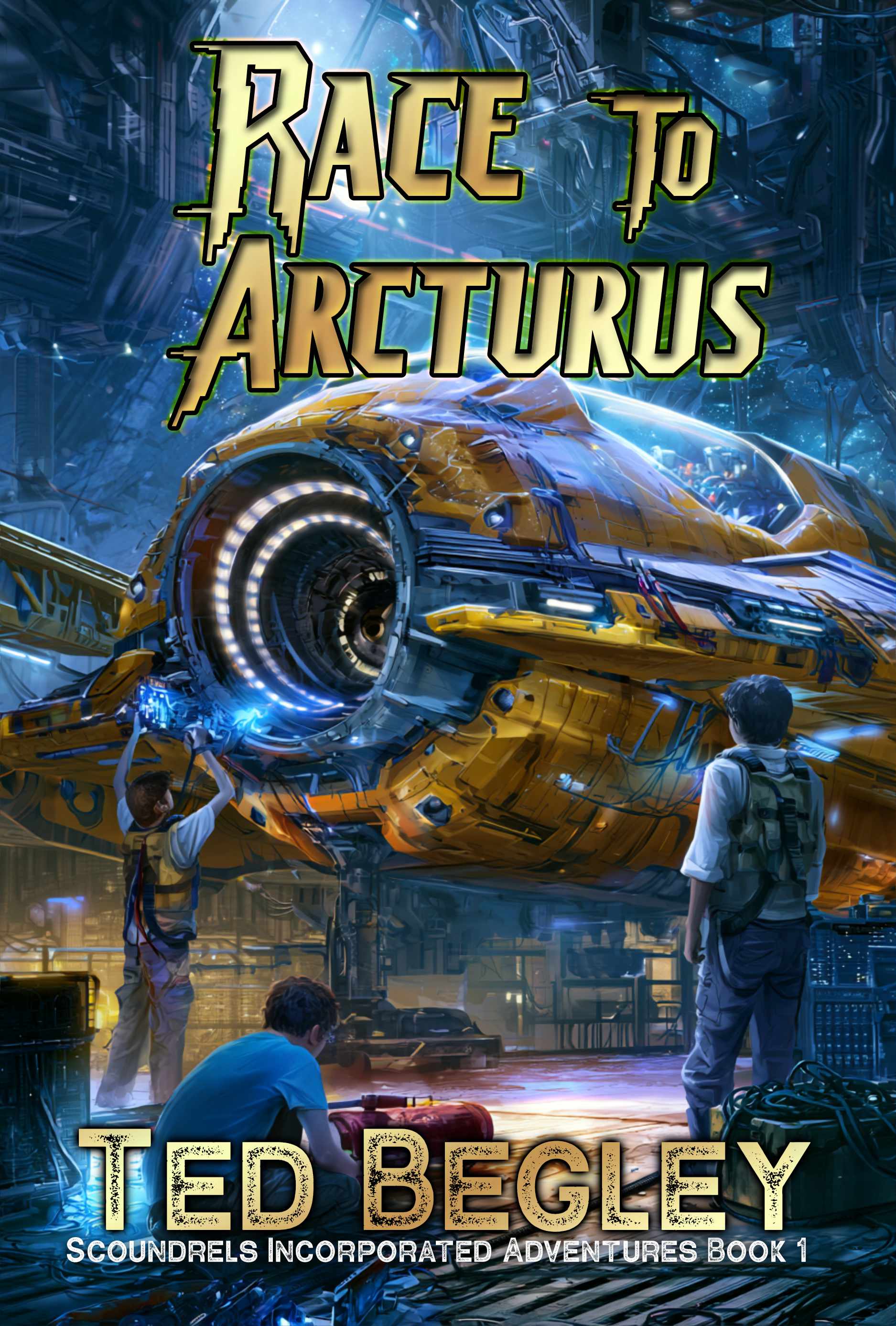
Sanderley Studios is pleased to announce that Race to Arcturus will be available in paperback on September 21! Hardcover and eBook to follow soon. This is a terrific science fiction adventure book very much in the tradition of Robert Heinlein’s juveniles. It starts out with three boys attempting to build a spaceship in a barn (they only blow it up a little bit). It has illustrations!



24 responses to “That’s Bait”
Forget about literature for the moment. Has she no experience with Star Trek? Star Wars? (And if she says that’s not “real” science fiction, I say “Bah!” and “Bah!” again.)
Doubtless those are not good enough to be taught in creative writing, either. I do have to wonder about this level of blinkered perception.
I received one of the clearest lessons in slight of hand from, of all places, the Care Bears. (Specifically the Adventures in Wonderland movie. I hadn’t seen it in years and was watching it with my daughter some time back. Yes the dual perspective is relevent.) There is a running gag involving the Hapless Sidekicks and their fear of spiders. There was another running schtick of the Cheshire cat showing up in all kinds of weird forms and opportune and inopportune moments. So when, at the end when the Fake Princess is having to do things only the Real Princess could do. (Very fairy tale structure.) Exactly no one is surprised (neither Kid me nor Adult me) when the Cheshire cat creates chaos by Sitting on the head of the two Hapless Sidekicks as a giant spider. Then Princess does the Impossible for Not A Princess to do thing… Kid me could not figure out the switch. Adult me was going. “I see what they did there and the hints were all there and it still WORKS” And you can see it once you know what to look for because they didn’t layer the subtlety in because it was the Care Bears and subtle those shows were not. But the structure of the set up was a master class. Simple, direct, effective.
If you can learn misdirection from a campy kids show? I say ‘Bah’ to the notion that you shouldn’t study everything you can stand to study.
Oh that is really fun! And the best children’s movies and books are multi-layered so adults can enjoy them too.
Kid shows and kid fiction is more difficult than it at first appears. Children are extremely picky and won’t go for just anything. A well done children’s story tends to last because it hits just where it is supposed to (hooks where the littles can grab on to it) and does not overstay its welcome (tiny attention spans).
Every genre can teach. Horror for pacing, children’s stories for paring down the excess and focusing on the theme, and so on.
I thought it sounded bait-y as well, but can testify that 45+ years ago, in a college creative writing class, we were told “no science fiction”.
That’s why I thought there was a conversation worth having about it. Because that’s a ridiculous stricture. As are several others on this list. Also, why no SF but no ban on fantasy? I have seen it put as ‘no speculative fiction’ which I still find silly.
45 years ago, fantasy might have been beneath acknowledgment its existence. Thirtyish years ago, the magic realists from Latin America would have forced them to turn a blind eye to fantasy
Perhaps that goes without saying. They can be quite sniffy about genre.
Uh . . . that doesn’t leave much to write about. Fluffy bunnies have fun at the park?
Maybe? so long as the bunnies aren’t doing what bunnies do best.
“What exactly do you mean by ‘Fluffy Bunnies’ you abusive User! And what exactly is ‘fun at the park’ you disgusting . . .”
“And what exactly is ‘fun at the park’ you disgusting . . .””
Fluffy bunnies at the park breakin’ ALL the rules!
Maybe the fluffy bunny is BunBun.
Bunnicula, the vampire bun reincarnation of the third vampire (not the first because copyright, or the second that one was psycho). Totally not sci-fu, shenanigans, relationships, politics, but hella dark as flock.
My kids and I adored the Bunnicula series!
As for the “Politics”, that depends on what politics the teacher supports.
IE If the teacher supports “extreme political positions” (ie does not see that as politics), then the students can write about that. [Twisted Grin]
And, YAY! Monday! I shall Race to Amazon . . .
So, Creative Writing girlie put “science fiction” on the same Verboten list as “S**, R*** and I*****”?
Man, I would fill her fricking inbox with nothing but space weapons and p1ssed off aliens for a whole semester. Her eyes would bleed. Because what’s more creative than an orbiting space weapon? Seriously, that’s barely science fiction anymore.
But speaking of stupid academic tricks, I’m having SO much fun in current WIP. Jimmy Carlson decided he was unschooled and the local university was “persuaded” into accepting him as a student. And his entourage of robot girlfriends, Valkyries, aliens, and a few of a more fantasy nature.
My biggest problem is not getting bogged down in petty anti-Woke propaganda. I’m trying to make it fun, not spiteful. Propaganda is always boring and stupid, so I’m skipping it and going for a more person-to-person reaction thing.
Like the Chair of the Humanities department meeting Beatrice the robot girlfriend for the first time and having the Uncanny Valley swallow her whole. That was a hoot. ~:)
“Science fiction is about gadgets, not people” is a thing that non-SF writers have believed since it got a name. Almost always, stating or implying it is a red flag for arrogant ignorance.
L. Ron Hubbard (according to himself, of course), when asked to contribute to Astounding in the late 1930s (because he was a super-duper successful pulp writer, which is reasonably true, even if he did claim it for himself), loftily declared “I don’t write about gizmos and gadgets, I write about people!” (Which is hilarious if you read any but his very best pulp output.)
Stephen King, in one of his nonfiction books, probably Danse Macabre or possibly On Writing, derided Robert A. Heinlein (!!!) as “mechanical” and a writer who only wrote about gizmos and gadgets. (Tell me you never read Heinlein without saying you never read Heinlein.) (He also called Murray Leinster a pretty good writer, then slagged him for writing a terrible book that, as far as I have ever found, was not a book written by Leinster.)
It’s a belief that never seems to die, no matter how many counterexamples one brings against it.
The academy generally disdains SF, with exceptions like Philip K. Dick (because he didn’t “really” write SF, he was more literary; an idea Phil would have howled with laughter at), unless the particular prof specializes in the genre (and even that’s not a guarantee of lack of disdain), or actually is an SF writer.
That alone makes me think that, while this is bait, it is based on possibly several things amalgamated together.
There is also the fact that of the two basic kinds of writers, the Academy only respects stylists, while SF is, almost by definition, populated by storytellers. (PKD is for sure a stylist.) So when they look in SF for stylists, they find a few, and feel entirely justified dismissing the rest, because they aren’t “real” writers.
All of the above, though I would add: not helped by the occasional SF reader who insists that only super-hard SF counts and anyone who reads soft SF might as well be reading fantasy.
Even then, hard SF can still include a focus on people. David Weber gets teased constantly about his massive infodumps on setting lore or how spaceships work, but if you talk to any of his fans, they’ll also mention how much they like the characters. It’s not exactly an either/or.
And even in Hard SF, there are writers of great power and beauty, like Poul Anderson, who create indelible characters fans talk about still fifty-plus years later. Yes, there are fools and myopic obsessives on all sides.
Another part of the “problem” (if it is one) is that American SF is a conversation that’s been going on for over a hundred years now. Someone not familiar with that conversation can get very lost jumping in the middle with no context; and academics tend to assume that, since they are smart, the hacks who write SF must be the dumb ones.
But I’m trying to refrain from the epic-length rant. 😀
Wonder how they would manage to study Greek mythology under those conditions.
That’s not an accident.
I’m basically on team ‘around half the original liberal arts were mathematics’.
I have doubts about certifying a thing as tertiary if everyone is so deep into needing remedial work that they see STEM and go “ick”.
Though, an very autistic undergraduate who is very intent on “Tom Clancy, but more so with made up numbers”, and on “I know everything about machines now” is a student who would be a great deal of challenge to try to work with.
Some of those could be a “don’t bring your baggage in with you, and don’t rely on the cheap stuff for shock value”.
In terms of job skills training, it feels like teaching romance plots would be the optimal course design.
If a course is supposed to be more well rounded than vocational, trying to at least understand most major genres sounds reasonable, even if one is trying to teach in a select few.
Anyhow, if one is basically writing one’s job specification one can calculate that one can grab enough of the available students, and serve them tolerably enough not to be fired, without taking on avoidable hard work.