
Once more, I’m sparked into an essay by a thing I saw on social media. I’m enjoying these sparks, and hopefully you are as well. If not, don’t tell me, because you’re likely to keep seeing them.
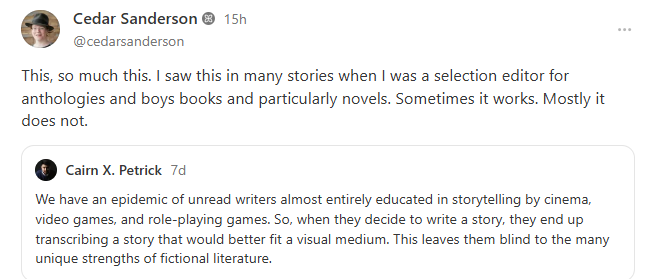
Cairn X. Petrick: We have an epidemic of unread writers almost entirely educated in storytelling by cinema, video games, and role-playing games. So, when they decide to write a story, they end up transcribing a story that would better fit a visual medium. This leaves them blind to the many unique strengths of fictional literature.
Cedar Sanderson: This, so much this. I saw this in many stories when I was a selection editor for anthologies and boys books and particularly novels. Sometimes it works. Mostly it does not.
I wanted to unpack this more than I could in a note. Particularly a note jotted while I was up to my ears in housecleaning and baking.
There is a difference between an author who visualizes the story in their head, and writes it down as it plays out before them, and the author only familiar with visual media. This is also not me knocking the story telling in video games: games dwarf books and usually out-earn theatrical film and recorded music put together. Books are a tiny fraction of the market. Gamers immerse themselves in story, and the visualization is a large part of that because of how human brains work.
This is me pointing out that if all you know are games, films, and cartoons, that’s not going to make you a good writer out of the gate. Text stories have different demands on your skills. You don’t have the visuals. You don’t have the soundtrack, which even if you aren’t aware of it, it’s very much part of the story you are consuming when it comes to films and games. I was sort of aware of this, but spending time with D. Jason Fleming watching movies, then discussing them with his deep knowledge, has really impressed on me the importance of the elements of film, and how you just can’t do some of the tricks in text you can on the screen.
The other problem, and this is more relevant to a themed anthology but I have seen it come up elsewhere, is that chances are a film or cartoon adaptation of a story is diluted from the original story. If the writer adapts the film version without looking deeply into the origins, what you wind up with is the textual version of the telephone game. Things distort so much they no longer make sense if you look at them too closely. If your audience is as familiar with the adaptation as you are, it might work because you are making the same assumptions. Unfortunately, you absolutely cannot assume your audience is all aware of the adaptation or even the original story-lore. As an editor, this kind of thing in a story would have me flipping it into the ‘no’ stack, particularly in a competitive reading where I had far more stories than slots to fill.
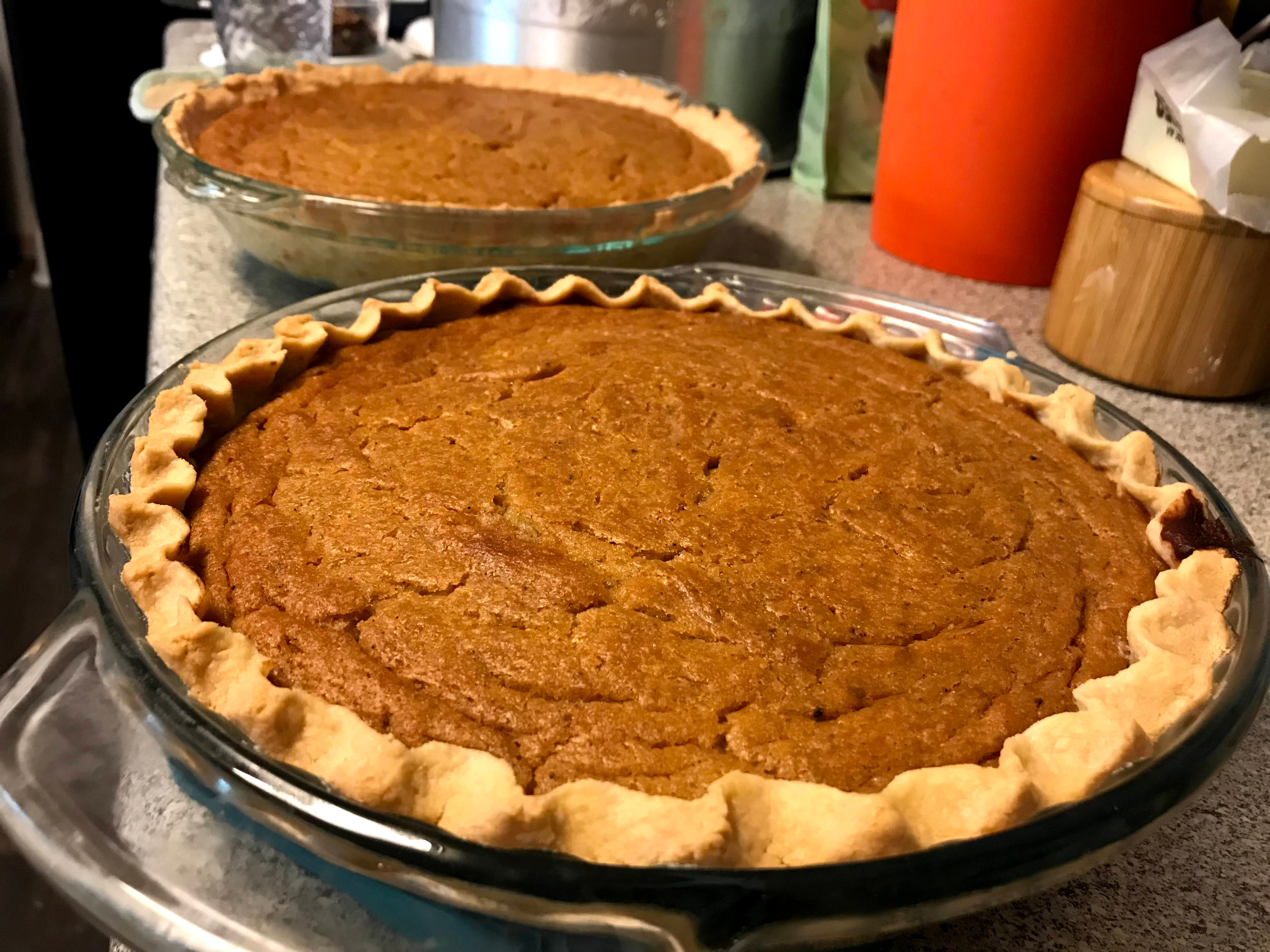
The textual storyteller needs to treat the reader as collaborator, not simply as audience in the dark. If the author doesn’t at least sketch out the setting, the appearances of the characters, the sounds, the smells (ok, film doesn’t do this, but we know the brain will supply a smell from a visual. Look at a picture of a warm pumpkin pie and tell me you don’t know how that smells!) then the reader is lost in a darkened theater of the mind without the light of the projector to bring the author’s world to life for them. Text can also let a reader into a character’s head which, yes, film can do, but there’s an intimacy of thought which spoken words strip away. In prose the reader supplies the faces, the lighting, the score, and the camera.
Writers who come to fiction from games and film are not doomed. They simply have extra translation work to do. Learn what the page can do that the screen cannot, and what it cannot do that the screen does effortlessly. Read widely in the form you intend to write. If you prefer film or games, then at the very least dig deeply into what makes those work, and put thought in how to translate them to a page for the reader. When an editor has more stories than slots, the ones that still feel like transcribed cut-scenes go in the no pile. The ones that use prose’s own tools — even if the writer first imagined the scene as a tracking shot — are the ones that survive.



26 responses to “Visualizing Story”
One of the best novelizations of a film that I read included the three main characters’ back stories. That filled out SO much that it made their actions much more reasonable. Especially the “bad guy” in the film. No, he was not 100% rehabilitated, but knowing the why of his actions made the story better. The other characters likewise. Including the space aliens. I’d say the additional information added, oh, a chapter and two pages to a pocket paperback in terms of story length, in ways that could not have been done in a purely visual and aural (soundtrack) medium.
The novelization was written after the film was made, so the author had to convert from a purely visual medium into a text medium. He made it work.
It is interesting that the novelization was done after the film was made. Usually, the novelization is done from a draft of the script. I mean, I can point to recent novelizations that were done forty years after the film released, but those were commissioned as specialty items to promote Blu Ray releases of the films.
The author said in an interview that he’d roughed out the draft of the book, sat in on a pre-screening of the movie, and reworked chunks of the book. (James Cameron’s film The Abyss. I had to hunt down the title.)
That was Orson Scott Card, right?
Ah, Orson Scott Card. I was wondering.
Curious as to what were the 40-years later novelizations? As for doing them before the movie, I can see that, too. I have a copy of volume 2 of JMS’s scripts for “Babylon 5.” I specifically chose his because he wrote and directed the series. In his scripts I notice he’ll provide character motivations so the actors can understand how they’re to approach the words he gives them. If one were writing a novelization, those motivation clues would come in handy.
Coming from prose, I was never sure how much one is allowed to “direct” an actor to say the lines. I found out the direction should be limited, so the B5 scripts have been helpful in figuring out the line one should toe. In a book you can specify if a character is rolling their eyes or speaking in an angry tone, but an actor or director may approach the dramatization very differently, and you must give them leeway. Interestingly, I don’t think those who believe they know all about writing books from watching movies ever realize that particular distinction. So even if they were to jump into screenplays they’d still get it wrong.
The novelizations I had in mind were commissioned and are sold by Severin Films, and include Rats: Night of Terror and Virus: Hell of the Living Dead, the latter being commissioned specifically because the original script for Hell of the Living Dead was massively ambitious, while the actual film was extremely limited in budget, and the folks at Severin, being friends with screenwriters Claudio Fragasso and the late Rossella Drudi, wanted the original vision to see the light of day in some form. There may be other examples, but those are the ones I know.
JMS wrote and produced Babylon 5, but he only directed the final episode, and a later direct-to-DVD special. His book on scriptwriting is worth tracking down a copy of if you’re interested in the subject. Not the gold standard, but certainly worthwhile. One example from the book I remember vividly is a discussion of parentheticals and why you should avoid them. A parenthetical is a bit of direction in parentheses between the character name and the character’s dialogue on the page, and actors generally hate them, because acting is their job. JMS’s advice was to include them only when absolutely necessary, and also to do them in a way that still leaves the actor room for interpretation, rather than dictating specific action. The example he used was (from memory, not the right name):
versus:
As for motivation and other things, technically speaking, a script should include only descriptions of things which can be shot on a camera. (There’s a famous and apocryphal anecdote about F. Scott Fitzgerald walking across a studio lot when a car passes him by, and the head of studio leans out the window shouting “WE CAN’T PHOTOGRAPH ADJECTIVES!!!”) A further restriction is that the writer is not supposed to direct from the page, leaving performance to the actors and visuals to the director. (Of course, if you intend to direct the script, that changes.)
Screenwriting on spec is about the most restricted form of writing there is, even more so than sonnets.
The novelization of Star Wars contradicted the later trilogy.
I once described my default first draft style as minimalist theater in print. There are people, they say their lines with emotion, their appearances and sometimes their movements and clothes are described, but the environment around them suffers. I’ve gotten better at it, I think, but there was a period where I spent a lot of time doing previsualization in Midjourney to get a grip on my settings.
And that can be a really useful tool for writers, to create visuals of their world so they can describe it, if they can’t picture it for themselves.
Sometimes I had to generate an image that I liked, and then run /describe to get some idea of the vocabulary to use for describing it!
“Minimalist theater in print.” Honestly, that’s almost exactly how Dostoevsky wrote, and is a moderately fair description of Heinlein’s prose method as well.
“The door dilated open” is still a classic piece of setting, though.
Heinlein’s style is a long discussion, actually, but you are not wrong.
The thing is, the writer may be able to “see” the scene in his mind, but the task of the writer is to get the reader to see it as well, by giving enough cues and hints that the reader’s imagination can fill in the blanks.
One thing I used to do when I was starting out, was to watch a movie and talk to myself out loud about what I was seeing, what the location depicted, what the characters were doing while they spoke, etc. Translating from visual to audible, as it were, and then translating from audible to written words.
Listening to well-written old time radio shows can work, too. Gunsmoke is the best, but there are many worth listening to.
Pie, pumpkin pie. Oh I’m sorry, was there a post? When is dessert?
I do wonder how much description you need because I can fill in the blanks pretty well which means for me a writer doesn’t need to do much. In fact that’s a problem I have with movies made from my favorite books, the movies are never accurate to my vision.
I think you can get away with a very spare description style, as Deej mentioned Heinlein. However, you need to get feedback, it is quite possible to leave out too much!
The trick with Heinlein is that he wasn’t as spare as it sometimes feels, because he was sneaky with his description. No paragraphs of description for him. Detail here, detail there, and if you pay attention, it all builds up.
Yes, exactly.
The meme about autism and being unable to fake enthusiasm is right on the money.
Completely wrong blog post, my apologies.
I’m trying to envision what you’re talking about, but I can’t seem to. My experience with videogames consists of Pong, Adventure, and Pac-Man, so, as a dinosaur, I don’t understand these things. As a storyteller with words, one is able to focus on the part of the world/setting that is of interest (like the lost art of lighting and the close-up as in Star Trek the original series). If you write purely visual stimuli, you’re unnecessarily limiting yourself, so maybe that’s what you’re referring to. It’s important to focus on more than one of the senses when it’s appropriate. For instance, here is the opening of one of my stories:
Yes, thank you for this. In a writers’ group on Facebook I encountered this young’un who insisted he didn’t need to read books to be a good writer. After all, he watched movies and played games, and learned all he needed from them.
I pointed out that movies and prose fiction did not use the same techniques. For one thing, movies can use “stunt casting” in a way that books can’t. Case in point, the second season of “Stranger Things” got mileage out of casting Paul Reiser and Sean Astin. Their very presence in those episodes created tension and suspense in the viewer. Everyone watching thought of Reiser’s character in “Aliens,” and feared Astin was intended to go against type and betray everyone. Especially when Astin’s face was sometimes lit from below, which contributed to the sinister impression of his character.
In a book the closest you could come to stunt casting is judiciously employing an archetype, e.g., the talking, morally-neutral snake in the beginning of the “Sorcerer’s Stone.”
A “Council of Elrond” scene where everyone sits around sharing intel and strategizing is fairly easy to do with movies and games. With those you can have flashbacks and voiceovers during what would otherwise be a talking head scene. In prose you better be on your THAD game (the Talking Head Avoidance Devices Elizabeth George teaches would-be writers about in her books on writing novels).
Oh, and of course music! I loved the sense of foreboding, the impending raining down of fire and brimstone when the fifth season of “Justified” ended with Ruby Friedman’s “You’ll Never Leave Harlan Alive.”** It’s harder to deploy music so deftly in a book, although I think GRRM tried that with the “Rains of Castamere” for the Red Wedding sequence. Didn’t land nearly as well.
I pointed out to the silly goose that people who wanted to write movies and make video games were never foolish enough to claim they didn’t need to watch movies / play games in order to know how to make them. Quite the opposite, and it doesn’t work any differently for those who want to write books.
**For some reason I thought the series made up Harlan County, a la Cabot Cove or Gotham City. Then I Googled the song…
Virtually none of what you list are tools available to screenwriters, except for cases where they are “on staff”.
If you’re writing a script on spec (“on speculation”, that is, hoping that someone will buy it and make it), you cannot indicate casting choices. You cannot indicate music choices (unless you have gone out of your way to license a song and are offering that license along with the script). (Yes, I can name scripts that violate that rule. Every single one of them was written by a writer so successful that they could and did buy such licenses.)
Indeed, character descriptions must be so vague that they could be filled by anyone from Dwayne Johnson to Michael Cera (and if you don’t, then the producers will rewrite to fit the actor they hire anyway). So you have to come up with a one-sentence description that puts the character vividly into the reader’s mind, while also being flexible enough to fit any actor who auditions well or the producer has close ties to. (The canonical example is from the first scene in Lawrence Kasdan’s Body Heat from almost fifty years ago: “Teddy Laursen, rock and roll arsonist”. Puts an image and a style into your head, but could be embodied by almost anybody; and ended up being played by Mickey Rourke.)
So a screenwriter has to write so well that producers see on the page all the things you describe, without doing any of them directly.
My little fanfiction thing partly started out from an idea I’d had for a video, that I eventually decided I didn’t have the time to figure out how to make. Converting that sequence into a written sequence ended up with something that, despite having pretty much exactly the same events, ended up being very different. Instead of watching the events unfold, the reader is riding along inside one of the character’s head, and that character *knows* what’s about to happen.
Later I went back and sketched what it might take to turn one of the short stories, I think it was 4000 words? into a video, and realized it would probably be a full 90 minute movie. And I’d have to do some fairly delicate cinematography with the waiting parts as well.
One of the tensions is the main character doesn’t have the expertise to know what’s going on; they’re leaving it to the actual expert, with, essentially the abort switch of things “go wrong” (“Just… anything that doesn’t seem right, ok?”) and they just aren’t comfortable with not being able to be in control of things. That’s very delicate to show in visual without the character also doing something stupid.
In the written word with access to the character’s internal monologue, that’s much easier to show; they’re just thinking to themselves how much they don’t like any of this and everything is setting their teeth on edge. How do you do that visually? Have them stare intently? Much harder to manage.