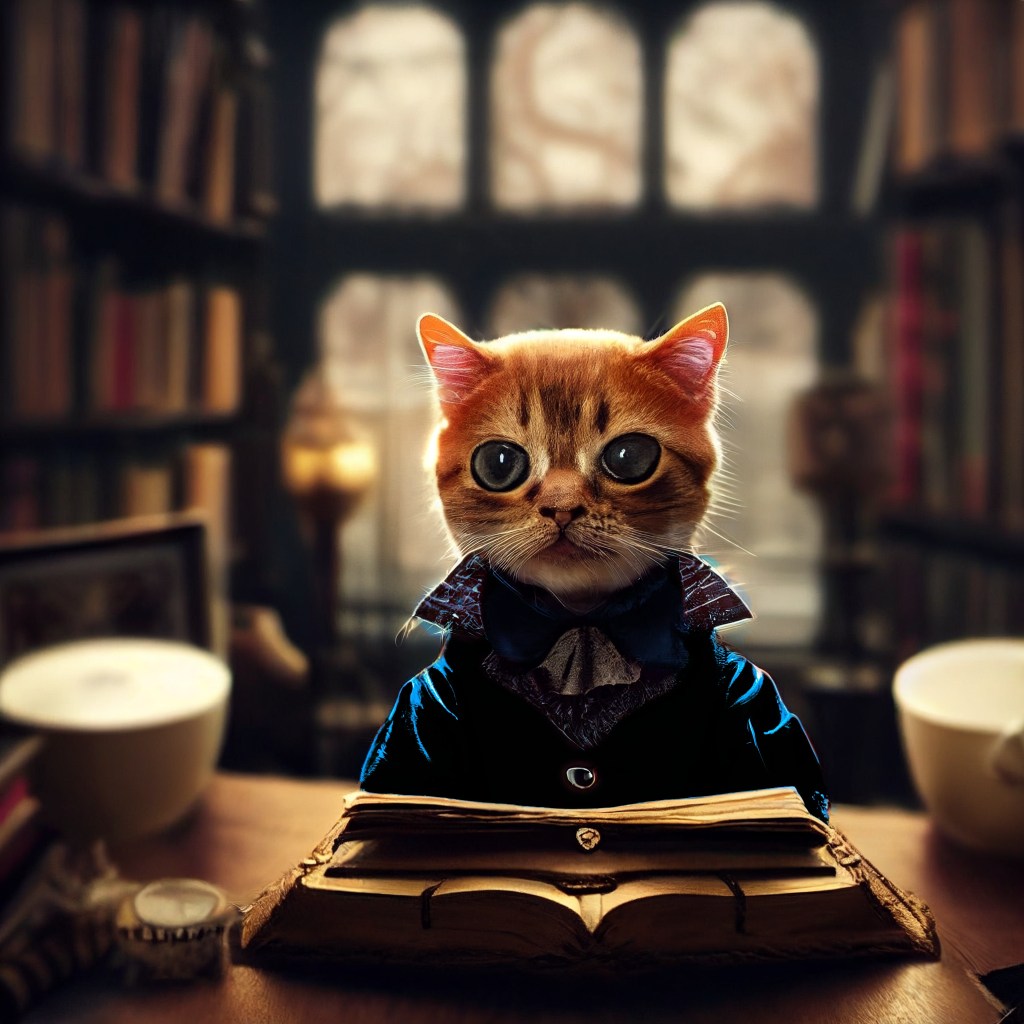
“You must have a great imagination.”
“That’s so creative!”
Do I? I don’t know, at least not when it comes to writing. My mind creates doomsday scenarios out of the smallest radar return or new spot on my skin*, but does that count?
I’m not sure. I need building blocks for my writing, either an inspiration that has a known world attached to it, or real-world technology and culture. I can’t conjure things out of nothingness. My mind doesn’t work that way. That’s why research books make a knee-wall beside my writing desk, and page after page of notes (with Chicago-style citations) sit in a stack on top of my printer. The muse demands facts, numbers, historical or scientific references, and other materials before the story works itself into proper form. Nothing has ever sprung, ex nihilo, into being.
There are authors who can create worlds and people from nothing. I’ve listened to them talk about how to do it, or rather, about how they do it, and why I should be able to do the same. I’ve tried the exercises they recommended, and … ended up with a blank page and a well-rotated cat, clean floors, dusted book shelves, and no story. Like an oyster, the muse demands a grain of sand to produce, if not a pearl, at least a semi-decent story.
My imagination doesn’t work without a solid factual foundation. I’d like to blame my training as a professional historian in a field that insisted no part of the story be told without documentation and proof. To create a scene from whole cloth is forbidden, lest Clio (or the department chair) arise and smite thee.
And yet … And yet, when I am writing, I see a different world, place, and people. The seasons and time outside the scene fade away, and I am in that place, not the world of here and now. When I finish something and look up for a moment to see a spring afternoon instead of a cold autumn night, I startle. This is one reason I try not to let my story-imagination wander when I drive. That gets dangerous very quickly. I truly see the world inside my head as I write the story, and the real world around me fades away. So in that sense at least, my imagination is very, very strong.
Whatever works for you, however it works, is great. We are all different, with different minds and story generators. If taking apart fairy tales and folk tales for material leads to stories, great! If you lean on pictures and music to kick-start your creativity, go for it. I gobble up history and start wondering “What if …” “Can I do a character, say a middle-aged business man in a world of magic, but he has no magic at all, and is completely mundane aside from that terrible secret, what is the world like … The Hansa was full of middle aged business men, yes, so …” And a blue-collar fantasy series was born.
Whatever works for you, is your imagination. I’m not a “creative” as the British describe it. I tell stories, some of which have more obvious footnotes than do others.
*I’m a natural red head. I have more spots than Carters has liver pills, even after two decades of nearly nocturnal behavior.
 Mad Genius Club
2 responses to “A Great Imagination?”
I find my own fictional reality spawns in stages. It may be fairly nebulous and wish-fulfillment at the beginning, but then I have to supply (book-world) realism to it to be happy. That’s because I am myself a critical reader of fictional realities (“oh yeah? just how was X possible without the creation of Y which wasn’t possible at this time because of Z?” sorts of internal retorts which throw me out of someone else’s story, with prejudice.
So, over time, on a long series fabulation (which is the sort of stuff I write), I keep skimming back over the events with a reader’s eye, not just a creative one, hoping to spot and remove the consistency “itches” before they become embedded in the plots and difficult to deal with.
These fixes don’t have to be perfect (before the actual publication finalities) while the larger series is fabulating itself, but they need at least place-holder fixes that are slightly better than “because I say so”, so that they continue to nag for adequate correctness until I can shut them up by dealing with them believably. I want those red lights subdued before writing too far, if large enough, or until final polishes, if more easily handled (just a matter of choices with local story impact).
(I try not to think about my tinkering with world/plot-building as excessively god-like, as if the characters were real people I was harming or excusing in the process). That way lies fairly illusory madness in real world relationship assumptions. 🙂 )
My wife and I made a great team for coming up with stories although I may be overstating my contribution. She was on a panel once about Where Do You Get Your Ideas, and she explained it very well. https://frank-hood.com/2025/07/27/where-do-you-get-your-ideas/