Every so often there’s an argument raging over the internet… I know, I know, shocking. Deplorable. How could they?!?
In this case, the repeated kerfluffle – for these are never new and novel abruptions – is about how much (or little) a writer ought to be reading. I have my opinions on this, but largely they would boil down to: if you never read, then how on earth can you learn to write? Obviously, a writer cannot spring into form from nothing. Spontaneous generation has been disproven for even the smallest of creatures (even bacterium have a progenitor) and it certainly does not apply to writers. Even if a person can legitimately claim to never have read a book in their entire life, and be truthful about it, there are other forms of storytelling. Which are also subject themselves to controversy. I see those who claim audiobooks don’t count as reading. Ebooks don’t count as reading. Frankly, I’m loose enough to point out that movies, TV, and even yes, video games all contain stories and do a rather decent job of telling them to their consumers. Which doesn’t make them reading, but it does mean that even that mythical writer who’s never so much as peeked into the pages of a text has absorbed story. Badly, perhaps. Still.
There’s another argument, tangential to the first, of what stories ought to be told. Some stories are held up as worthy, while others are kicked under the rug to lie lumpy in the background of history, and still others are butchered and bowlderized to suit the current mores and expectations. If you think I’m directing this in any particular direction you’re likely wrong, because I’ve seen it on every possible axis. And it’s not exactly new.
I was reading Dorothy Sayers, because I finally prodded my brain back into production of fiction, and when I’m actively writing I lose my appetite to read fiction, instead turning to non-fiction for research, or just to give my brain a break. This collection of essays was the latter. I do so enjoy her sense of whimsy and how she approaches her point.
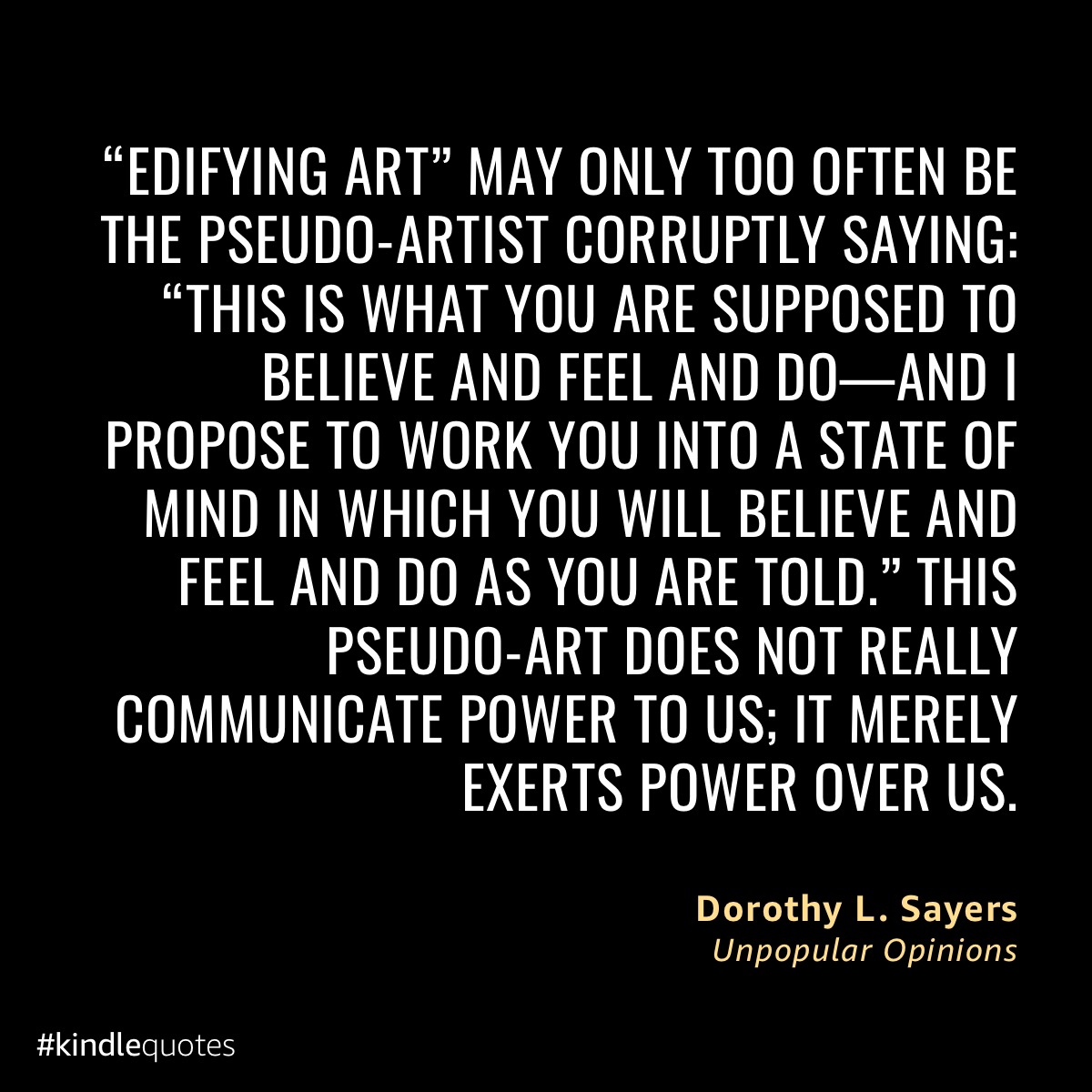
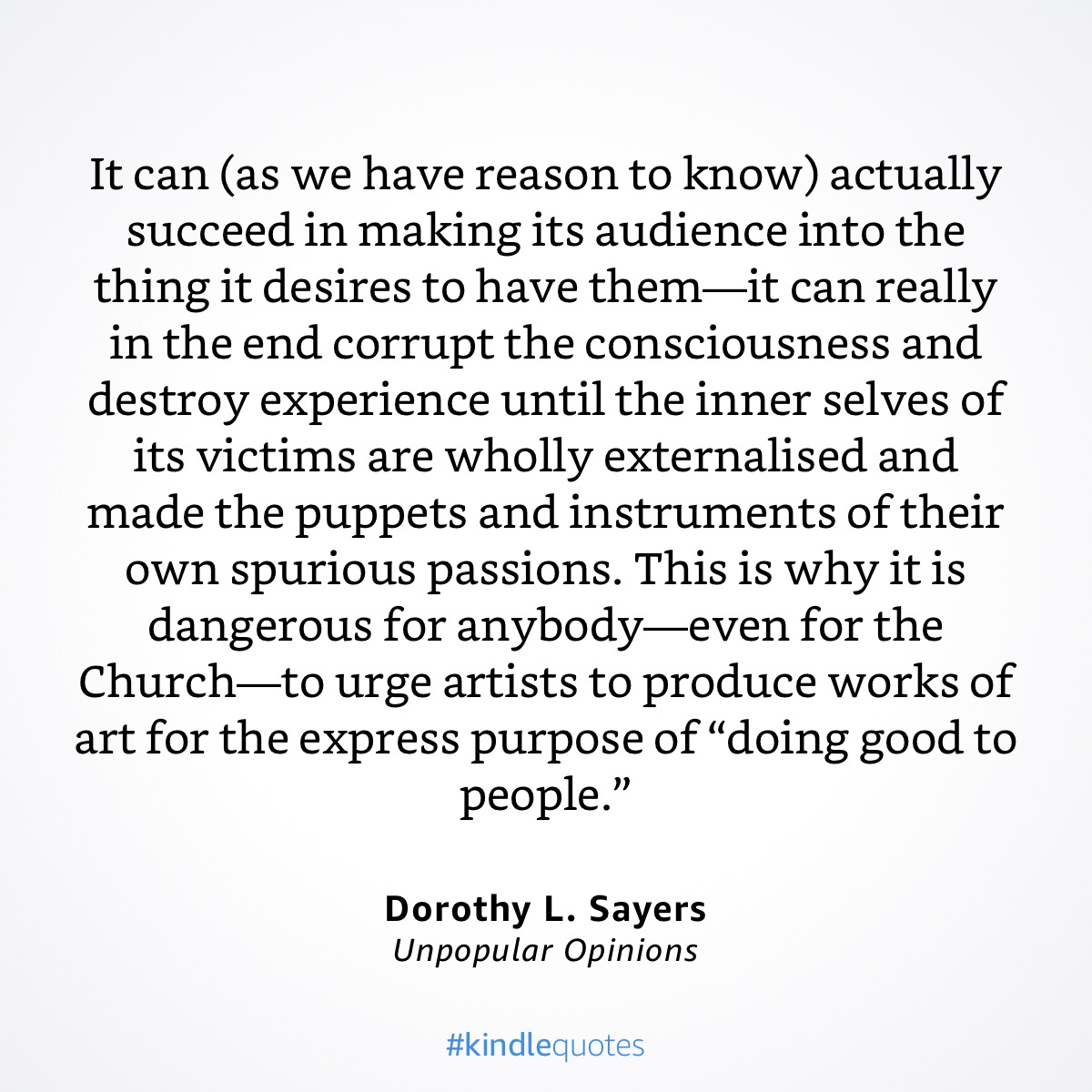
These snips come from an essay on what art is, and is not, and what the point of it is from a soul’s perspective – far from most novelist’s thoughts while they compose. Which is as it should be frankly. I’ve been seeing a lot of anguish about ‘conservative’ and/or ‘Christian’ writing and what that should, or shouldn’t, look like. Up to and including a very recent denunciation of Tolkein that had me rolling my eyes hard enough to be painful. I get this because it’s the sectors of the ‘net I hang out in, I’m sure there are parallels on the other points of the axes of people’s peculiar alignments as well. All of them are missing the point.
Message fiction exists for the message. Not for the story, not for ‘art’ but to exert power, as Sayers points out. On the other paw, all story has messages. Sometimes the author even intends these that slip through to the readers. Or viewers, as the case may be. Some readers never even consciously cue into the heavy-handed sermons they consume until they are subsumed by the intent of the pseudo-artist.
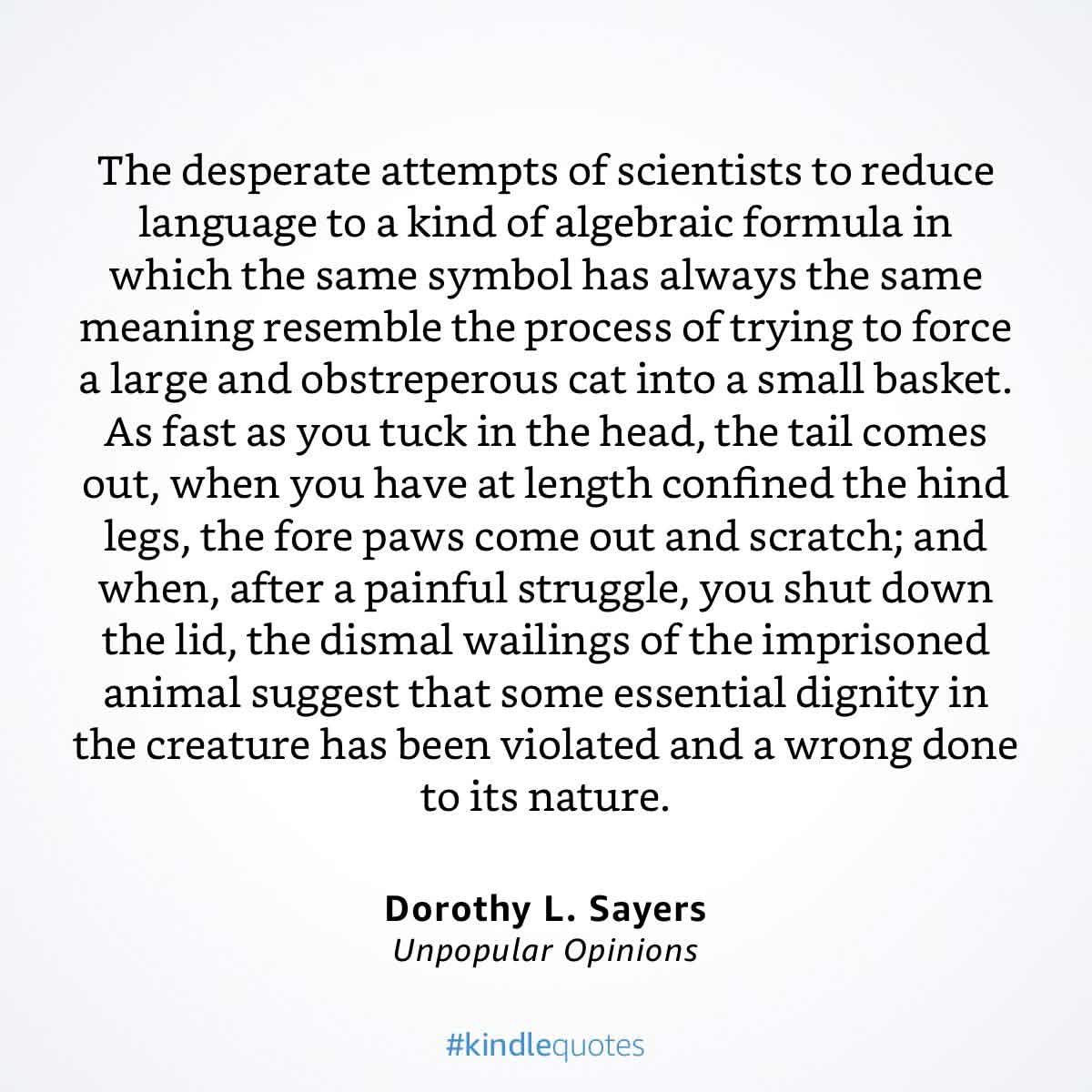
“take again the case of the word “reality.” No word occasions so much ill-directed argument. We are now emerging from a period when people were inclined to use it as though nothing was real unless it could be measured; and some old-fashioned materialists still use it so. But if you go back behind the dictionary meanings—such as “that which has objective existence”—and behind its philosophic history to the derivation of the word, you find that “reality” means “the thing thought.” Reality is a concept; and a real object is that which corresponds to the concept.”
— Unpopular Opinions by Dorothy L. Sayers
https://a.co/027VZebN
So! You should be reading. Widely, deeply, and in ways that perhaps defy expectations. Explore reality. Get out and do things. And then, write to understand where you have been and what you have done. This is the only true art. Not to attempt to sway others. Not to attempt to depict the face of your god. Simply to limn the characters in story as best as you can, because in that alone are you creating true art.


 Mad Genius Club
6 responses to “you should be reading”
Speaking more broadly yet… any story which demonstrates that moral behavior (pick your flavor) tends to particular results is making a moral point. Even the nihilist stories where nothing can be done are making a point.
That may not be the point of the story itself in full, but neutral amorality isn’t really an option. (Thank goodness). Even animals have a sense of justice (ask any dog or cat).
I don’t really see this as necessarily “message fiction”. A lot of this is lost in the background sea of morality (religious and otherwise) that we all swim in, of course, forgetting that that, too, is a choice. In stories, “would and could” are often accompanied by an implicit “should”, and the point that resonates may go all the way back to Kindergarten and sharing your toys.
Propogandists can distort this, of course, and do, but it’s part of all story telling, however benign.
I like a different litmus test better: if the joke or story makes you laugh with an unexpected apercu, well, then, it made a point. If it makes you smile, you think of it as moral. If it falls flat, but it’s supposed to inspire, it’s propaganda.
Tough subject to grapple with, though I do like Sayers’ various approaches.
It’s the dose that makes the poison.
Which came first, the bacterium or the…ummm, the other bacterium?
“I’m one of the people you’ll meet who’s written more books than they’ve read.”
— author, dreamweaver, visionary, plus actor Garth Marenghi.
Good ol’ Garth, who once told the world “I know writers who use subtext and they are all cowards” (https://youtu.be/bXIdA6pOVc0).
(This is a fictional character on a show which is mostly subtext.)
Literally my favorite quote of his.