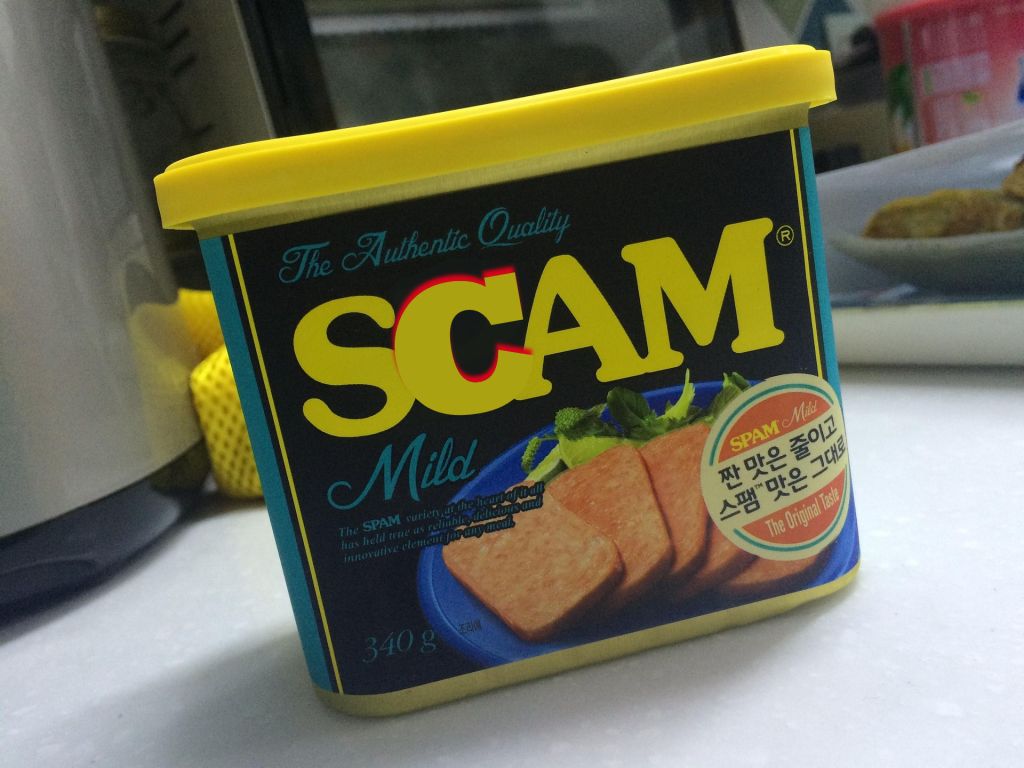
Scam, scam, delicious scam.
Writers have always been victims of scams. Usually the scammers congregate in whatever is the most “painful” part of the business for a newby.
It used to be, back in the early twentieth that the biggest scam was the fake publisher. They accepted you, but you were supposed to contribute some money to the print run. Which, of course, tended to be the entire cost of printing. And the printrun was then dropped on your front porch. They were vanity publishers, of course, and as such a perfectly legitimate business (except they tended to inflate the price of printing) but the scam part is that the newby expected to be in bookstores, and instead found himself with a few thousand books and no idea how to sell them. Some people turned it around, mind you, and did a good job of selling the book, but still what they were being paid for was not what they actually sold. And the language of the pitch was ambiguous enough — if they were smart — that no one could touch them.
Later, after publishers go rid of most of their reading department, the scam became “agents” who would allow you to bypass the reading line, etc. These agents charged a reading fee, and most newbies were young enough in the field they didn’t realize they were being taken for a ride. I think some of these agents, though making most of their money from the writers and reading the manuscripts, many of them of course hopeless (though you could ask for rewrites and collect more reading fees, natch) actually did submit the promising ones.
I say this because I met one of the guys who tried to sting me with a high “reading fee” when I was starting out later on at a world con. He was, needless to say, a bottom wrung agent, but still he had at least some sales under his belt. And another one, engaged in the same game, I later found out was representing a friend and doing okay for her. HOWEVER 99% of those would elicit a “who?” from the offices in Manhattan, because they never submitted anything and certainly didn’t submit anything that got bought. Their business was reading fees. The more adventurous would often recommend his “Friend the book doctor” which I can’t prove but suspect was either the same guy under another name or his significant other. Book doctoring ran into the thousands of dollars per book, and of course was not a guarantee of publication. Even if this person was a very good book doctor.
Did people fall for these. Oh, Lord, yes, including people you’d never think would. It was so difficult back in the nineties to even get your stuff looked at or the first paragraph read that it was easy to fall for. You would grasp any straw when you were drowning and had been for years.
Honestly, I think what saved me was that I was so far beyond broke, there wasn’t a chance of my spending any money on this. In retrospect, it’s a good thing I never showed one of these to my husband. You see, I refused to spend money I wasn’t making, so my money for discretionary things was usually the $500 birthday gift from my parents, which I stretched to a year of purchases of, let’s face it, mostly books. But if I’d asked my husband who always believes in my writing more than I do, he’d probably have put a knife in the retirement accounts to get me this, so I could get the appreciation I deserved (in his mind) and then we’d have wasted it all.
I rarely got the pitch, though, because back then the scammers had to be careful who they targeted. There was still the expense of a stamp, writing or printing a letter and a reasonably believable hand signature. It might seem like nothing, but over thousands, it kept their lists lean and only to those that might bite. I suspect — but can’t guarantee, because I was in my thirties back then — most of those who got bit were people in their sixties and seventies, comfortable money wise, and desperate to break in fast, because, well, they didn’t know how long they had.
Again because they could do only a few people, they were expensive per sting and I was immune by reason of being broke.
Nowadays the most painful part of publishing — unless you’re crazy enough to continue beating your head on the plate glass of tradpub — is…. come on, say it with me: PUBLICITY.
Even I — and the even I is important, not because I’m smarter than you, but because I’m an old pro with contacts and my ear to the ground — am baffled by how to publicize a book beyond my core audience, which is why I REALLY need to start studying how to do this for No Man’s Land, because at 1500 each “easy sales” I’m hitting up against the “sell to people who never heard of you.”
Which is why when I first got spam from “publicists” I didn’t realize these were scams. The only reason I didn’t fall for it is because I research. I always research. The reason I almost did is because that first one was very clever.
How clever? Well, part of it was circumstances. I had just come back from Portugal, and my mom had died less than three months before. So…. my mind was not in the right place.
BUT the email was breezy, and implied we had exchanged emails before — so it’s going to work on someone who’s very busy (check) and doesn’t remember every email exchange. It started with something like “All right Sarah, I know I said I’d have this to you last week, but life got crazy. I hope you don’t think I’m not serious about helping you publicize No Man’s Land. I have now read it and prepared that strategy we talked about for social media.”
I knew I hadn’t had a long conversation with this man, but I also knew that he might have sent me a tentative email and I said “yes, sure” then forgotten all about it, so my first question back was “Fine. But first, how much?” The cost was $250. And while I’m not swimming in dough, the book had already at that time made way more than that, so why not?
Well, because I’m not stupid. So between my answering him and his sending me the price, (And btw, points, this guy obviously wrote personal emails, because he responded to me, etc.) I looked him up. There was a lot of “I paid him, and he sent me this thing that I could get for free in any blog” (If you want to know what the thing is, it’s something like “Do something every day to promote yourself. Try to give something of value, like an article on how to do something, then the link to your books at the end” etc. etc. etc. It might even be useful, but not targeted at all.
Be aware that your search might also return…. nothing, because these people are now changing names every “email campaign.” The names are usually foreign though and — I hate to say this, because it sounds like I’m stigmatizing whole continents, but it’s true — either Indian or African.
The sea of scam spam, though, is not that very targeted operator. And is relatively recent. As in, I didn’t get many even for No Man’s Land, though I got a few. I got more for Christmas in Time. And even more for Done with Mirrors, including a few to the book pimping email, which is interesting and horrifying.
The reason for the sea of spam scam is that it doesn’t cost them anything. It goes my email. And I suspect most of them have an AI agent doing this. (The reason I think this will be excerpted below.)
All of them start by saying they read your book, and usually praising it to the stars. All of them say that they know how much effort you put into it, and all of them tell you they’ve worked up the strategy for how to promote it, etc. All of these are based on the idea this is your one, all precious book and you’ll do anything to promote it.
This was laughable for a very short collection like Christmas in Time which was obviously done for a seasonal thing. It was still ridiculous for Done With Mirrors, which says in the blurb most of the stories are reprints.
Also, most of the time I would be immune from the scam spam, because a cursory look at my profile shows I have dozens of books. Which means either I’ve figured out how to publicize (bah, I haven’t) or I’ve been stung before and won’t fall now.
BUT again, AI agents. What do they have to lose by sending it on wide dispersion to everyone?
The reason I suspect it’s AI an not very good at targeting is the following spam received at the book pimping email. Spot the tells:
Hi Sarah A. Hoyt,
Completing a book like Done With Mirrors: A Collection of Short Stories (Sarah A. Hoyt’s Short Story Collections) is no small achievement. Translating elite law enforcement training principles into practical guidance for civilians requires clarity, discipline, and a strong sense of responsibility. Before reaching out, I always take time to review both the About the Book and the About the Author sections, because thoughtful work deserves equally thoughtful outreach.My name is Fernandez Henry, and I help authors increase genuine reader discovery. This approach connects your book with readers who are already interested in personal security, preparedness, family safety, legal self-defense awareness, and crisis readiness—without ads or forced promotion.
It is completely normal for books to begin with modest visibility. As real readers engage, the book gradually gains traction. Titles that reach higher engagement benefit from increased visibility, stronger social proof, and ongoing organic interest from the right audience.
Here is how it works: To help a book rise naturally, I coordinate 30 to 40 real readers from our community to engage with it. These readers interact and support the book transparently, helping it gain steady and authentic traction.
I usually begin by selecting 20 to 40 carefully chosen categories and interest areas that align with personal security planning, situational awareness training, responsible firearm education, home defense strategy, family preparedness, legal use of force literacy, and emergency response readiness. Before any placement, I review the book to ensure each category truly aligns with its genre and target audience. The focus is not mass placement—it is meaningful exposure that connects your operational guidance with readers actively seeking structured and responsible approaches to personal safety.You have already done the demanding work of empowering readers to become competent and confident stakeholders in their own protection. This visibility strategy simply helps ensure it reaches the people who are looking for practical security education and preparedness resources.
If this sounds like something you would like to explore, I would be happy to prepare the first set of relevant categories for Done With Mirrors: A Collection of Short Stories (Sarah A. Hoyt’s Short Story Collections) and walk you through the next steps. Just reply “Yes,” and I will take it from there.
If you’re staring at that and going “What?” that was exactly my reaction. How in heck is something that is a collection of fiction short stories about…. LAW ENFORCEMENT? And self protection? Unless it is the fact the chick on the cover is holding a ray gun. Forget careful review, a real human would have to be deaf, blind and crazy not to realize a book of previously published short stories was not instructions on self defense.
Other than that, the “bite” is fairly typical of its kind. Though not the ones about “social media strategies” (I looked for one, but I report them as spam, so I don’t have one on hand.)
Linked in is a pit of these people, so be aware of that too.
Anyway, be aware these are not real, and what you’re buying is… nothing. Oh, okay, a little bit of false reassurance. But it won’t help your book sell.
No, I still don’t know what helps your book sell, but when it comes to publicity I’m not spending on anything but what my friends have tried that work.
Say no to the scam spam, and keep on trucking. There are no easy ways. But there are ways. Just stay with it.






 Mad Genius Club
Leave a comment