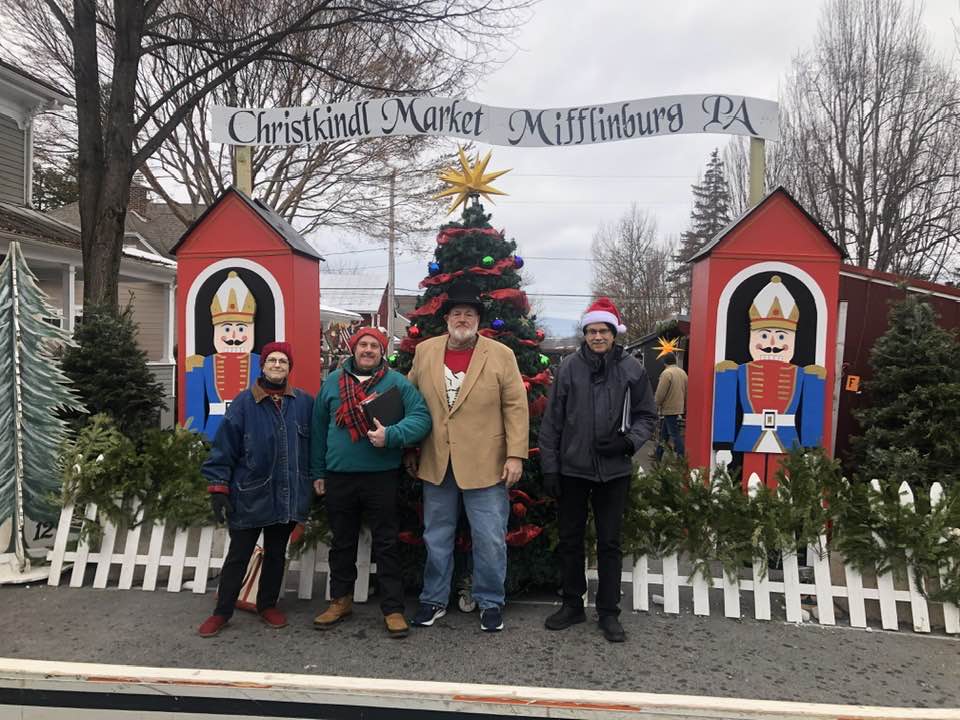
Well, after driving a couple of hours to and from Mifflinburg on two freezing afternoons last weekend, here’s the after-action report, from a story-teller’s perspective.
Mifflinburg is the home of one of the strong Mennonite communities in central Pennsylvania. Every year the citizens close off a cross of streets for four blocks in each direction in the center of the picturesque town, enclosing houses and churches, and turn them over to a walking market of food-and-trinket stalls.
It’s modeled on similar fairs in Germany.
“The earliest Christmas markets in Germany date back to at least 1434. A few weeks before Christmas, local craftsmen and food vendors sold their holiday products from stalls set up in the square surrounding the town church. The markets went by various names until the 1600s when the term Christkindlmarkt, or Christ Child Market, was adopted.”
”Mifflinburg’s version of this 600-year old German tradition was partially inspired by the proximity of several churches on Market Street. The churches serve as venues for various Christmas concerts and programs, providing a haven of warmth to visitors. For three days each year, Market Street is lined with outdoor craft and food vendors, where visitors experience the festive atmosphere of an authentic German Christkindl Market. Founded in in 1989, the Christkindl Market of Mifflinburg is the oldest, authentic outdoor Christmas market in the United States.”
School buses drive loads of both juvenile and teenage students from all over (on different days). The attendees are a mix of plain folk, ordinary farming and working families, curious visitors from greater distances, and vendors who do this sort of thing for a living. The whole town gets into the event, and the churches which are enclosed in the fair produce real life manger scenes and arrange for ladies-communities who provide respite in their breakfast halls (and cash for the churches), when strollers get foot-sore.
Now, officially our Barbershop Quartet is responsible for walking the streets and singing carols — end of story. In brief, from an entertainer perspective, I can report: We sang to the strolling school choirs and had them sing with us (complete with German lyrics), we incorporated every hopeful child who wanted to sing along and clowned for every wide-eyed baby, we thanked the folks in one of the church halls for lunch with a song or two, and when we got to the live creche scene outside one of the churches, we sang “While by our Sheep” to the sheep, and “Away in a Manger” to the manger, to the amusement of the bystanders. (Alas, we knew no carols for the asses.)
That was a report as a performer. But I also entertained myself as a reader, and as a writer of stories.
I couldn’t help noticing the mix of folks, both by age (babes on up) and by cultures. The region was well-represented with families both Mennonite and other. We pleased the bulk of them best by sticking to the old conventional favorites that they recognized (as opposed to commercial or modern tunes), but there were occasional sophisticates who appreciated Medieval or Renaissance offerings (The Boars Head Carol, Coventry Carol) and were visibly surprised to encounter them there in that location.
I’ve puzzled over why I enjoy the event so much, and it came to me that the overall atmosphere is one of good will, in honor of the holiday. Though a few of the attendees passed us by as if we were recordings, the greater part of them stopped and engaged with interest, explaining things to their children.
It’s a pleasure to find enthusiastic young singers who are brave enough to let their hope and enthusiasm show, and it’s a delight to beckon them in and shove the words at them, and support their moment in the sun, especially with their parents and siblings looking on.
An entire high school chorus (arrived by bus) stumbled onto us singing Silent Night and burst into enthusiastic cries, “We’re doing carols in our chorus. Can we sing with you?” We waved them in, asked if they knew the German lyrics (which they do, in Mennonite country), and set to with a will, changed from 4 voices to 20 for a few minutes, while their non-singing cronies cheered them on and the audience enjoyed the ad hoc nature of the affair.
You couldn’t spot a soul who was consumed with mischief, or having an unhappy time, or acting out — everyone was on their (age-appropriate) best behavior. You could make up story after story about the families you saw, the fun they were having, the pleasure they took in each other.
There was one silent encounter that made the strongest impression on me, of a woman watching for quite a while as we sang in the center of the market (as in the picture below). She seemed in appearance to be a foreigner, perhaps southeast Asian, and I speculated that this might perhaps be her first time in this sort of local festivity. I would smile at her while singing particular lyrics cheerfully or laughing at some kid going by, and she would smile back as if (I pretended) it reminded her of other season-affirming festivals from her home culture. I couldn’t help spinning out an entire back story for her as I sang, and I could see how just this sort of encounter is where some of a writer’s most vivid characters with fascinating backgrounds come from, whose fictional backstories just write themselves and are fruitful of more story to come.
So, go out and have encounters with strangers, and see what happens.
Merry Xmas and good will to all!
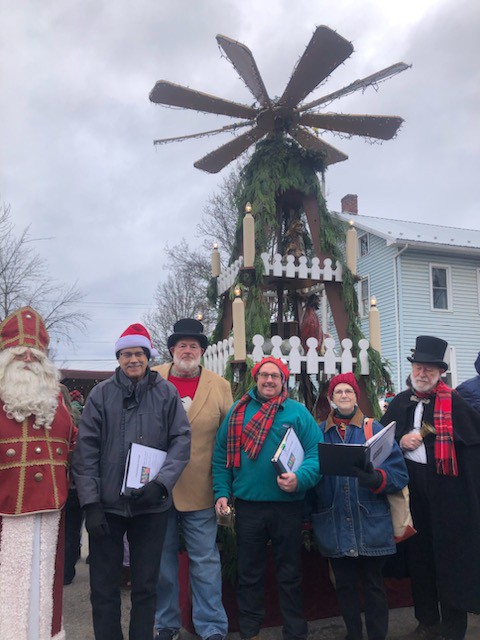
Saint Nicolas and a Bellringer join us at the center cross




 Mad Genius Club
Leave a reply to Karen Myers Cancel reply