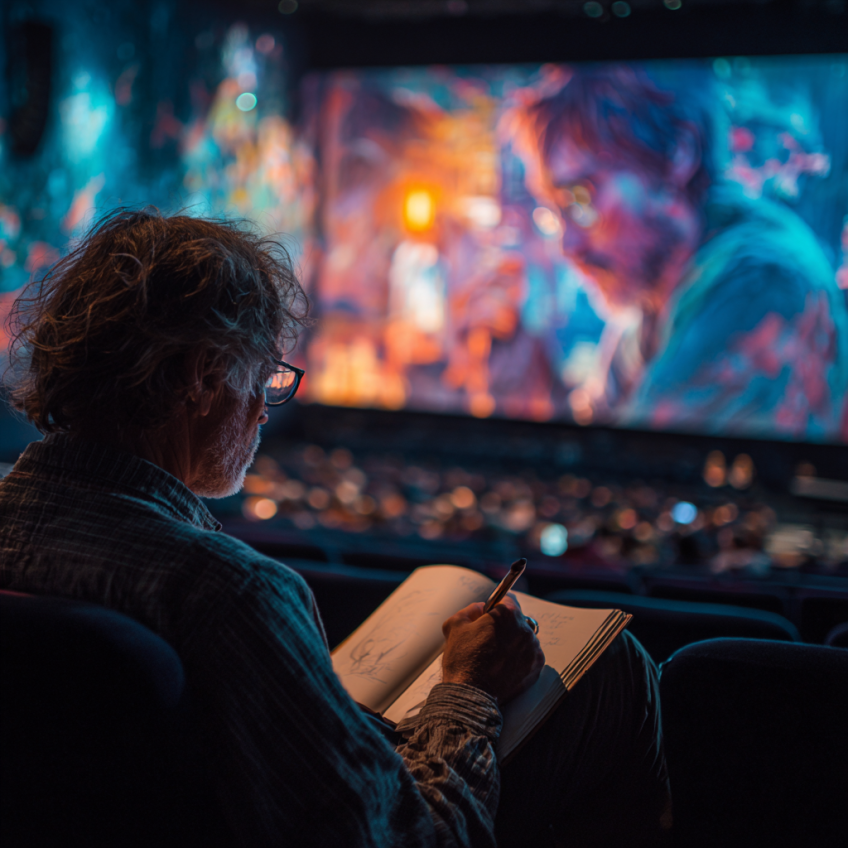
Each medium where storytelling occurs has its own specialties and tools.
I was just reading a fun book by David Carradine about the making of Kill Bill, one of Quentin Tarantino’s finest movies. Although that wasn’t the intent of Carradine’s diary-like story, the anecdotes he related made vivid to me some of the differences in storytelling techniques between written story and cinema.
For example… take character development/backstory
Telling a story is less visceral than showing it, even though (unlike in film) we can explicitly describe what everyone is thinking. For example, even when telling a story live (or performing a song), we tend to add gestures and other physical aids to help people “see” it.
By contrast, state of mind can be more easily expressed via inner narrative than non verbal clues. The inner POVs of characters are a mainstay of written/spoken stories.
Alternatively, film uses explicit narrative to shortcut story-telling, to skip over events. “Seven years later…” But presenting direct inner narrative is not its strong suit. (e.g., “Well, just seeing that fellow made me mad, you see….”) — a little of that sort of narrated film goes a long way. It may be necessary for story-event clarification, but it’s not very effective in the middle of an action scene.
For example, in a fight scene, Carradine talks about pausing for constant changes of a shirt as it keeps being sweated through. Film cares about controlling that visual consistency — in this case it effectively lies in order to present a fighter who is so good that he doesn’t have to work up a sweat. And it operates in something resembling real time, not slow-motion.
It made me think — getting sweaty in a story matters viscerally, because it makes the fight seem more real. But the point of this particular movie at that moment is to emphasize the effortlessness of the high-powered character instead. It’s about character definition, not visceral identification.
That made me instantly contemplate how I would write such a fight scene (for other characters). First of all, there’s no time (length) constraint. Taking injuries in a fight matters, because it hurts and the character has at least an inner reaction to that which includes many things besides pain (consequences, fear, pessimism, surprise). (For example, this could include the inner pride and satisfaction of how effortless it all is, if true). I can dwell upon that at length (as long as I don’t get ridiculous about the time expansion), and an external observer in the story would perhaps be clueless (beyond trying to read grimaces).
Cinema doesn’t have that explicit inner voice as events occur, unless it uses voice-over in the moment, a clumsy tool. It must rely on things shown, or things narrated at another time. In the moment, it is constrained by the general unknowability we all have in understanding eachother via external observation.
They are both effective story-telling techniques, with unique strengths and limitations. But they are very different and require different narrative tools, well-beyond any scene or event changes or rearrangement of plot.
Makes me re-evaluate my opinions of good script adaptations of books. Problem is, if it’s a story I know well, the script always seems to have to leave out some of the best little bits of internal character thoughts.
Different tools, different needs.
Do you have favorite adaptations? How would you adapt your own work to film? What about other media (Comics, music, games…)?

 Mad Genius Club
13 responses to “Media-specific Storytelling”
For filmed books, I always try to see the movie before reading the book. That way I can potentially enjoy both. I remember when Buck Henry’s Catch 22 (as opposed to the original Joseph Heller’s Catch 22 book) came out, I really enjoyed the movie. Then I read the book and was even more impressed. My friends who had all practically memorized the book were disappointed. They were unable to take the movie on its own terms and outraged at every little discrepancy.
Screenwriting from a book is similar to translating one into another language. Sometimes you have to take liberties to make the result impact the consumer of a different media the same way the original did.
When I do a reading, I tend to play the characters, or act out with one hand the action (character finds a “whippy stick” and zots an imp on the schnoz while saying “bad creature, bad, bad.”). I can’t not do it.
A friend told me that my early work would be fantastic as anime, because of the visual style of my writing then and how it fit the visual style and plot lines of adventure/action stories. I could easily imagine it, especially set to certain music.
I would not say that voiceover is a clumsy tool, but a tool used clumsily by too many practitioners. Its most effective use is when it is in contrast to what is being shown, which gets at what cinema does better than any other storytelling medium:
In cinema, you can show multiple stories happening simultaneously. In prose, you can only go one word at a time.
In the first Mission: Impossible movie, there is a brilliantly done scene where Tom Cruise is talking with Jon Voight and realizing that Voight is the one who betrayed him. This is shown through the flashbacks, but what Cruise is saying narrates the version of events that Voight wants him to believe. So there are three levels of storytelling happening at once: the conversation, the narrative Voight is selling, and Cruise working out the truth while pretending to be fooled.
In any given Zucker-Abrahms-Zucker film (including Airplane!, Top Secret!, and The Naked Gun), there are gags going on in the background that are sometimes funnier than the foreground story.
For an extreme example of how cinema can do multiple things at once, Jacques Tati’s Playtime is a film without a particular story, and done almost entirely in long shots. It presents a modern urban landscape with many things happening in the frame at the same time, and Tati purposely didn’t draw audience focus to any one of them, preferring to let the audience choose what it wanted to focus on. Somewhat famously, his own character, the usually-comedic M. Hulot, enters the film in a way most people don’t even notice on first viewing, until something funny happens to him.
As for voiceover done well, the modern canonical example is The Shawshank Redemption. Morgan Freeman’s character’s narration works not only because of contrast and counterpoint to the image, but also because he thinks he’s telling the viewer about Tim Robbins’s character, but really he’s telling you about himself without knowing it.
I could never, ever keep a straight face when I saw a pull-along suitcase after seeing Airplane!.
The white zone is for loading and unloading only. There is no parking in the red zone.
“They bought their tickets, they knew what they were getting into. I say, let ’em crash!”
Video is an external view, while text is an internal view.
In movies you can show the vista of two planes dueling above the cloud layer, turning, twisting, beams and explosions bracketing them.
In text, you describe the narrowing of focus, down from the lights and stark beauty, to the narrowing of focus to ranges, angles, and lock tones, vision greying as your plane tries to crush you through your seat, while you play an elaborate game of chicken with your foe, deciding whether to guide your weapons in until the last possible moment, or when to turn and defend against the ones he has surely launched in return.
See, and experience.
To me, the best book to film adaptation is Hunt for Red October. Film preserves the suspense, military ethos and emphasis on sea-going danger, high technology, and cloak and dagger stuff that are the book’s strengths. It develops the characters more fully without being overly mawkish or sentimental in a way that would clash with the overall tone. It trims distracting subplots and streamlines the technobabble. Book to tv adaptation…probably the Agatha Christie short stories adapted for the early seasons of Poirot, or the 1995 P&P, although the latter’s fanbase annoys me from time to time, and I’ve gotten very tired of this idea that Darcy *must* be a gruff, rather abrupt and inarticulate oaf. My mental image of the character, reading the book around 1993-1994, with no exposure to any of the existing adaptations, was of a suave, haughty, sarcastic kind of guy, like a Basil Rathbone villain, and nobody else (well, maybe Georgette Heyer) seems to have picked up on that.
Basically there’s a Golden Age of Adaptations which starts around 1989 with Poirot and Campion, continues through 90s boom of Shakespeare, Oscar Wilde and Jane Austen (and to some extent Charles Dickens) adaptations, and culminates with the release of Return of the King in 2003. Not everything in it is infallible: Mansfield Park 1999 is very “current year” in its attitudes and priorities, although well-made and fairly entertaining as long as you understand that the writer/director is almost continuously lying to you about one character or other, and therefore it’s unwise to carry assumptions from it back into your readings of the book.
This Golden Age is followed immediately by a Silver Age, which starts not quite two years later with the release of the Keira Knightley P&P in 2005, continues with another round of Dickens and Austen, the later and increasingly flawed seasons of Poirot, the Hobbit movies (sorry, I don’t hate them), and arguably most of the better MCU movies, finally culminating in Love and Friendship (Whit Stillman’s 2016 adaptation of Austen’s Lady Susan).
The Bronze Age of Adaptations actually preceded the Golden Age, IMO: a cycle of mostly book-to-tv adaptations on both sides of the Atlantic that included the first two adaptations of Sense and Sensibility, the Ian Carmichael version of Peter Wimsey, the Jack Palance and Louis Jourdain Draculas, The Agatha Christie Hour, some stuff that’s well regarded but not relevant to my interests, like Pallisers, Rich Man Poor Man, Shogun, etc. To me, this Bronze Age starts with the 1971 Sense and Sensibility and ends with the 1983 Mansfield Park.
You have some prominent adaptations that kind of fall between two stools, like the 1987 Wimsey and Northanger Abbey, or the 2004 Bride and Prejudice. If you find it tidier to cut the Golden Age off at, say, 1999 with Kandukondein and I think some Dickenses and Wildes, and declare the Silver Age as starting in 2001 with the Poirot reboot, or 2002 with Fellowship of the Ring, I’m okay with that too. But that’s roughly how I see the major cycles of book adaptations that have occurred in my lifetime (more or less, the Bronze Age starts a bit before my time). As for the current cycle of adaptations, the words “Kaliyug”, “Dark Ages” and “Dung Ages” come to mind.
The Hunt for Red October is a masterful adaptation that does something even more impressive than what you list: it compresses the events in the book, especially the climax, in a way that is cinematic, honors what the book did, and leaves no dangling threads or questions.
One movie that is better than the book it is based on: The Firm. Instead of the book’s (admittedly tense) climactic sequence that boils down to “He made copies, and took the copies and money and ran,” the movie digs deep into the materials that were already in the book, adds one single (and very believable) element (the mail fraud), and pulls off a climax that’s gripping and tense and makes characters that were straight cardboard in the book into something much more human, particularly for a Hollywood thriller.
I still remember Tom Cruise’s rant in The Firm about coming from poverty and not wanting to go back to it. It was a turning point in our sympathies for a character we hadn’t liked until then.
Come to think of it, that detail may also have been added. Then again, been a long time since I read the book, so maybe not. Still, probably the last movie where director Sydney Pollack was firing on all cylinders, which means it’s a great piece of entertainment.
Medium affects the message. A lot. This is why when people say that the book was better than the movie, they mean the original book — never a novelization.
Doing a novelization is thankless (except in payment) and a definite skill. I know of one novelization that may arguably be better than the film. A Study in Terror is the first film to posit Sherlock Holmes investigating the Jack the Ripper case, and it’s quite good. (The second one, Murder by Decree, had a bigger budget, a more recognizeable cast, but was very, very 1970s and involved possible psychic powers and some other silliness.)
The novelization for A Study in Terror was by Ellery Queen, and featured Ellery Queen receiving a suppressed manuscript by Dr. John Watson, which was the story in the film. But then Queen re-investigates and reaches a totally different conclusion about the case than the film does. It’s a very neat bit of writing.