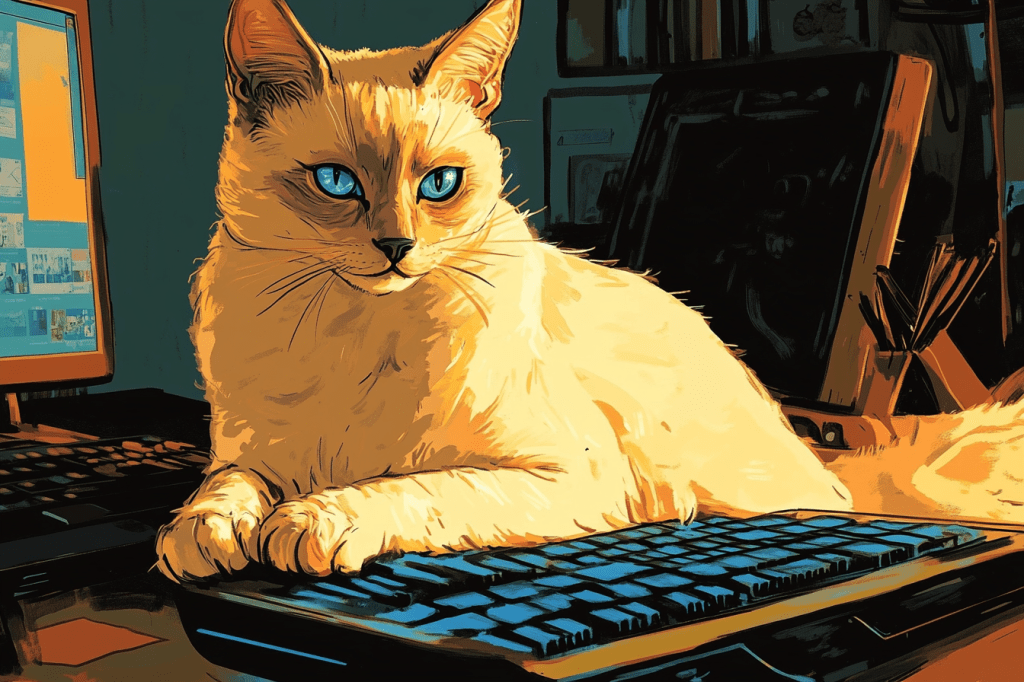
Last week I suggested we all get out, and do and see things. This week it’s in the 40s, raining, and I overdid it a trifle with garden work yesterday. It’s the perfect day to hole up in my cosy house with cats, books, copious tea, and perhaps some cookies if I bake them.
In addition to book research, I could write. What a concept! That is, if Toast allows me to continue typing uninterrupted. Right now I’m contemplating a pair of warmly hued ears right in the center of the monitor as she sits and stares at me. I know what she wants. I’ll probably give her the cuddles and ear skritches.

One of the science fiction stories I can remember reading early on, (Toast must you sit on my mouse? It’s like wearing a fur muff) was a James Schmitz tale of a young woman and her Very Large Cat. It made quite the impression on me, but later when I wanted to try finding it, and perhaps more of it, I’d forgotten the author’s name. Imagine my delight when I rediscovered it in a Baen collection twenty years later. I suspect I’d first encountered it in an anthology, as I don’t recognize the covers in the wiki link there. You can read it free online, if you like, but you should know something before you do.
Novice, the story I’m talking about, is one of those interesting phenomena in my life when it comes to reading. The first time I encountered the story, I was perhaps ten or eleven years old. A perfect time to be reading about a fifteen-year-old who was smarter than her age would convey (I was, also, which is part of why I related to Telzey so much) and of course, her cat. Coming back to it twenty years later, as a mother, I read it very differently than I had as a child. Note that I didn’t love it any less later in life. Simply… there are nuances I had entirely missed when I read it with child-like wonder. Schmitz is a master of his craft.
There are other books I read as a mother which hit differently than they had to child-me. Or some which as an adult I reacted to the subtexts I’d missed earlier in life with less experience. It makes one of my current jobs for Raconteur Press, which is reading the submissions for boys books, a little more difficult as I must judge them with child’s eyes and the wonder of a young person, not a matron and elder human. I love to see a nuanced story, which has layers that may not be apparent to the young reader, which their parent or grandparent will perceive. However, there still must be the connection to the child and the child’s dreams, goals, and sense of wonder.
What books, if any, have struck you in this way? Not that you grew out of them – I can think of many I simply would not be able to read now, as an adult – but which morphed through the lens of your growth and development into a responsible, wiser, and sometimes sadder being than the child-you?



 Mad Genius Club
18 responses to “In which the author stays in her cave”
Margery Allingham I think is the only one I reread recently where the change in perspective was strictly “different” rather than mixed. I’d read most of the Campions as a teenager, around the time the tv series reached America and enjoyed them at an adventure/mystery level without thinking much more about it. Rereading them in the last couple of years, I noticed
-her interest in people and places (and a lesser extent things) as links to the past, and how they change over time, like the water mill adapted to hydroelectric in Sweet Danger (or some of the plot maguffins in the same story) or the WWII Quonset huts at the research facility in the 1950s book The Mind-Readers.
-The Chesterton influence, which is both more obvious and less deep than some of the other writers of her generation. She’s the only one who mastered that trick he and Kipling had of blithely asserting something that makes the reader go “wait, what?” and then rolling with it.
-Some interesting similarities in tone and atmosphere between her More Work for the Undertaker and Melvin Peake’s Titus Groan, both published around the same time. Peake’s works vastly exaggerate the atmosphere and surrealism, of course, at the expense of everything else, but the resemblance is there.
-Also, Allingham’s young men often feel more plausible than Sayers’s or Christie’s, who were both pretty good psychologists but often seem like they were reverse-engineering their men from their knowledge of women. Complicated a heavy veil of resentment in Christie’s case, probably due to the divorce from the first husband.
Gene Stratton-Porter: Freckles / The Keeper of the Bees
Kipling: Kim
Eric Frank Russell: Wasp
Dickens — various
…These were very different reads the older I got, each for different reasons. Some books you wander into in early youth and find them interesting, but the random peeks into adulthood are a hit-or-miss proposition.
Now, calling any of the above books “children’s stories” is an anachronism — they were written for adult readers.
The Stratton-Porters are aimed at what I would call a “naive audience” target which is no longer a useful market. (Even soldiers on the front lines were eager to get her works with their K-rations). Her books often cover very adult themes of the day (bastardy, infidelity, child/spouse abuse), but that seems to roll off the back of the sub-teen reader who is busy identifying with the hero. (Reminds me of reading Dickens too young.)
The Mirror Crack’d from Side to Side by Agatha Christie (1962).
The first time I read it, as a teenager, it was a good mystery which I didn’t solve but Marina Gregg’s narcissism, pathological selfishness, and cruelty barely made an impression.
Fast forward 40 years to the Agatha Movie Project. I reread the books and watched 7 of the 8 films. I couldn’t believe that I overlooked Marina Gregg adopting three young orphans and then, when she became pregnant with a “real” baby of her own, abandoning them to boarding schools they never left again because those children were merely dress rehearsals for the real thing.
Margo, the sister, speaks for her adopted brothers when she says about Marina Gregg: “Why shouldn’t I hate her? She did the worst thing to me that anyone can do to anyone else. let them believe that they’re loved and wanted and then show them that it’s all a sham.” This is after a page or two of furious resentment.
I have three children and it’s horrifying now, what Marina did to those kids.
Even more interesting is how Hollywood interpreted Margo. Of the 7 films we’ve seen, the 3 English language ones either eliminate Margo entirely or vastly truncate her pages of misery into bland acceptance. The international films ALL allow Margo, to varying degrees, express her unhappiness.
At the Agatha Christie Festival (2024) I spoke with numerous people about Mirror. People with kids were shocked. People without kids didn’t get it and made excuses because Marina Gregg was a super-special traumatized artist, don’t you know.
Here’s the films if you’re interested in finding them for a film festival of your own. Watch them in date order.
Mirror Crack’d from Side to Side, The (1962) 8 film adaptations
The Mirror Crack’d, (UK, 1980) Angela Lansbury as Miss Marple. Margo eliminated entirely.
The Mirror Crack’d from Side to Side (UK, 1992), #12 of 12, episode 21 of Miss Marple. Joan Hickson as Miss Marple. Margo appears, you think she’ll have a plot, and then nothing.
The First Shoot (Shubho Mahurat) (India, 2003) Raakhee Gulzar as Ranga Pishima. Not exactly Margo but still angry over being tossed aside like a used tissue.
The Great Actress Murder Case (Daijoyuu Satsujin Jiken)(Japan, 2007) Kishi Keiko as Mabuchi Junko. We did not find this one with English subtitles but we’d love to!
The Mirror Crack’d from Side to Side (UK, 2010) series 5, episode 4 (#20 of 23) of Agatha Christie’s Marple. Julia McKenzie as Miss Marple. Margo speaks but is bland and accepting.
The Mirror Crack’d (Le miroir se brisa) (France, 2018) series 2, episode 18 of 27 (#29 of 48) of Les Petits Meurtres d’Agatha Christie. Margo confronts Marina which didn’t happen in the novel or anywhere else.
The Great Actress Murder Case (The Great Actress Murder Case) (Japan, 2018) Sawamura Ikki as Shokokuji Ryuya. Margo actually gets siblings, normally removed from adaptations. You also see Marina sending the kids away while she revels in her trauma and grief.
Ms. Ma: Nemesis (South Korea, 2018) part of the multi-episode arc. Yunjin Kim as Ms. Ma. The cruelest Marina of them all and the angriest, most conflicted Margo of them all.
It’s generally accepted that a certain incident in Gene Tierney’s life was the inspiration for a key part of Marina’s backstory. I think possibly the English-language versions choose to lean into the Gene Tierney angle, which means leaving out the adoptive children.
Tierney had mental health issues and a messy love life that included Oleg Cassini, JFK, and Prince Aly Khan, but she adopted no children and seems to have had a good relationship with Christina Cassini (her younger biological daughter) and been genuinely concerned for Daria Cassini, the mentally and physically disabled child born after Tierney contracted rubella.
It may not have been Gene Tierney. Or just Gene Tierney. In 1947, Queen Juliana of the Dutch Royal family was exposed to rubella; her daughter, Princess Christina was born impaired. The story made all the English newspapers. We learned this while in England at the Agatha Christie festival.
In addition, the reason why rubella victims were supposed to self-quarantine was because the problem of prenatal exposure was widespread and recognized. Gene Tierney and Queen Juliana were celebrity victims but they were far from being the only ones.
I suspect that Agatha took her inspiration from numerous events and combined them. She was very active in the theater and probably heard incredible stories about selfish actors and how they treated their families.
For a non-actor story, Dorothy Sayers (who she knew personally) had a child out of wedlock in 1924. When she married Oswald ‘Mac’ Fleming in 1926, she wanted to “adopt” her son and formally acknowledge him. Mac refused to accept some other man’s child in his household so she didn’t.
There’s lots of parallels to choose from!
Tierney would have been the parallel that the English language adaptors were most familiar with, hence my speculation.
Sayers’s illegitimate child had been public knowledge from the time of her death in 1957, about five years before The Mirror Crack’d was published, so I suppose that is possible. It would have been a catty gesture on Christie’s part, but not out of character.
Yeah, there’s no way to know. What I have learned about Agatha is that she was really observant, an excellent listener, and not above eavesdropping on the bus or in restaurants. She had a mind like a magpie.
Agreed. I’d love to know who the inspiration for Mr. Gregory, the mentally unstable chemist in After the Funeral, was, because she obviously met someone with a similar affect, whom she found frustratingly opaque.
It could have been the head of the pharmacy department when she was a young aide, volunteering during WW1.
Mr. P also, I think, served as the model for the murderer in The Pale Horse, also a pharmacist.
https://agathachristie.fandom.com/wiki/Mr_P
It could be “Mr. P.,” the head of the dispensary during her service during WWI. He also inspired the killer pharmacist in The Pale Horse.
WordPress doesn’t want me to include the link (this is my second try).
Go to the Agatha Christie Wiki and look up “Mr. P.” It should pop.
I remember Mr. P, and he’s generally a safe bet for having inspired anybody who plays with poisons in her work, but the After The Funeral character always struck me as a more self-hating kind of guy, and I wondered where that side of him came from.
I really don’t know. Other than her autobiography which was NOT a tell-all, there’s not much to go on. No friends and relatives wrote tell-alls either! The only person who might guess accurately would be Dr. John Curran or one of the other die-hard Agatha scholars.
Good point!
The original Telzey story was published in Analog May 1964 called Undercurrents.
“Novice” was June 62, so it appeared before “Undercurrents”.
I read this Telzey story when I was about 13. It was great, a 15 year old girl, smart , competent girl with a psionic talent. IT resonated to me. However it was bought by older brothers and they liked it as well. Unlike current fiction it was not a story that focused on teenage angst and emotional insecurity. Most of Schmitz characters were competent and capable, not flawed like many current characters. It was inspiring that we can succeed . It was a time that Americans believe in dreams and went for them.
Musk does that also in real life. He dream of starships and made them real.
The original cover from Analog https://www.luminist.org/archives/SF/AN/AN_1964_05_L.jpg
Ray Bradbury’s Something Wicked This Way Comes. When I read it as a kid, it was a spooky adventure story about two kids and a haunted carnival. Rereading it as an old man, it’s all about an old man considering his life and his regrets, wanting to shield his son from the world and knowing that he cannot. Somehow the hero of the book became Charles Halloway when I wasn’t looking.