At least one of the central tables at the local Barnes and Noble have been covered with romances for the last six months or so. These are paranormal romances, for the most part, enemies-to-lovers or similar sub-subgenre. The cover copy suggests more than a little darkness in the stories, the art likewise. Most are also “spicy,” some to the point of being paranormerotica in my opinion. Over in the Romance section, biker romances, mafia and Russian-mafia romances, and the like are not uncommon. The bad boy either improved by or rescued by the girl seems to be popular among trad pub and small romance presses these days.
Skip to the national headlines, and you have the rockstar-like adulation for the young man who is accused of murdering an insurance company CEO. Granted, the young man is not physically ugly, but the fangirling among some in the media and popular culture is … worrisome at the very least. Fashion journals discussing the sweater he wore to the initial hearing? Really? It feels too much like the worship given to the Boston Bomber.
Note, I am not saying that the bad-boy romance novels causes women to go gaga over accused criminals. The idea that a good woman can save a less-than-good man goes back quite a ways in western culture, as does the heroic criminal striking a blow against corrupt society (Robin Hood and friends). Archetypes are archetypes for a reason, and people have and do improve themselves in order to be the person their love hopes they can be. But that’s from inside the individual, or because of (medieval through 1800s version) prayers and role-modeling of the love/parent/mentor, not the magical power of XX chromosomes*.
Do bad-boy romances sell? [1/19 See update below.] Obviously well enough that small-press, trad-pub, and indie authors sell them. Should they come with warning labels? Some perhaps, although I have a strong anti-predator bias when it comes to romance, and I bounce hard off of certain tropes. Obviously I’m not the market these authors and publishers are aiming for. In the real world, women do fall hard in, ahem, love, with “bad boys,” and fangirl terrorists and become groupies for criminals and sleezeballs. Tropes and archetypes become those for a reason, and people enjoy living vicariously through fiction. The bleed-over into reality is both fascinating, and worrisome, at least for me.
Now, interestingly, the stock on the sales table at the bookstore doesn’t seem to change all that much. Is it because they are that popular and so the staff restock the same titles on a regular basis? Or is it because very few people actually buy those sorts of books (at least in print), and so they don’t move much? I don’t have an answer for the question.
If you want to write this subgenre, I’d suggest that you do a lot of research, and make the genre very, very clear in your cover art and opening pages.
Edit to Add: I got a chance to ask someone at the bookstore about the book table. The dark spicy romances are very, very popular, enough so that they restock frequently and heavily.
*Family blog, so will avoid the author slang term.


 Mad Genius Club
32 responses to “Art Influencing Life: Bad Boys and Groupies”
It has been my observation that in far too many cases a man marries a woman because of what she is while the woman marries a man for what she believes she can turn him into. Such expectations and the inevitable resulting conflicts certainly contribute to the ridiculously high divorce rate in this country.
“She marries thinking he’ll change; he marries thinking nothing will change” is the one I was taught.
What’s reasonable to expect has gotten warped– “you aged! Bye!” “You still have the same personality! Bye!”
Just like how “nice” got warped to mean a complete dishrag, so the only ones who will do anything are the “bad boys.”
Which, come to think of it, kind of aligns with the “all good girls are quiet and agreeable and never cause any issue at all,” and ended up with the contrast of absolutely nasty being the only non-doormats.
I’ve been slowly coming to the conclusion thaten have more baseline variability, but less environmental adaption, while women have less baseline variability, but more environmental adaptability.
My theory is the baseline variability is controlled by stuff resident in the X chromosome, so men are like rolling one die and doubling it, while women are rolling two dice and adding them. Similar range. Similar average, but very different spread.
And from attachment theory, it turns out men and women have different distributions of the two main social bonding hormones: vasopresin and oxytocin. Men have much more vasopresin, while women have an even split. However, while vasopresin does basically the same thing under most conditions, oxytocin can significantly change function depending on the environment.
The big thing is oxytocin doesn’t bond well when you’re under stress, and under enough stress can flip to behave like vasopresin.
And modern dating is extremely stressful. I can see how that would set the stage for pretty significant personality changes for the woman in the relationship: dating is running in high stress problem focused mode. After things have settled down and especially after getting married, she relaxes into a more soft fluffy comfort mode, until the first kid shows up and all of her nurture drive is attached to the kid, and usually largely detatching from the husband in the process.
Meanwhile, he’s pretty much the same and wondering wth happened to the girl he was dating.
Meanwhile, he’s pretty much the same and wondering wth happened to the girl he was dating.
And, in his head, he’s still dating.
The bonding is frustrated, so instead of the two becoming one, and the child being theirs, it’s “I’m a single guy who happens to have a live in. Who just got a weird hobby of ‘child’.”
So, for men, they really are not that different. The important difference is which way they bonded while dating.
There are two main ways people bond: solving problems together, and sharing comfort/emotions with each other. The first one is the vasopresin side, and the second is the oxytocin side. And you can bond in one way without bonding in the other way.
Having a baby hard resets the oxytocin bond to focus on the baby, which means if she did not have an established problem solving bond with the father, their bond just vanished. And the father doesn’t have the same natural hard reset to bond with the baby: it needs to be intentionally cultivated.
However if they do have a strong problem solving bond, that isn’t affected by any of that. So she still goes to him with the ‘I have a problem’ questions, and he is still in the ‘do you need help here?’ mode. But again, that’s a different type of bond from the shared comfort and closeness type bond, and forged by cooperatively addressing stress sources.
Also turns out that cohabiting is emotionally the same as being married. All those couples who though cohabing was ‘just a test drive’ bought the car without thinking about it.
There’s a very major difference, actually.
They both have the sex-bond flipped over to “temporary.”
For those wondering– that’s what the “roughly equal amounts of oxy” part for guys is; women tend to bond faster and more strongly via sex than men, because of those higher levels.
This is incorrectly treated as only women bond from sex, which is false and harmful. With sufficient repeats of bond-break-bond, that can be destroyed/dulled.
Basically, a trauma response that makes it hard to have a connection.
But that’s part of the thing, men don’t really bond through that. You ask a man with a stable marriage why he lil ones his wife, and 9 times out of 10 it will be some variant of he can depend on her absolutely.
Women do have that sort of bond response to that, which is one of the reasons it is so dangerous to start doing that early in a relationship. It automatically sets up unequal expectations, among all the other hazards at play.
But that’s part of the thing, men don’t really bond through that.
I’m aware of the stories that people tell themselves. Some of them are even admirable– nobody wants to go “hey, you give good below the belt action, that’s why I like you.” It reduces folks unjustly.
I also am aware of what I’ve observed, and of the studies done on the actual hormone reactions; guys do bond via sex, though slower, and are more harmed by a break up where they were sleeping with the woman than those where they were not.
Guys are just also more likely to be emotionally abused if they admit that sex isn’t casual, and much more likely to HAVE a high body count/suffer sex addiction.
I think we’re talking about different parts of the same elephant here. The system has some fantastically complex emergent behaviors. So agree it is there, but normally to a much smaller extent in a male who has reasonably secure attachment styles.
Of course, just to throw more monkey wrenches into the works, my understanding is if someone in not under high stress levels, but is also deprived of oxytocin, the receptors go into over drive mode, and simply go nuts over any oxytocin, and will even sweep up dopamine.
I suppose the point I’m trying to make is that the oxytocin bonds are much easier to unintentionally and unequally make and break, the vasopresin bonds are a much more stable and solid foundation for a couple, even though they do require the couple to be more intentional about making them. And that if those bonds are not properly set up during dating, they build a weak foundation for a successful marriage.
If you’re interested, here:
https://www.hims.com/blog/oxytocin-in-males
Might recognize the company as the folks who sell hormone supplements/help treat hormone issues in both men and women, but note that they do actually link studies.
I have literally seen feminists declaring that a woman has no agency when she does what is socially acceptable.
So, no, traveling East of the Sun, West of the Moon does not show agency, because it’s socially acceptable to seek out your husband.
Thankfully, I’m young enough that by the time it got slammed into my head, it was obvious that the “not socially acceptable” stuff they pointed at was the only stuff that was socially acceptable.
IE, one MUST obey them, or one wasn’t “free.”
Now I want to go hang out at the local B&N and more closely watch– ours has a couple like this, too, but they seem to be picked by REALLY BRIGHT colored covers, or weird names.
So people stop and look, unless it’s got a big sign like ROMANCE over the top, then you’d think it has cooties.
If it’s picked by bright colors, it might work by “pick up, read, go ick, but now I want something good-”
Yeah, my impression is that the “fashionable” romances tend to benefit from cool covers alot.
Some of the bad-boy groupie stuff comes down to attempts by young women to be transgressive; and should IMO be treated with the same mild disdain and refusal to fuss and fume as the young men trying to push society’s buttons about racism, nazis(1), or monarchies.
(1)At least one member of my extended family who I never met and only know through family stories was a POW in WWII who *hated* Hogan’s Heroes with a passion. And yet I feel, like the Jews who worked on Hogan’s Heroes, that that style of mockery is the best way to keep people from latching onto nazi imagery for the shock value/forbidden fruit value.
“What if he wanted to go to the Russian Front?” *Cackles*
Oh, I find it simpler than that.
Feminist Logic Here:
1. Women are better than men, and more powerful than men, and should always tell men what to do!
2. Men who don’t agree by being strong and powerful, and able to tell women what to do are therefore bad!
3. But I want someone strong and powerful, and able to stand up to me and who can sometimes tell me what to do.
4. So I must want a Bad Man!
5. That’s scary. I only want it in fiction, where it’s safe and tame.
Thus, you get ‘bad boy’ romances that have absolutely nothing to do with how those sorts act in real life.
Unintended consequence: losing track of the line between the stories you consume and Real Life, and thinking that the ‘bad boys’ of reality will act like the ones between the covers.
Except that it’s older than that. The Nazi film Jud Suess is noteworthy for anti-Semitism among Nazi films. Yet there were women swooning for the title character.
In fairness the title character was played by a matinee idol associated with shady but dashing playboy roles; it’s kind of like how some people rooted for Hugh Grant in Bridget Jones’s Diary inspite of him being the bad guy.
There’s bad guys, and then there’s bad guys who torture a woman’s husband in order to get her to submit to rape.
True.
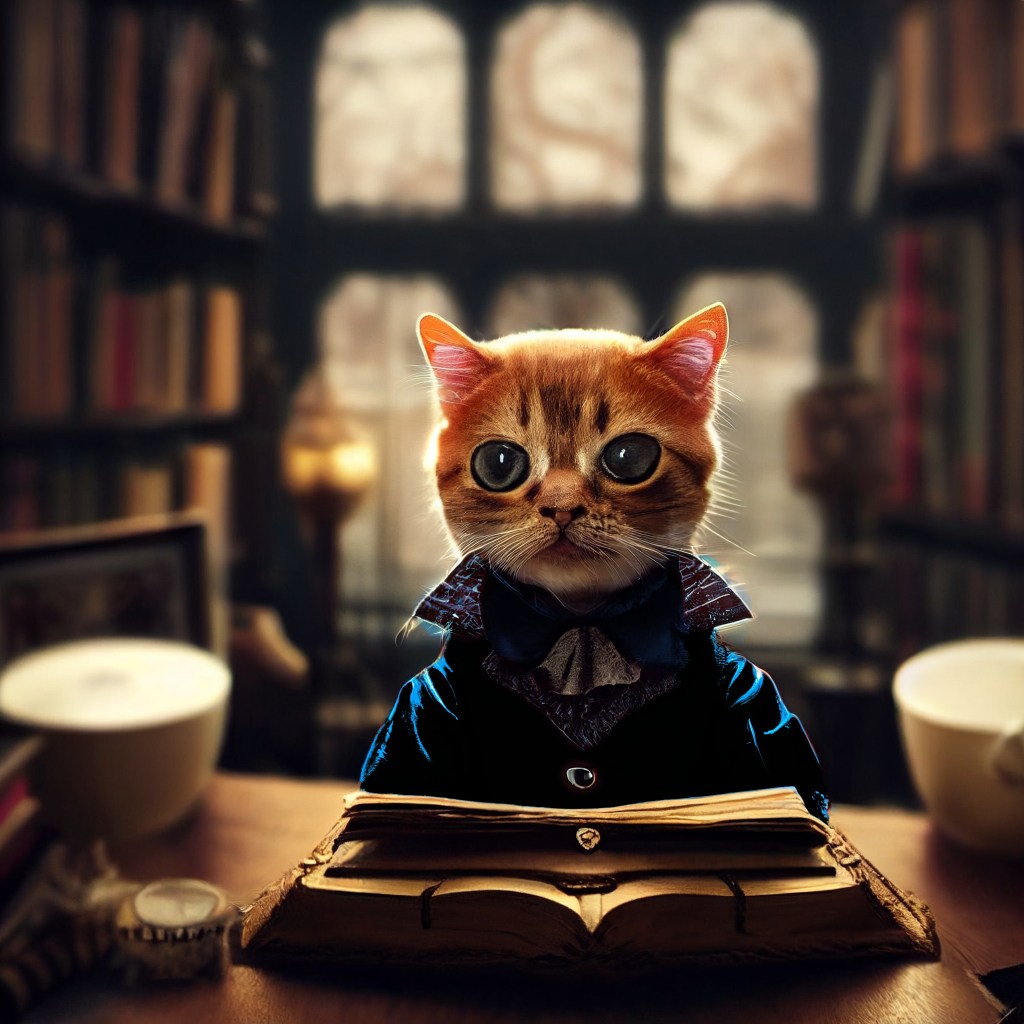
Also, yay Professor Cat picture is back! I missed him/her when the post first went live.
“At least one of the central tables at the local Barnes and Noble have been covered with romances for the last six months or so.”
Guess I haven’t missed much in the B&N universe then. I can’t imagine the “bad-boy” romances have been much improved by DEI. Feminist pretzel logic writ large, with extra justification and a side-order of scolding.
I try to keep my romance stories -constructive- so that both people win. Even when one of them is a robot. If you’re going to have a fantasy, why can’t it be fun?
I ran into a YouTube reviewer who described these sorts of “romantic” heroes as, “Guys who get the girl when they ought to get the chair.” (An exaggeration usually; most of them should only get twenty years in the slammer.) I, too, bounce off that trope hard. When you could put the hero’s actions in a serial killer novel, and they wouldn’t seem out of place, it’s not really romantic in my book.
(Seriously, if Hannibal Lecter had hacked the heroine’s phone so that it called him whenever she tried to contact the police, then showed up at her house pretending to be the cops, it would be one of the creepiest parts of the book. But because the private detective who did that was handsome, we were supposed to accept it as just a misunderstanding that can be laughed off.)
Fantasy can get even weirder for the creepy factor– like a lovingly detailed description from the POV male love interest of how long it took the species-of-love-interest guys he had swallowed alive to stop moving in his stomach.
I started skimming to see if there was improvement.
There was not…..
The female lead was dating Sarlacc’s Pit?
(I kid, I kid, this was probably some kind of dragon shifter thingie.)
Right in one, dragon and… I think it was mermaids? But world where everyone could transform. (Anime does it better!)
I GTFO’d fast.
Seems like a sound response 🙂
That reminds me of something I once read about courtship in the Caucasus a century or so ago. When a young Circassian bravo wanted to impress a girl, he would ride up to her front door wearing his finest clothes, mounted on a black Kabardian stallion with silver-inlaid bridle and saddle and stirrups, with his best shaska saber and kindjal dagger at his waist — and with the heads of any other man who’d shown an interest in her trailing from his stirrup. Because that showed he was willing to kill anyone to win her for himself. And I suppose that with all her other boyfriends dead, what choice did she have?
Apparently in the Caucasus that was considered a highly romantic gesture.
That reminds me of a comic a young lady artist did some years ago, wherein a lovely young lady returns home to find flower arrangements everywhere. As she wonders who did this, this absolutely revolting literal rodent of a guy pops up and brags that he did it to impress her.
The last panel is of him getting dragged away by the cops, with the young lady looking furious and Mr. Rodent looking very confused. I believe it was part of a trend among some female artists on the site at the time to draw art of how certain romantic gestures were creepy as all get out in real life.
It’s The Fat Electrician, so language warning, but about 10 minutes in… well, the daughter of the richest guy in the county married the guy who really should have been dead like four times before the American Revolution, horse thief, drunk, fighter, hothead….
He’s a Red Flag Fandango in history dude: