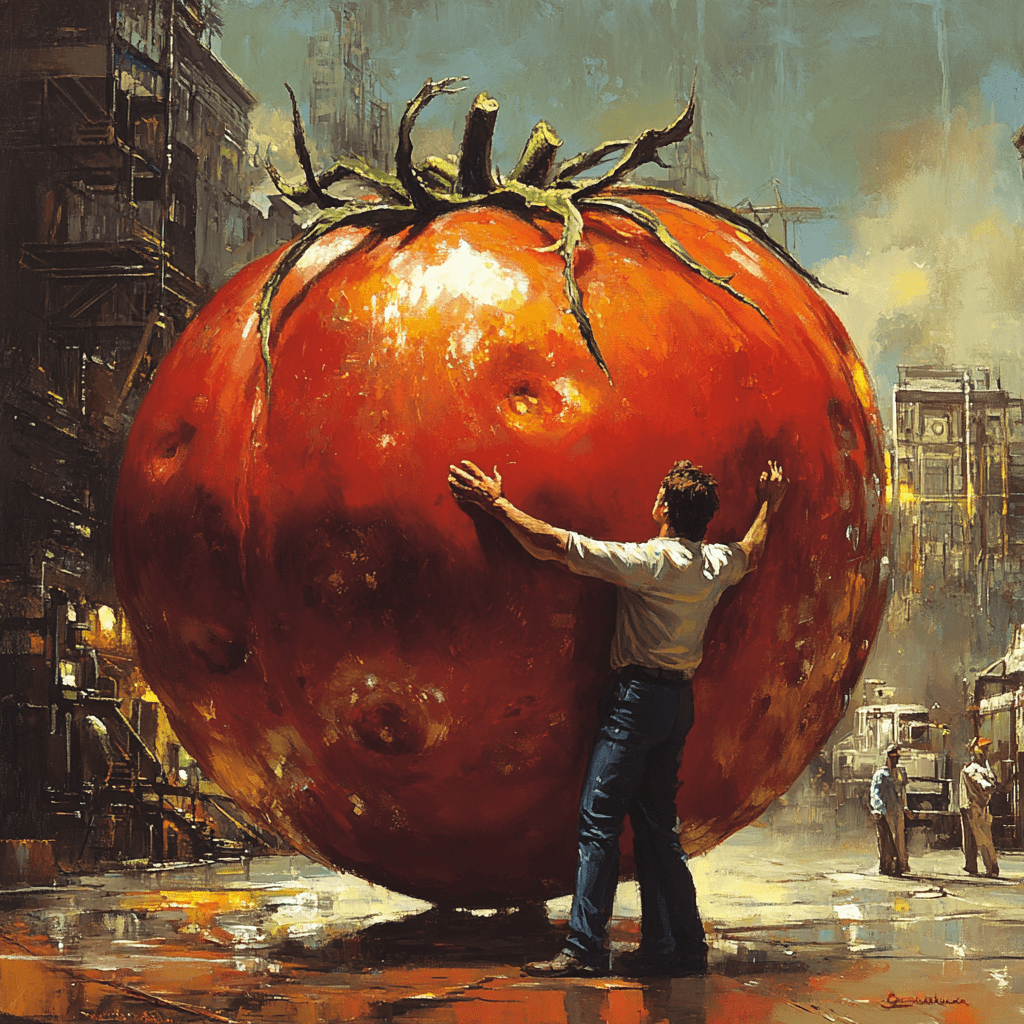
Relearning to Write, Now With Tomatoes Episode 2 – by Charlie Martin
In our last exciting episode, I talked about my favorite way to actually get words written. Freewriting, speedwriting, nattering, whatever you call it, it’s the process of disconnecting your words from the gentle ministrations of that voice in your head that says you just aren’t good enough.
“Gentle ministrations” is, of course, blunt sarcasm, and why I call that voice “the Bastard.”
The next step, if you are doing freewriting because you want to be A Writer, is to learn to use it and harness that internal dialog to the Forces of Good.
Conveniently, the process is really much the same.
Get any natter out of your head first — this isn’t instead of morning pages as much as morning pages are a warmup, but if you have some idea you want to write about — start to write about it.
Same way, same intention to just write whatever comes to mind, but with some idea in your head what you want to write about.
That’s how I started the shitty first draft of this. Actually, this and the freewriting piece that preceded, were originally one piece. At this point it was already 1400 words, and I try to make things for Sarah about 1000.
A trick. I kept just freewriting. You can fix it in post. When I went back to read it again, it was two pieces. Which is cool.
I mean seriously. It’s cool. It’s the opposite of the shit-a-brick feeling.
At this point, you need to make some choices. If you keep finding yourself burning out after 15 minutes, or 500 words, that’s okay. No one is looking over your shoulder but you and the Inner Critic (that bastard.)
Let’s assume that’s not what’s happening.
Once you have gotten somewhat comfortable with freewriting, there’s another technique that I find really helpful. It’s called the Pomodoro technique; those of you with an acquaintance to Italian will recognize that just means “tomato.”
The Pomodoro method is also pretty simple. When you start to work, get a kitchen timer. The guy who invented or discovered this used a cute little tomato-shaped timer, the tomato for which the method is named.
Set the timer for 25 minutes. Work for the whole 25 minutes, without stopping. (See how freewriting fits into this?) After 25 minutes, put it down for five minutes — set the timer! — get up and stretch, drink a glass of water or a cup of coffee, have a snack. But when the five minutes are up, set the timer for another 25 and go back to work.
Or don’t. Are you done with something? It’s okay. I find unless I’ve really into something, I get around 500 words in one tomato. But a lot of things can be done in 500 words. If it’s a short email, maybe you have a 200 word draft and then spend the rest of the 25 minutes polishing.
(Honestly, it’s often better to call the session early, walk away and come back to edit later. That’s what I did with this.)
Sometimes — fairly often if I’m really going — I don’t want to stop after 25 minutes. That’s okay too. Set the timer for another 25 minutes. I call that a supertomato. I do recommend that after doing 50 minutes of concentrated work, you do get up and walk around a little, stretch, take a break. Personally, I lost my ass in the 2008 crash. I can’t sit on it for more than an hour and walk afterwards.
So what’s the too-long-didn’t-read version of this:
- freewriting: write for a predetermined length of time, writing down anything that comes into your head. Just don’t stop until time is up.
- directed freewriting: just like undirected freewriting, except you start with some idea or direction for what you want to write. But be careful — you’re still freewriting. Other things may very well come to mind and that okay. You can, as the TV people say, take care of it in post.
- Pomodoro “tomato” writing: still the same old freewriting practice, except you set a 25 minute timer and write throughout that 25 minutes. This is mainly just a method of getting more words, remembering that you still can take care of any nattering or, ahem, infelicities in post.
If you take this up, the odds are really good that after a little practice, you’ll be writing lots more than you ever thought you would. And some of it is bound to be good.
References and afterwords.
The first draft of this was almost 1900 words, which I thought might be too long. When I re-read it, I thought “wow, this is two pieces.” Sarah agreed. But I didn’t even think about it until after I’d run out of words. In fact I didn’t look at it until I had a break and slept on it. In the meantime, here are some books that I recommend.
- Becoming a Writer, Dorothea Brande. On Kindle it’s 99¢. Best buck you’ll ever spend.
- The Artists Way, Julia Cameron. This is the 30th Anniversary edition, and I started when the first edition came out. Oh. My. God. $15 on Kindle.
- Accidental Genius, Mark Levy. $9.95 or Kindle Unlimited.
- Writing Without Teachers, Peter Elbow. $6 on Kindle.
All of these deal with this “freewriting” practice; all of them have lots of other good ideas and advice.
Next up: turning pro.





2 responses to “Relearning to Write, Now With Tomatoes Episode 2 – by Charlie Martin”
I can vouch for the pomodoro method – I don’t use it consistently, but I find it helpful when I’m feeling crushed by housework, and sometimes when I’m writing.
Charlie, I’m kind of an on-again, off-again shill for dictation, so I will just say that if you have a standard American-ish accent and are comfortable with an ai doing initial dictation cleanup, it becomes easier to write standing up or lying down. I found an article with commands for making Claude.ai do this; it looks like the article is no longer there but if there is interest, I can link to the blogpost I did with a transcription of the commands.
I’d certainly be interested. I’ve discovered that I normally don’t think much faster than I type, so dictation gives me less leverage. But it’s always worth a try.