I’m at this point in the novel-in-progress now. Finally managed to get all the players on the same part of the gameboard map, so to speak, and am driving the action towards a pinnacle of…
But you don’t want just one. Instead, you’ll want to do smaller peaks, leading your readers upwards, then letting them fall into a valley of not-quite-success, before you finally hit the big one, blow the roof off your world, and then you can slide into the far side of happy-ever-after or at least for now, in a golden glow of achievement. This isn’t the same as the try-fail sequence you may have used in the overall plot to set up the final climactic series. This is a building, one step leads to another, sort of thing.
For one thing, it sets the final ‘win’ up better than just proceeding there directly. If you have established the foundation of that success, it will be more believable to the reader. The valleys are also necessary. They give the reader a little break from the tension of a climactic scene, but they also show that the main character(s) aren’t just handed their goal on a silver platter by the author. You want them to earn it. It has to be a little – ok, a lot! – bit of work to get there.
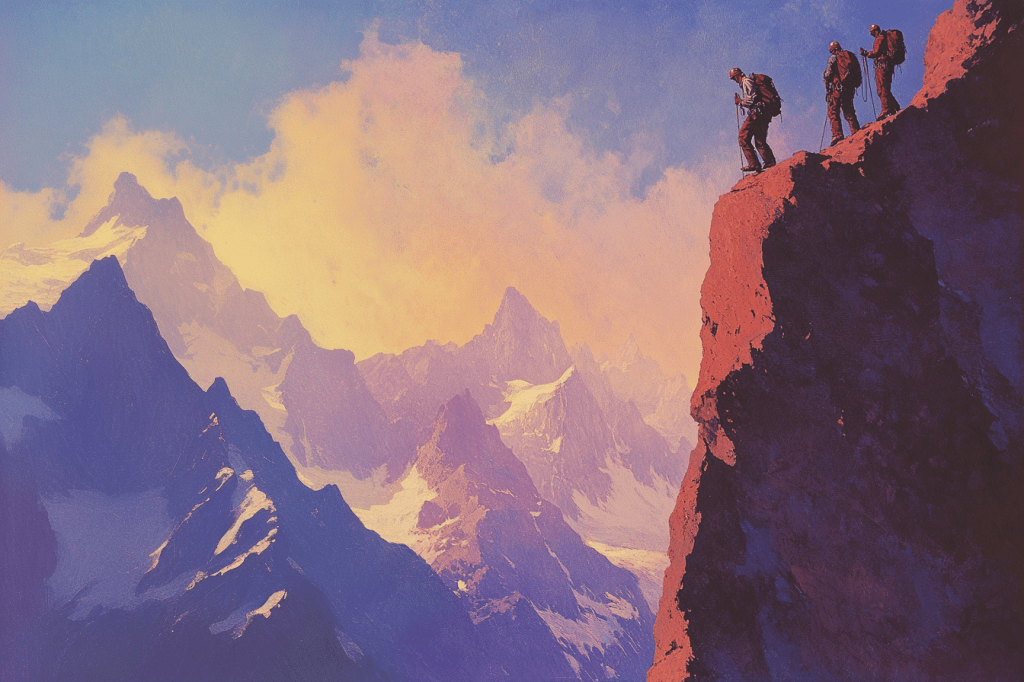
For another, it will wind the reader up more than a linear progression. They are anticipating the finale, and then you take them somewhere slightly unexpected. Don’t take them wildly out of expectations, that’s more likely to result in a walled book, or a disgusted huff and tap back to library on an e-reader. When mountain climbers are ascending a truly difficult peak, they do it in stages, and every stage is more dangerous than the one before. Give your readers the whole journey, not just the summit, and the book will be the better for it.

Which is not to say that you need to accurately depict all of the boring bits. Some, yes, to convey that waiting and boredom punctuated by moments of sheer terror is the manner of life and combat both. Not so many that your readers’ eyes glaze over and they fall asleep. Eliding over most of this can be done fairly easily, and should be, even in a full novel or series. You want to portray the parts that are relevant to the plot, the character’s development, or setting up the next climax.
Another thing to check is that your progression is in order. You don’t really want to have the big peak… and then more, smaller ones that come after it in the book. If you do, you want to see if perhaps what you have is a series, with a break point between the big one, then the successive ones being in another book, having given your reader some recovery time in between (which needn’t be much! Write both books, release fast, get more readers and more money).
You absolutely should give your readers, and your characters, what Dan Hoyt told me is the ‘cigarette moment’ after the last climax. Even if you do intend to set up a series, and do awful things to the main characters to motivate them into that next book, don’t do it here. Give them a moment to enjoy the win, even if it is bittersweet. A purely bitter anticlimax will put a reader off, and they may not follow you into the next book if you leave them with a bad taste in their mouth. Allay the pain with sweetness, give a little hope to lighten the shadows, a moment of joy and they will follow you anywhere. It doesn’t need to be a ‘happy ending’ but it should promise that such a thing is possible, given enough time and perseverance.
Build them up, blow their minds, and leave them happy. Really, this is the way to write a book, and so much more. Some things in life are universal.




 Mad Genius Club
4 responses to “Building to a Climax”
I read a short story once where the “hero” did everything right on the first try, and succeeded in his quest. Then a voice said, “Great work at novice setting. Five minute break, and we reset for level two.” it was cute, and funny, and worked.
Now, if only I could remember where I read the darn story!
Heh! Yes, that is funny. Sounds like a litRPG.
I remember the first book where I was outlining along and realized even then that things were going too swimmingly for the heroine. I had to put in some bad twists.
I tend to think more about “where do I stop telling this story?” I like to leave the reader (and myself) with the feeling that the characters will go on after the story ends. So I don’t plot in terms of climaxes, but more focusing on the point where this particular problem or issue has been resolved, at least enough that the reader can fill in the rest. I suppose, as a short story writer, I take one of those peaks that you mention and make it the whole of the story, rather than a succession of them.