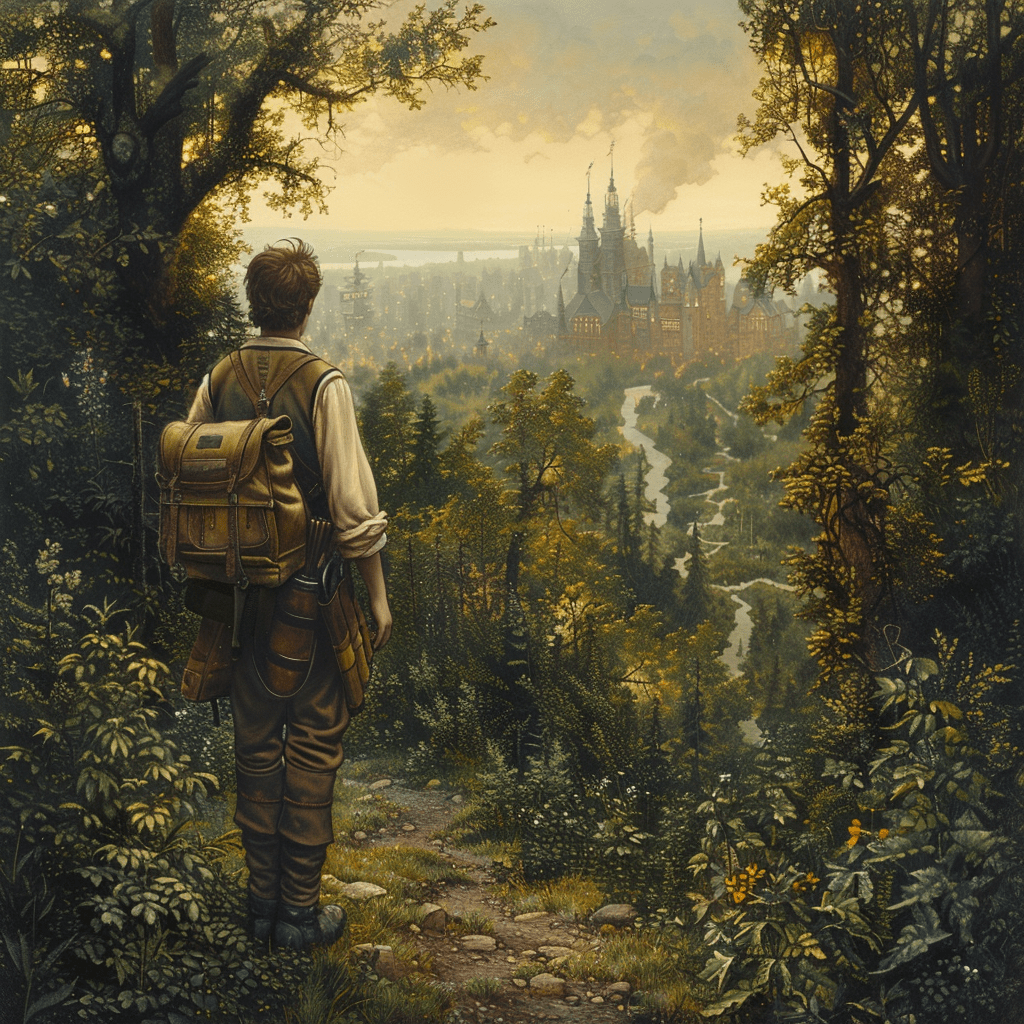
There was a time when it seemed like one inescapable cliché of Heroic Adventure stories was the way they embraced a particular sort of “Hero’s Journey” path (looking at you, Conan the Barbarian, Tarzan, Mowgli). The plot embraced the “young man/orphan discovers/grows into his powers, finds companions (optional) and achieves revenge/marriage/rulership (multichoice list), and broods on his throne wondering “what next?”, having achieved his goal. You know, your basic successful life trajectory from rags to riches with a heavy dollop of (fantasy or other) adventure along the way, and then you close the book.
Nothing wrong with that, but I have different ambitions.
In modern terms, once the fantasy hero has achieved his current-narrative goals, then what? If he is now emperor, should he try for godhood instead? Do we want to hear how well he governs, or are we done with him? Do we want to know more about Harry Potter, after he marries and his children grow up, and the Big Bad is defeated?
My prior series were planned as 4-books-and-done (extendable if needed), and so I had the ability to plan for variety in individual book-goals as I wrote them. But now, I’m doing an indefinite length series. Each book has to stand alone as a plot, but the overall series has to have room for growth, both for the characters and for their world.
If I’m going to write a continuing (fantasy) adventure story set in a particular world, there are only so many approaches I can take that satisfy me for both longevity and continuity.
I can multiply the characters so that the original hero gradually slides offstage in favor of his family, his friends, the people he met, etc. The problem with that is the reader (and I) really wants to have more of the one who got his attention in the first place, and the rest are unsatisfactory substitutes. I always feel a bit gypped in the Romance genre when we’re expected to switch our attention from the heroine of book 1 who now makes only occasional appearances in sequels, and become equally engaged with her rather different sister, etc., in a show of versatility. But in Romance the goal is achieved by the end of the book, and the extensions have to go to other characters, with motley success.
The various Adventure genres have a bit more leeway. Maybe in that MilSciFi 1st book the hero manages to survive boot camp and become a lieutenant. OK, we have a recognizable career path to pursue for multiple books, if we can vary it and keep the reader’s interest. But it’s limited if it’s just the Rinse-and-Repeat of heroic fantasy where the hero goes from Swordsman to Petty Noble to God-Emperor over and over — the goals aren’t different enough. Those end up being basic adventure biographies. (Old soldier/ruler reminisces about how he achieved his eminent position). Now, specialists in the details can vary how each goal is achieved, but it mostly leaves me cold.
What always pleases me when I read long form is a variety in individual book plot goals that correspond to some of the accidents of life — not just a multi-entry career path, but one with twists and turns that aren’t predictable, that mimic the changing goals and satisfactions of a real life, as well as the changes in the surrounding society and polity and technology.
When I write a series, I try to leave plenty of room for growth for my characters and changes in their conditions and desires. It’s not just the usual life changes (courtship, marriage, family, work) but also the world around them, as if I’ve imprinted on the Industrial Revolution and its predecessors/successors — worlds don’t seem right to me if they are unchanging.
Lately, I’ve taken a lot of reading interest in Andrew Wareham, many of whose long series aren’t just military or related, but very much alive to the changes in their historical societies and industries. Their heroes change their life trajectories in response to their changing environment. The books are mostly from a single POV, while I’m fond of a team of secondary POVs for different perspectives on events, but I greatly enjoy their engagement with the realities of their time and place and society, and what the “thinking man” does to better himself, including working on his own flaws in the process (or not).
If you work in long forms, what do you do, to leave room for growth for your continuing characters?


 Mad Genius Club
13 responses to “Leaving room to grow”
I’m starting a new series which I would like to see as long form. Or, it may be a single stand-alone, depending. I am, however, consciously thinking about leaving room to grow. The MC is 18 and in high school in this book. So there’s room on account of his youth. We can all learn lots of things when we’re young.
I did just finish writing a 6-book series. My two main characters achieved their goals and growth. Whenever I think of what comes next, the perspective shifts to other characters, and–like you said–I’m not quite as interested in them. I also can’t stand the thought of my main MC sliding off stage a bit. That’s how I knew I was done, despite temptations to go on, because he would slide off.
Bernard Cornwell’s lengthy Sharpe series is a great example of a successful long form. So many books (over 20?). So many marvelous, distinct stories.
My 1st book in the new series has the hero at 15, so I’m treating that as a prequel (how he got into this situation and the seeds of what he is). At Book 2, he’s 20, and it’s going to go slowly (2-3 books per character year. He’s a busy guy with a lot of ideas…).
I think that’s the trick, to have main story problems that can be solved in a short period of time. Long enough for there to be character growth and so forth. But unlike a romance, the story doesn’t end at happily ever after. Just the book. The next has the MC dealing with a problem helped/hinder/protecting his new wife as they build a new life together . . . and onward.
There are lots of problems that happen after the wedding vows (rolls eyes, oh lord are there problems!) And becoming king, I suppose.
But that is a fairly limiting position. You can scheme, plot , plan, and strategize, but you aren’t out there having hands-on adventures. That’s for your spies, agents, diplomats, and generals. So take your time getting there.
Pam Uphoff posted recently about her Wine of the Gods series that has now hit 90 books and several generations of heros (plus sidekicks and heros emerging from among the enemy)
On the other hand, I recently was reading John Jakes Kent Family Chronicles and am bouncing hard on book 5 because the faimily heir is such a despicable person that I’m having trouble continuing (if I do fully abandon the series, that will make it one of a very few series that I have started and not finished, even if I dislike them, and this one of an even smaller number of books that I abandon partway through)
And I enjoy Pam Uphoff’s books, but I read for a particular continuing character, not a continuing world. The continuing world saves a lot of gotta-ground-the-reader-more between entries in the writing, but it’s the character I want as a reader.
It’s like short stories. I read them for the little burst of flavor, admiring them like a haiku. But for overall pleasure reading, I want me a novel or (better) a long series with some long-term continuing characters. So that’s what I write.
Happily, there are all sorts of readers out there. 🙂
I had one set of books (the historicals) which could be seen as a series, but I planned from the start that the various key characters would complete their various story arcs, and then other characters – usually younger – would slip in and have their own story. I never planned for one single character to carry through multiple books.
As for the contemporary comedy series, I’m capping it at 12 volumes, because the tentpole character (who sees all the rest of the various stories through his experiences in Luna City) has completed his arc of personal and professional growth, and I want to conclude gracefully, on a positive note.
I tend to write family stories, so the character matures, has a family, has to deal with the complications of families (how do you find a babysitter when there’s a magic fight breaking out?), and so on. That also allows me to explore how the characters deal with physical maturity and the complications that brings.
I did cheat, thought. In one case I split off a separate series with the next generation of characters, allowing the main protagonists to ease into the background, available for advice and counsel, but no longer the center of action. Mostly.
I use a shared world; when one character’s story is done, they *may* appear as a side note (I can’t believe how successful the daimyo of Shelleen has been with his Red Mercury Mine!) but otherwise, I don’t worry about it.
If someone’s story is done, they are done and there are loads of stories about secondary characters who become main characters or entirely new parts of the world to explore.
Which might explain (besides our complete lack of marketing chops) my microscopic sales.
“what do you do to leave room for growth for your continuing characters?”
Number 1, short time span. My series so far stretches from October to maybe September the next year. Every month a new world-ending disaster looms.
Number 2, the characters are taking it very easy. They’re not striving to make the next mile marker on a path somebody else laid down for them, they’re polishing their armor and resting up for the next outrage that’s going to fall on them.
Number 3, they’re not “leveling up” the way anime characters do, they’re using their wits and trying to refrain from killing everything in sight. It was decided early on in the series that nuking cities from orbit was not a solution.
Number 4, George McIntyre is LAZY. He is a lazy son of a beeotch. He wants to hang out with his peeps, play boy-racer and admire his girlfriends in their robotic splendor. He does -not- want to rule the world, become God Emperor of Dune, drain the swamp or any other such Good Guy behavior. His idea of winning is the least-effort, minimum disruption path to victory. You don’t meet disaster head on and pound it into submission. You turn just a little and let it whip by an inch away, because there are five more coming right behind it.
Number 5, none of the characters give a crap about the usual Important Things in life like social standing and monetary success, because they’re surrounded by people who prove such aspirations to be meaningless and silly. Your girlfriend is ten thousand plus years old, how impressed is she going to be that you got a promotion at Big Corp?
Current WIP, George got kidnapped out of bed and dropped on the border between Valhalla and misty Niflheim. Where the sacred spring Hvergelmir lies sparkling in the sun, from which the Norns water the roots of Yggdrasil. Does he flex his nanotech muscles, grow a SciFi spider army and take over? Where’s the fun in that? He grows a spider army and -doesn’t- take over. ~:D
I’ll list the answers that occurred to me as I read your post. The two most successful long-playing series I can think of are the Land of Oz series and Discworld, both of which got around this problem with extensive worldbuilding and scads of characters. New(er) characters are given detailed introductions and lots of character development as the series goes on.
C.S. Lewis managed to shoehorn “The Horse and His Boy” into the Narnia series very successfully, again due to lots of worldbuilding giving information about the two other countries bordering Narnia, with the familiar characters being important to the plot but playing second fiddle to the main story.
Georgette Heyer managed to pull off the most successful romance series I can think of. “These Old Shades” and “Devil’s Cub” are excellent; the main character of the second book is the son of characters in the first, and there is a third (“An Infamous Army”) which I have not yet read. As always with Heyer, it’s all about character development.
I’ve got a short-story cycle that will have a continuing character, but for long works, I seem only capable of shared universe. Characters resolve their problems and end their story.
For a truly long series, the idea set up is if the central character does not change, and there are very few characters if any that come along for the whole series and they also do not change. He (or they) travel, or at a location where characters are continually shifting around them. These characters get to be prominent, and change, and leave.
Also the central character is immortal so you don’t have to worry about time passing.
I realize this is Doctor Who. It is indeed the perfect set-up.
More of an episodic, plot-driven as opposed to character-driven series. Kind of like older detective / Western TV shows – hero encounters somebody with a problem, and helps them resolve problem, but hero has not really changed internally.
There is still room for the character to gradually change over the course of the series, but nothing too drastic in any given episode.
Interminable series need to be episodic. You can’t have a story structure that arcs over dozens of books, the reader would be unable to see it as a whole.