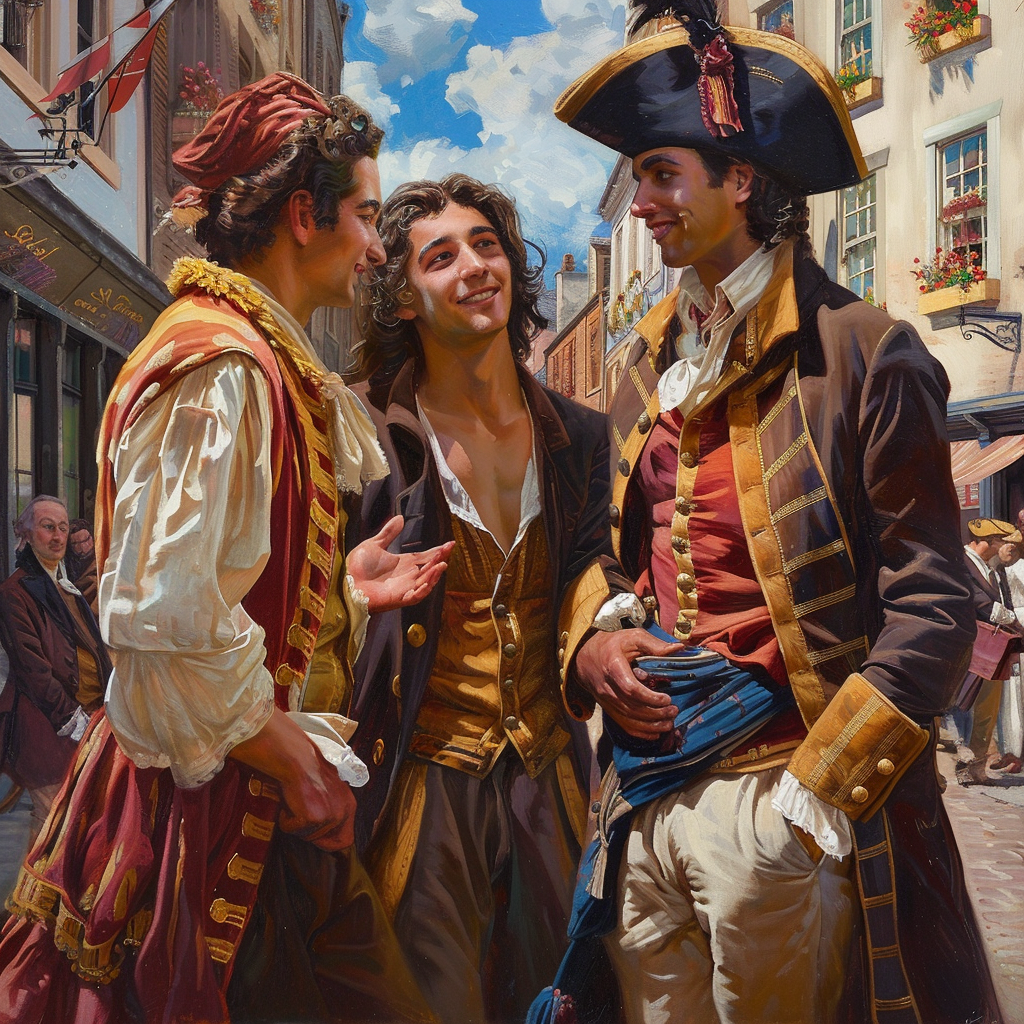
All of us fiction writers deal in verisimilitude — in the representation of a world that seems to the reader like it is (or might be) real, even if the “real” part is set in the far reaches of the universe or in fairyland. Consistency and plausibility are the chief underpinnings of your fictional reality, of course, but don’t forget the little details that make the telling of a story smoother, more like real life.
What sorts of things?
ROOTS. Things in the present are the results of events in the past. That applies to agricultural crops (foreign and domestic), animal breeding, manufacturing practices, architecture, war, politics, migrations, fashions, customs, and so forth. Hinting at causes and changes over time does a lot to provide depth to your world.
BLIND SPOTS. Is everything as rational/acceptable in your built world, as a modern, proper, outsider reader would wish? (Boo, hiss.) Or, instead, do you refer to slavery, arranged marriages, the sale of surplus children, filthy habitations, coercive religions, unpleasant elimination practices, permanent scars, etc. (Think of those historical Romances where everything is clean, clothing is cheap, and no one is fatally rude.)
TECHNOLOGY. Inventions have histories and background, too. Old tech gets replaced (think “bridges”), foreign tech gets imported, competitors steal tech, and patents complicate things and create a fruitful ground for disputes.
SOCIAL INTERACTIONS. This is one of my favorite areas to fill with detail. If you’ve got a group of characters (and all stories do), then you’ve also got a place for nicknames, elaborate endearments, abbreviations, slang, conventional insults, refined politesse, fine degrees of social scale, criminal cognomens. **
The amount of warmth and disdain and social history that you can fit into banter and explanations and all sorts of dialogue is essentially endless, and it provides depth to the relationships as well as the world they’re part of.
What sorts of tips and clues do you write in to provide verisimilitude to your worlds?
** Note: I understand that current middle/high school students are finding ChatGPT useful, not for the doing of homework (though doubtless many try it for that) but for the crafting of eloquent and pungent literary insults for the admiration of their friends and the consternation of their enemies.




 Mad Genius Club
9 responses to “Bits and Pieces for Verisimilitude.”
To be sure, “blind spots” means that they are not noticed by the characters. Sometimes.
Or shrugged off, as in “what can one do, eh? It’s the way of the world.”
It’s the characters who notice things that would be completely omitted from any normal account that bug me.
I like to work in conversations that mention contemporary-to-the-period events, happenings, controversies, scandals and the doings of then-famous personalities – the sort of conversations that we would be having in the present day. People do not really change all that much – only the specific topics and concerns do.
I feel like usually the characters and the situation tell me what details I need to focus on. Like, in Seeking the Quantum Tree, I knew the bad guys invading Avugha (the country where that book takes place), would have vaguely 1960s Soviet hardware, but I didn’t realize that would mean “tank turret looks kind of like a dome seen head-on” until I was sitting down to write the invasion scene, and looked up reference pictures online.
When writing Wolf’s Trail, I also had a long discussion with baby boomer relatives who had absorbed more info about the American frontier and Wild West than I had, about what powered the telegraph process before electricity became a household thing. (Answer: large, primitive batteries at each telegraph station). I needed it to know if the telegraph station would be operational at a town which, well, maybe I’d better let my hero explain:
When we reached Neustadt, the street lamps were all dark.
Haenler grunted. “Not good for much is that new-fangled electricity,” he said.
I started to write a note to the Stormcrow Inquisitor, and then stopped.
“Do you know whether the telegraph is tied into the power grid?” I asked Haenler.
The farmer looked thoughtful. “The town’s only been buying power for their street lights from the institute on the island the past five years or so, I think.”
I didn’t like the sound of that. There were many artifacts from ancient times, which could supply enough electricity for a town the size of Neustadt. And they were invariably dangerous to play with, especially if you stored the artifact in a houseful of recovering werewolves.
Haenler went on. “The Neustadt telegraph office has been here much longer than that, but I couldn’t say exactly how long.”
That meant the telegraph office probably had its own battery.
“Good,” I said. I finished scribbling a note to my Uncle Jerome, the Stormcrow Inquisitor.
He was a disagreeable man at the best of times, and I didn’t like involving him, but it was unavoidable. The alarm bell at the Institute meant that the situation was beyond the control of the Stormcrows working there. And that meant they would need to explain to the Inquisitor what they had done wrong.
[…] Read more…. […]
I had no idea that clay cooking pots have to be “cured” in order to use them to cook. (Usually this means coating the inside with oil and then cooking it in an oven/fire, letting that cool off, and then boiling some water in it for a while.) Otherwise you eat clay and get water into the pores, and things explode, which is not delicious.
I also had no idea that you can use clay cooking pots in modern ovens and on modern stoves. I mean, I remember the fad for cooking stuff in terra cotta flower pots, but in some countries they do that every day. Some clay pots are even microwaveable.
If you have an electric range, you’re supposed to get a “heat diffuser” to put on the stovetop under the pot.
And if you have an induction stove, you can get a little induction thingie that transfers heat to the clay pot.
I also found out that Mexican cooking has stone hot pots just like a lot of other countries, except they use a basalt mortar called a molcajete. (I am sure this is no news to most of you, but I just saw my first one two days ago!)
All this sounds like it would be a cool thing to do on a spaceship, with some kind of futuristic cooking system. Or in a fantasy story, because honestly most fantasy cookery is really light on details or non-modern vegetables.
I did do pottery in a couple of art classes at school, but the art teachers apparently didn’t want to get into all that.
Pretty much everybody wanted to make coffee cups and things. But we were just told that we couldn’t make anything that could hold water or cook things, and that we had to leave the bottom unglazed or the pot would explode.
(I expect that the kiln temperature of an unexpensive school kiln was the limiting factor, or that somebody had tried to make drug paraphernalia in the past.)
So I was under the impression that curing a pot was just letting it sit out for a few days. Apparently this is not so, and there are all kinds of processes that you can use for curing pots for cooking.
Oh, and apparently there are ways to cure pots that allegedly remove a lot of the lead from glazes containing lead, as well as improving the durability of the pot.