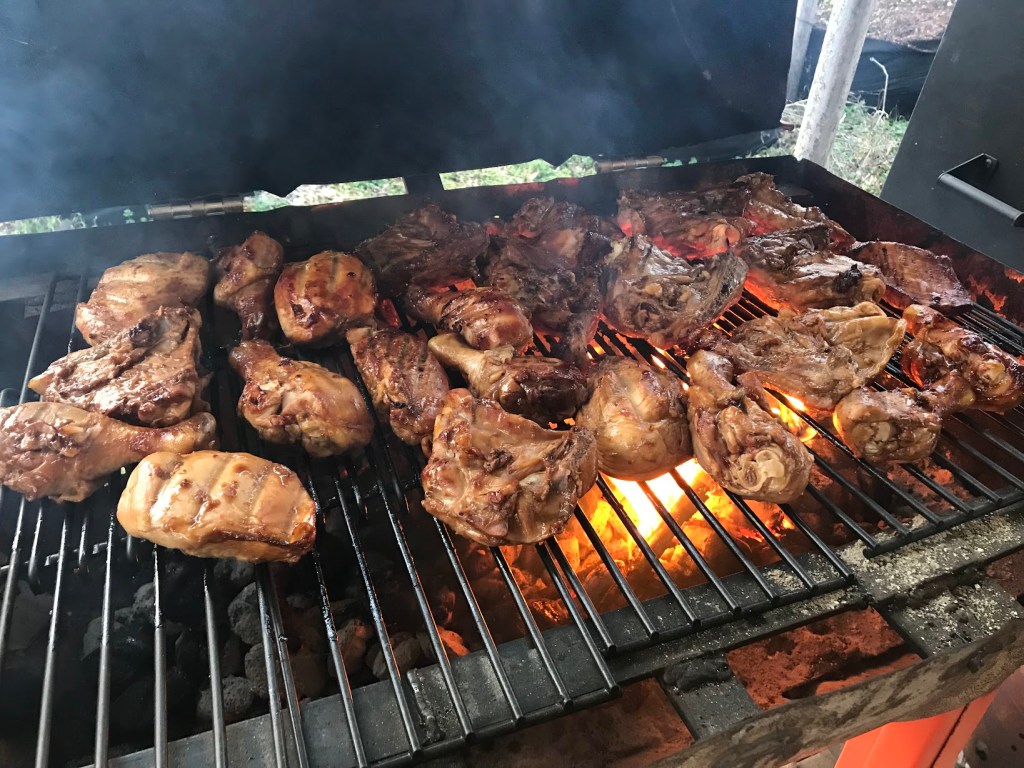
I should probably write something on selling books, but just at this moment I’m vague, foggy, and trying to consume enough coffee to simulate awakeness. I could, I suppose, make the analogy that in order to sell a book, you first have to attract the reader’s attention the way food does an eater. We think about food, we get hungry… ok, books don’t really make us hunger, do they? Why not? We are bored, we are tired, we are lonely, we want to learn… the right books can fill each of those holes in our spirits, and sometimes more than one at a time.
I went to a restaurant with friends yesterday. We’d been talking about food, and getting hungrier, before we arrived. Then, when we finally got out of the car, we could smell fragrant aromas of cooked meats and such, savory and appetizing. Who of us hasn’t walked into a bookstore and taken a deep breath? No doubt, ebooks lose on this one aspect, as much as I love my ability to own and carry thousands of books around in my pocket. The same appetite stimulant can come in the form of talking about books, reading a review, and thinking about reading, though.
When you get closer, you see the food, and then you begin to understand why presentation matters on a plate. If the food looks a bit of a dog’s breakfast, you might lose your appetite and turn away, revolted at the idea of putting that mess into your mouth. The cover of a book serves here, as the beautiful portrayal of something good inside. Even if you are, say, serving a chicken curry which is largely colored with chickpeas and turmeric, there are ways to serve it that look beautiful – a scattering of fried onion, vivid green of chopped herb sprinkled on there, perhaps a crumble of feta. The colors play well together, as do the flavors, and your mouth waters. You begin to know what to expect when you put it in your mouth. A book cover signals all the same things to a reader.
The other thing you want to do, with your book, is make it varied and balanced. A meal that shoots from one flavor to another, willy-nilly, or worse, has no flavor at all, will cause the picky eater to give up after pushing it around on their plate and stare sadly at it, still unfilled and longing for what they weren’t given. A book that is one-note is as bad as uncooked unseasoned gravy, a quivering gelatinous blob on the plate that would turn anyone’s stomach. You want to make sure you have balance! The richness of character emotions played out on the page, through the use of dialogue and interactions. The piquant stab of conflict, tart and puckery like citrus in the salad. The sweet at the end, soothing and leaving the reader smiling as they close the book’s cover to sigh over leaving the world you wove for them.
Your book could be anything from a bowl full of uncooked ingredients, interesting in potential, lacking in execution. Or it could be a fully-developed multi-course meal, with plot structure conducting the journey from one part of the story to another in harmonic flavor symphony. Yes, I do think of cooking as akin to composition – which is how I conduct a story. I am no musician and never have been, although I appreciate how it is done. In any given dish you want salt to bring out the flavors and add to the savory. Fat to convey the flavor and add richness. Sweet and sour, in their places, can be unexpected notes but very useful as beats of story that come in moments to convey emotional growth. Heat, in many cuisines, is there to warm, to linger, to be a lasting memory of the bite long after it’s swallowed. When done properly, not so much that the tastebuds are seared and left numb, it is a wonderful way to enhance the most bland of underlying food bulk.
For storytelling? Well, you want a little of this, a little of that, the ghost of your writing exemplars will whisper in your ear when it’s enough… I realize that many writers are looking for recipes they can follow slavishly to a completed dish, er, book. However, they will become truly good writers when they realize that they can safely substitute, just as you can in a recipe, and in doing so subtly affect flavors, textures, and wind up with something new and fresh to present to their readers. When they have sampled many, many stories – not just fiction! Not just books! – then they can begin to amalgamate all of those flavors into something that is uniquely theirs.
And now, I am going to wander off to the farmer’s market in search of ripe tomatoes to make up my own tabbouleh, and come home to make up hummus for supper tonight, because I’m in the mood for food.


 Mad Genius Club
6 responses to “Feeding Up”
Nothing to add (except maybe that it is possible to mentally crave something to read in a way that kind of feels like hunger). But this is a great way of describing it.
I know I get reading cravings. Sometimes I want something new and different, sometimes I want to wrap myself up in a cozy read.
Can you hummus a tune? (Someone had to do this)
PS, your metaphors tend to be consistently visual, which shouldn’t surprise me given that you have such strong visual art capability.
I can! And I’m making hummus, which is likely to go over much better than my attempts at carrying a tune.
*reads Cedar’s post*
*Googles “Indian Food Delivery Near Me”*
Um, I’ll be back to say something sensible after dinner.
Jelly! No Indian food delivery near me. I’ll have to settle for making a few things I like 😀