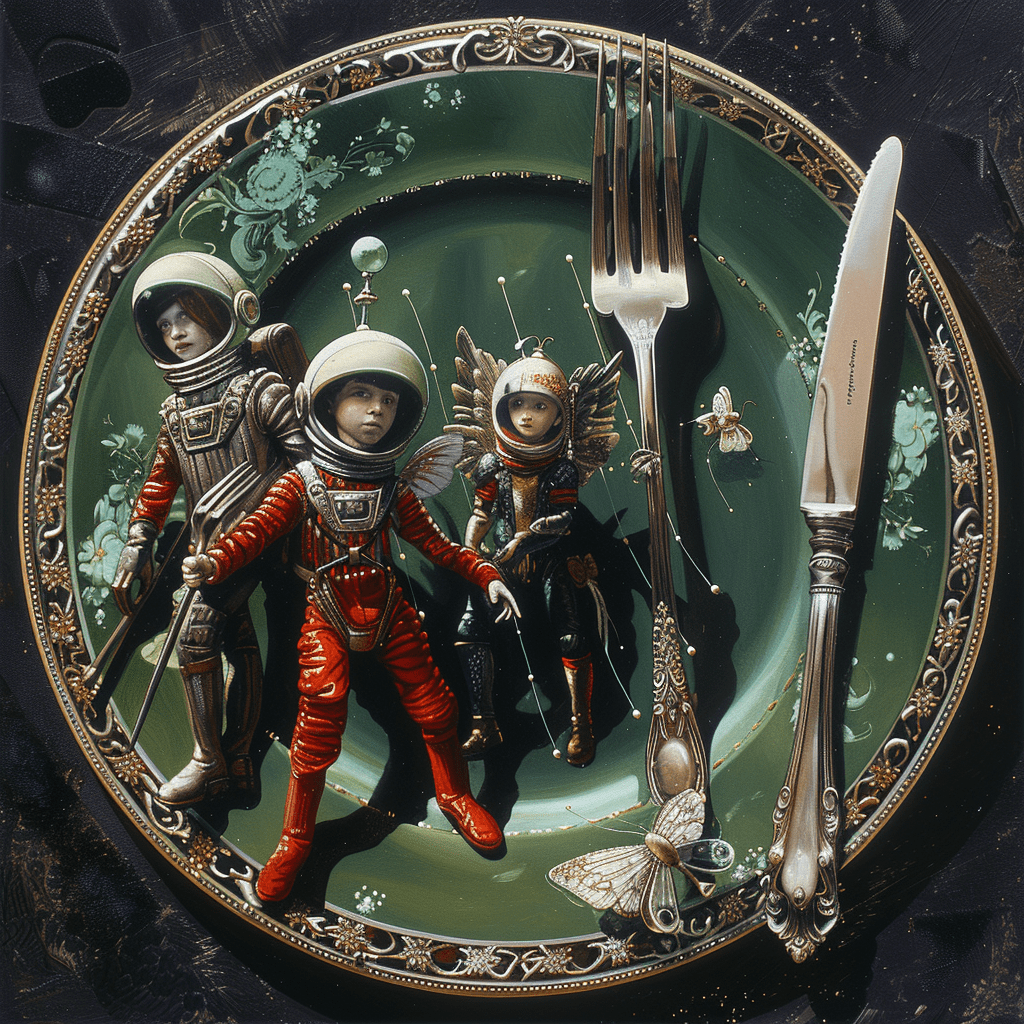
When it comes to science fiction and fantasy, my preference is science fiction. All varieties of science fiction, which, yes, includes space opera and time travel.
I mean if we’re going to be picky about it — fighting words — my least favorite is hard science fiction, because few hard science fiction authors have mastered the elegant art of Heinleining, i.e. introducing the science or the tech by telling us the essential about it then letting it go.
This is just the preponderance of the field, and why I’m hesitant to pick it up. It doesn’t mean we don’t have a bunch of people doing it right. And at any rate, I still pick hard sf over say classic fantasy.
But Sarah, you’ll say, if you read space opera and in fact prefer it, why do you not just read fantasy? I mean, FTL, anti-grav, mind-powers? Just give them elf ears and be done with it, right?
See, now? Them words right there? Those are fighting words.
It’s not the same thing because the … mouth-feel is entirely different, as are the mind sets it evokes.
To a certain type of mind, just having magic in the world, with no explanation of how it works, how we found it, why it went away, etc. etc. is worse than having a zit right inside your ear canal, where you can’t reach it. It’s going to drive you nuts. And being driven nuts makes it very hard to read for fun. (It’s fine for writing, not so much for reading…)
In science fiction, when scripting “impossible things”, i.e. things that violate science as we know it (note as we know it) you can
a) give it a good long time. Because, look, even for things we’re absolutely sure we understand in its entirety, there isn’t a guarantee some genius insight in the future won’t upend it all and allow us to do things we now KNOW are impossible.
I won’t tell you that a good, oh, 200 years ago or so, people thought heavier than air couldn’t fly. One or two of you will weaponize autism and show me that the best scientists knew that heavier than air could fly, etc.
And that’s nice. That’s right nice. But still no. Because you know d*mn well that a good number of scientists would swear themselves blue that heavier than air couldn’t fly. And if you go back 500 years, say, the idea of putting people in a tube and firing them through the sky is just crazy cakes. Their concept of a man flying would be closer to a glider.
Yes, of course, Leonardo daVinci and his helicopter. But about a hundred other inventions, including the internal combustion engine needed to come online before that would work. And some of it required materials that people in the quatrocento couldn’t find.
So you give it a good long time, and time for material science and exploration to discover things that make it possible. Probably.
b) You push a loophole. What?
Look, what do you think humans have done all along. Without finding loopholes in what all the right and good people know and believe, we’d still be following herds and chasing them off cliffs as our primary means of getting food for the band.
What? Well… Look, there have been leaps. Agriculture is a major leap, as is what we’ve done with plants. I mean, right, so, your lawn and your broccoli might not be the closest relatives, but they’re kissing cousins, and broccoli used to look a darn sight more like lawn than not.
But… Humans poked at can’t be done. First slowly, then very fast, and here we are.
c) It’s science-fiction.
When I came into the field I got told that if I wrote science fiction, I had to know and respect everything the science “knew” in all fields.
Note knew is in quotes, yes, because this included the soft sciences. It included the evolution of man (yes, man evolved, but what Heinlein said about more holes than bastards in an European royal line? That might have multiplied. I know. I read about it for fun. And dear Lord, you have to assume some d*mn stupid things in the sense of “no species ever” did this to believe the right and proper science there. And the holes. Oh, you can have lots of fun with the holes. Only we weren’t allowed to. There were no holes. And everyone knew the truth. Revealed “science” sure is a fun idea. Is it me, or was it only 30 years ago that no homo sap ever crossed with Neanderthal? I remember having some spicy arguments with for real scientists about this. Yeah. Cool story, bro.)
No, yeah, I hear you, physics doesn’t change. But how we understand it, sure does. And these days when I try to look up gravity (beyond obvious basic equations) like, you know “what it gravity” I get a lot of articles that sound like the writer is dancing off the stage and waving two fans desperately. Which is… um… interesting. And when I have some time, I’m going to chase that rabbit hole. I might need to study more math. It might be worth it, too.
Anyway, this attitude always baffled it, at its core. If you’re going to respect all the science as known today in every yota and jot, you really have a small canvas. Of course you can write really good stories there. But what if you want to write stories of how we found out the Neanderthal genes are key to giving humans inventiveness, say? Yeah, you couldn’t.
And any invention had to fit with what we know today. Which was a fascinating concept right there. Look, people, if I could invent cold fusion, I’d be doing it right now, not writing fiction about it. And if a friend (I know two of you now) had invented it, telling me how to write it in a novel wouldn’t be their way of announcing it to the world.
Now, yeah, of course you should know as much about what you’re writing about as possible. If you’re writing about Mars and making it a well-watered and fertile planet (or at least making it as having been that a few thousand years ago) you’d best be writing in the 1930s. Or you best be writing in a future where Mars has been terraformed.
Beyond the really obvious, though, you meet a point of low returns. Take what they used to tell us about researching a town to set a story in: you can fudge it with minimal research unless it’s NYC. Because the editors know NYC.
Again, you shouldn’t need to be a scientist and know every little detail to write sf. There probably is a reason that in a ghetto, poorly selling field (no seriously, though I sell best in it for…. reasons of being weird, I think) hard sf is the poorest selling. And pushing hard sf as THE ONLY sf will merely get people used to the idea that sf is boring, and they’ll read only fantasy. (We have an entire generation — my kids’ — that does that by default.
d) you tell it from the pov of a lay person.
WHY? Wouldn’t the neato cool science–
First, if you could do the science to that level, you’d be doing it, not writing stories about it. Second, no. People are interested in stories of people in a situation, not in how the bolt was driven home inside the panel on the ship. (Unless it needs to be driven home while people are crying and screaming they’re going to die, because the engine is coming loose, of course.)
Second, because if you use a normal human being, completely disconnected from science, anything they say about how something works is unreliable narrator. And the reader knows that. But since the largest pool of readers is basically ignorant of science beyond “I push the button, light comes on” they’re perfectly comfortable in that head. Sure, throw in a little more fan dancing so the people who know a little more think about it and go “Well, maybe. Maybe there is a way to get around it.”
So…. If you have all that, and you have a space opera, why not have magic and call it spells or something?
Mostly because every human being over two years old knows that saying “Desiderum FTL” won’t give us interstellar travel. But if instead I tell you that we found a way, given enough energy, to open a gate through space…. well…. maybe. I mean, particularly if it’s 1000 years in the future or something.
This makes the mind set of reading fantasy “Oh, I wish this would be true” and also it renders people curiously vulnerable to what I’d call the “mythological way of thinking” including a strange belief in chosen ones and fate. I’ve seen this grow as fantasy became the only speculative medium that kids read in.
While the mind set of science fiction is “That sure looks impossible now. I wonder if there’s something we could do that would–” and that leads to an interest in science and a tendency to poke holes in “revealed” science and to notice when “science” has become ossified or is just plain making up things. (The shock when I came to the US and could access books written by anthropologists and archeologists and realized their arguments sounded more like professors of literature discussing the interpretation of a line than hard science of any kind. It was very salutary.)
Now, would such things lead one to fall prey to the upteenth discovery of Atlantis? Or a revelation of how ancient astronauts used astrology? Sure will. But most of us grow up out of it around 12 or so.
Look, I’m going to be blunt: Star Trek as silly as it was probably inspired a lot of people to go and study science. And is probably responsible for a lot of the things we have now, and a lot of discoveries made that aren’t silly at all.
Tolkien is great literature. The sense of wonder is about the same, and of course the research, and the feel is much more realistic than Star Trek. But if it inspired science and learning, it was probably mythology and linguistics. Which are distinguished fields of endeavor and yet very unlikely to take us to the stars.
This is a personal preference.
Sometimes the difference between science fiction and fantasy is such that you can’t fit a very thin piece of paper in between. But there is a difference.
The mouth feel is different. Mouth feel, if you make a recipe, is something that unless it is drastically wrong, only someone very sophisticated will notice.
I can make pretty decent soda bread that you can use for sandwiches, and the mouth feel is not repulsive. It is granted different from yeast, which is firmer/more elastic. But I used to have a friend who was a chef, and he could tell you the difference between two kinds of soda bread, and declare one much superior to the other. Meanwhile, the normal, average person, might not notice they’ve been served soda bread, not yeast bread.
So, the mouth feel of science fiction is different. It feels more real, even when it’s completely unrealistic. I think because the suspension of disbelief is different. In fantasy, you go “oh, this is all made up” pretty much from the get go. While in science fiction you go “Okay, most of this might be impossible, but maybe there is something there. And maybe some day we can have something that’s close to this, even by another road.”
My mind just likes the second one better.
Call it the protestant Catholic work ethic. Fantasy can be fun (and often is) but it feels like I’m just playing, and there’s nothing real there. (Which is nonsense. There is how people work of course. That’s always invaluable.) And so I don’t enjoy my enjoyment as much.
Um… maybe I’m nuts. Maybe there is no difference. And yet I still enjoy science fiction more, and will have much more fun with science fiction.
And still think it creates a mind set that is more likely to be good for the species and for free society.
So, let’s stop arguing what is and isn’t science fiction. Even planetary romances pulp launched a thousand careers in science.
Some of the nonsense is gone now that the gatekeepers are being put out of business. On the other hand there is a group of fans who insist they know what science fiction is, and no one else should step out of line.
Ignore them and drive on. Write what you want. Have fun with it, and let the reader have fun too.


 Mad Genius Club
48 responses to “Mouth Feel”
IMO any author who says “but it’s science fiction” to “explain” silly things in their own works, doesn’t deserve to be read.
And yes, the same holds true for an author that goes “but it’s fantasy”.
And no, I don’t expect an author to be able to “build a faster-than-light drive” or to be able to “work real magic”, but the author does have to encourage the reader’s suspension of disbelief.
Mind you, a good author can “invoke the rule of cool” for some elements of his/her story.
And yes, “anti-gravity brooms” are cool. 💖💖
Right. The rule of cool LIVES in me. As to whether I’m good, eh.
Yeah. Star Trek, original generation, is exactly why I studied physics and joined the USAF. Wanted to work at NASA.
Absolutely. Science fiction, to me, is a combination of “What if?” and “Any sufficiently advanced technology…”
Fantasy is just “What if?”
And even “hard” science fiction is very, very rarely hard engineering. Yes, it’s within the limits of what we (think) we know – but not within the limits of what we can do.
And the spaceships have to have enormous busbars….
Unless you use plasma conduits, of course.
Or your future master engineer decides to decentralize power generation. (Although that will kill your dramatic scenes of “will they manage to eject the fusactor before the whole ship goes kablooie.”)
I’m in the science-of-magic camp. I like my rules (hard science / hard magic) but don’t at all mind hand-wavium in creating those rules for the purposes of story telling/reading. “If this is the world I describe, then the following is possible…”
Consistency is far more important to me than reality (see tomorrow’s post). It’s how the characters react to the limitations rather than the limitations themselves that matter to me.
Meh. I’m stuck with science that’s literally magic, in the current thing. Sigh. Or magic that’s science. Search me.
I like hard SF when it’s done well. Andy Weir and our own Michael Rothman both do pretty well with it. But Space Opera tends to be, on a whole, more to my liking than hard SF. I want my stories to move along at a decent pace and have character development more than an infodump.
John Aloysius O’Keefe, pioneer scientist at NASA, with a career before that working on Vanguard, and satellites in space that led to GPS, and map-making in World War II, that helped pilots not run out of gas in the Pacific, claimed that reading _Thuvia, Maid of Mars_, was one of the inspirations for his career.
A useful thought on fiction is that the average person now or in the future really doesn’t understand technology, they just use it. They know they put gas in the car, but don’t understand the engine or how gasoline is distilled from oil.
In the future, it will be the same, they take their air-car or whatever to the station and the robots do something, and you go back when the gauge is low. You get in a ship, and somehow it takes you somewhere else, but as far as the character is concerned, it could be pulled by mules. Most know tech exists, but only pay attention when it fails.
I won’t tell you that a good, oh, 200 years ago or so, people thought heavier than air couldn’t fly. One or two of you will weaponize autism and show me that the best scientists knew that heavier than air could fly, etc.
With the warning that it’s been decades, I seem to remember the geeky type explained that it had to do with “well yeah the numbers work, except for over here where it’s got ‘how do you make the spiny bit go this fast’ you have ‘something magical happens’.”
So, the very short answer would be “heavier than air can’t fly,” the slightly longer would be “there is no way to get enough power to make heavier than air things fly,” and the scifi answer was “until we can get enough power small enough to overcome this issue, we can’t do this.”
Which is where we’re at on manned intrasystem space flight right now, arguably.
It’s worth noting that the newest really successful scifi franchise on tv was arguably Stargate, which didn’t completely do away with the “living in a tin can” model of space exploration but did make heavy use of a portal-based alternative. The jury’s still out on the success of the Villaneuve Dune cycle (1), but interestingly it portrays the no-ships as basically giant portals, which I don’t recall being a thing in the book?
I wonder what someone with enough data to plot urbanization trends in the English-speaking world over the last half-century alongside the relative sales of SF vs F during that timeframe. My hunch is that people started fetishizing Ye Olden Tymes With Added Fantasie more aggressively about the time that a). major cities (and living in a small apartment cheek and jowl with a bazillion other people) got a lot less safe and a lot less fun and b). NASA’s activities made it look (rightly or wrongly) like all we were going to do in space was ride around in sardine tins looking at ugly sterile rocks.
In the real world, we’re seeing the fallout of wishful thinking pushed to its limits, perhaps presaging a return to a more nuts and bolts approach; gaming technologies that make living in a tin can perhaps more tolerable; SpaceX lowering the cost of orbital launches; regulatory costs in the developed world rising considerably. Will the last two vectors cross at some point that makes mining the Moon and Belt for resources viable? Stay tuned, I guess.
(1) But put it this way: if autographs are still a thing 20 years hence, I expect Oscar Isaac to be signing a lot more pics of Duke Leto than of Poe Dameron. But I’ve been expecting that pretty much from the moment he was cast in Dune.
we haven’t become more urbanized. ALSO we have more living space than before.
The fantasy instead of sf was always a thing driven from the gatekeepers. I wonder why.
It set in in the 90s with the “must obey authority” which ment “respect revealed science.” Same time as “can’t have amateurs be better than police.”
The kind of thing that makes one want to write an amateur detective story for spite.
Except that would involve a lot of looking into people’s interactions, not so much fun….
Ahem– lady, you already did that, and I have two copies on my shelf.
AND you wrote it in a way that wasn’t “hur-dur, authority bad.” The people were people.
That counts as amateur detective? Oops… *Wry G*
Thanks!
She’s a ghost, he’s a mechanic! Together, they SOLVE A MYSTERY!
*Breaks out laughing.*
Thanks!
It’s about obeying kings or the nobility, whoever’s your “better.”
We all know da Vinci was a time traveler.
well, my son thinks so. 😀 Also wants to have a son and name him Leonardo.
Of course he wants to name the next one Michealangelo, so it might be a turtle thing….
Have the mothers, either real or potential, expressed an opinion of this plan? 😎
Leo and Mike, adventurers in time and space! Has a certain ring to it does it not grandma?
Um… they’d fit in Italy of the quatrocento if they look like son only not as gigantic.
That kind of reference back to a secular source of knowledge as authoritative seems like it’s either a sign of a partially collapsed society trying to bootstrap its way back up, or a complacent one that thinks there’s nothing left to discover. I think the latter, in this case.
I remember the ships in *Dune* as spaceships, that the Guild Steersmen guided through something like what we call wormholes, with the additional handwavium that the Steersmen’s mental power did something to locate or stabilize the passageways? It’s been a decade or so, and i wasn’t paying attention to the details in that section.
I have a vague impression that they needed the precognitive aspect of spice abilities to navigate, but like you, I feel like Herbert was a bit ambiguous on the details. The movie visual of the medium sized spaceships flying up from Caladan and passing through the portal ship to come out in Arrakis orbit was striking though.
They deal with different things. Fantasy teaches people to dream (and how to tell good dreams from bad). Science Fiction teaches people what they can do with dreams. (Both good and bad)
People may gravitate towards one or the other or both. I tend to wind up more in the realms of fantasy, but space opera has a place in my heart as well. Not much into hard sci-fi. If I want real science I’ll go poke my textbooks.
Yep. You need the Englishman who predicts Doomscroller Denethor, as well as the Englishman who predicts the telecommunications satellites that will serve us in place of the palantiri.
They play off each other. And the world is poorer without either. And frankly while fantasy is more common right now, a lot of it is limping because of limited good examples in the last 30ish years. So we have to build the scaffolding from the past good stuff to the present,
Sci-fi is rebuilding their space port. It’s work. Hopefully work that will proceed well.
And these days when I try to look up gravity (beyond obvious basic equations) like, you know “what it gravity” I get a lot of articles that sound like the writer is dancing off the stage and waving two fans desperately.
This is why I’m always amused when someone tries to tell me that “Climate change is just as much settled science as gravity.” That always causes me to say, “You don’t know much about the current scientific discussion around gravity, do you?”
I don’t have the math to judge a lot of what goes on in discussions about time, space, gravity and cosmology, but too much of it looks, from a layman’s POV, like slapping more epicycles on a model to make it conform to the data, and we all know how that turns out. Part of the reason I’m not (usually) a science fiction writer is because I’m basically agnostic about a lot of this stuff, and “I think you buffoons are probably wrong about large parts of the mechanics of the cosmos, but I don’t know which parts, and at the level of practical, day-to-day living I don’t really care either,” is generally not a good starting point for that type of fiction. And yet, here I am, researching asteroid swarm mechanics for a space regency I probably won’t get around to writing before 2025 (if ever) at current speeds of production.
Those details already make me want to read it.
Fantasy is very good at setting up clear cut Good vs Evil sorts of situations.
SF is more realistic in having mixed up chaotic situations with good, bad, gray areas, and situational variances. Plus cool rocket ships and figuring out the possible permutations of spacial, temporal, or dimensional portal/wormholes.
SF also can be used to explore the ramifications, possible good and bad uses of near future tech, such as artificial uteri and genetic engineering.
Fantasy magic is seldom like even historical attempts to work magic. (Those that didn’t work and so didn’t turn into Science.) Which means it’s an escape.
I like fantasy better but I see no reason for the two genres to be in opposition to each other. Everyone should be able to enjoy both, neither, or either according to taste.
I ran into this with the WIP. Because of its origins, I initially thought of it as a sci-fi/fantasy mix, but that wasn’t right. It is more a sci-fi mythic mix: a weird west in space. A border lands running a hard scifi shell, with strange things that shouldn’t happen going on at the border between civilization and the howling wilderness.
Sigh. Elly…. they think they do magic. They might, because genetics and really weird nanos, but…. it’s really science they can’t explain.
Autherian transform I never quite put together: the hidden mechanism was that standard magic was remote controlled nanos. The remote controls are introduced to the person through a retrovirus, but the colony failed, so it’s lose in the wild, and not properly matched, so infection can be very dangerous or fatal. Or do nothing other than make you sick.
And if it does give someone aptitude, it can vary considerably depending on how close a match they are to the vector they got.
Finally the real skill is in telling them what you want them to do. So a mage with a slow and limited interface can still be one of the most capable and brilliant mages, simply because they’ve put in the time and understand how the things work and their limits. Sort of like programming, where the aptitude is how fast/responsove a terminal you’ve got, and the rest depends on how good a coder you are.
The nanos were powered by absorbed and stored sunlight, which needs to be recharged when they do things. So, heavy magic use can literally cast a pall over a region, depending on how much was used, howuch is on going, and how dense the nano swarm is in that region.
Which also implies magic can be stockpiled, but that that is a bit like packing your house full of gasoline too.
And the characters don’t know any of that level of detail, just the outer effects.
yeah. This is nanos, but it’s more complex than that, because of course it is. Sigh.
Though in the wip’s case, they really are things from the time of myth, mostly hiding and continuing on in odd corners and the fringes of society after the rational world has overtoppled them.
Occult causality — that is, hidden causes — is magic. Giving you willow-bark tea is magic; aspirin is science because the causes are known. (Though I once witnessed a discussion where someone demanded whether aspirin was still magic because she didn’t know the chemical pathways, and someone else said that actually a good cause can be made.)
That is, it’s magia. As opposed to goetia, coercion of chthonic spirits or daemons.
“Fantasy is the impossible made probable. Science fiction is the improbable made possible.” – Rod Serling
OK dear heart. I promise to quit teasing you about burners and brooms. It was always meant to be in good fun anyhoo.
I was trying to remember the last “hard” sci-fi that I read. It was a collection of short stories that were magnificent, diamond-hard, and with one exception, as anti-human or grey-goo as all get-out. The cover blurbs for most of the soft sci-fi I’ve seen at the regional B&N are loaded with social-justice buzzwords, or what they describe sounds blah. Baen’s an exception, and a few small-press works are exceptions, but then a different consideration kicks in. (I can’t spend $20 US for a novella.)
Thanks for this, Sarah. It should be helpful for my WIP series: some are SF and others are supposed to be Fantasy, though set in the same narrative cosmos.
Why? Because maybe I can.