
Recently, we got to see an “interesting” move in a company changing their Terms of Service.
Findaway Voices (Spotify’s audiobook store) sent out the legal notification that their TOS was changing March 15, 2024, and what the new terms would be. These sorts of legal notices hit inboxes regularly, from “Wells Fargo is changing their Online Banking Agreement” to “BlahBlah 401K is changing their terms of service”, and many people think of this as legalese spam.
But when you’re a business, the contract is not some sort of legal spam, it’s the definition of your business relationship. You need to read it, and understand it, and if necessary, protest it, renegotiate it, or severe the relationship. In this case, Spotify changed the terms far, far past the bounds of reasonable.
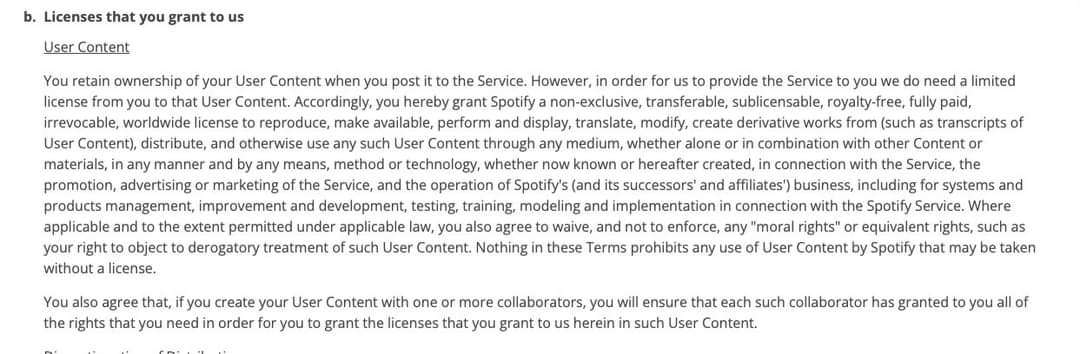
NO.
And the social media channels spun up, as authors talk to authors about business, and the warnings started flying:
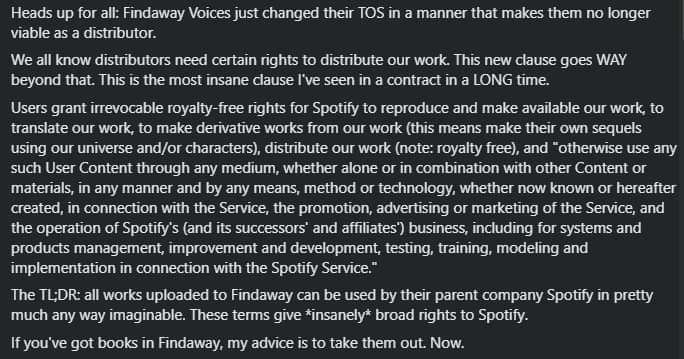
They can modify in any way, in any medium, royalty-free, transferable and sublicenseable. There go your ebook, TV, movie, audio, print… all your rights, because although you technically own the work, you just agreed they can change it in audio or change it to any other medium and sell the result to anyone they want… without paying you anything.
The helplines promptly got clogged up with people looking to yank their entire catalog, and people started emailing them, and those that distributed to findaway through other channels, like Draft2Digital, started making unhappy noises to their distributor about how to pull from FindAway.
Meanwhile, the pessimistic voices started. The argument put forth (or opinion put forth as an argument?) is roughly: “Most content creators won’t pay attention to changes in TOS/Contracts, and therefore the company can do whatever it wants to rip off content creators as well as the public.”
Breaking it down,
1.) Most content creators won’t pay attention.
A) “most content creators” is a very broad generalization, and it treats all content creators as interchangeable, equal parts… and the company as unresponsive unless a democratic majority agitates for change.
In reality, you and I know very well that content creators are not all interchangeable. The Pareto distribution applies here: 80% of the content creators make 20% of the sales, and the top 20% of content creators make 80% of the sales.
If the top 20%, who are the people most likely to treat this as a business and talk to each other about changes in contract, have a problem with the distributor, then the distributor Has A Problem.
B) You and I know that those top 20% of content creators are *also* not evenly distributed. Therefore, it does not take that many people to make the company aware that it has made a very boneheaded move that is about to lose them a lot of money if they persist.
This is a mechanism that activists often try to hijack, by trying to fool companies into thinking the very tiny but very loud minority is representative of a much larger silent majority. It’s also why we say “If only one beta reader has an issue, don’t automatically think you must rewrite. If only one reviewer after you publish has an issue, it’s them, not you.”
So in this case, when their normal help channels got flooded with content creators asking to remove their entire catalogs, and making enough noise that a very large source of content – D2D – was formally sending a lawyerly version of a “Dude? WTF?” notice… it doesn’t matter what the total percentage was, the message was clearly received.
2) The automatic assumption that the company is out to rip off content creators as well as the public.
Now, does this happen? Absolutely. People start a business because they love the business and have a specific niche or unmet need they’re trying to be the best at filling. Any company that is around long enough will go from the original founders to people who are walking into an established business and trying to make it remain at the top of the market, or become the most profitable, and lose sight of the core needs and values of the business. MBAs are notorious for killing businesses by walking in and assuming that their training and personal vision is more important that company focus or culture.
But the thing about those companies? In absence of internal turnaround or government interference bailing them out and suppressing alternatives, they die. Because neither content creators, nor the public, want to be ripped off, and places like that are not only toxic to work for, but to work with. Alternatives will be created, and the wallets will go elsewhere.
But very few businesspeople choose evil for evil’s sake, or are so wedded to an ideology that they refuse to respond to clear market signals. Most people running businesses respond to incentives, and if you provide awareness and incentive, they’ll change.
So bemoaning that the company is out to rip everybody off and there’s nothing you can do but leave, or that the new TOS is inevitable and there’s no point in pushing back… is ridiculous!
And indeed, the message was received. The immediate damage control began:
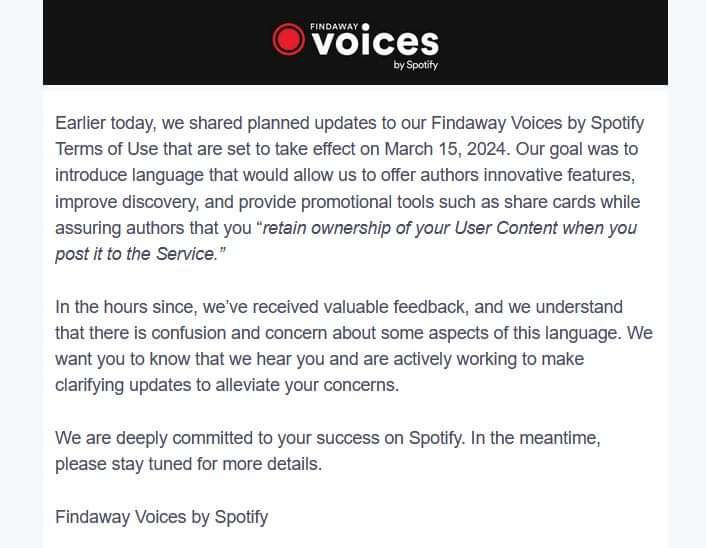
Followed by the hasty consultation with the legal staff on WTF did you do?? How do we fix this?
And the very next day, the fix was launched.
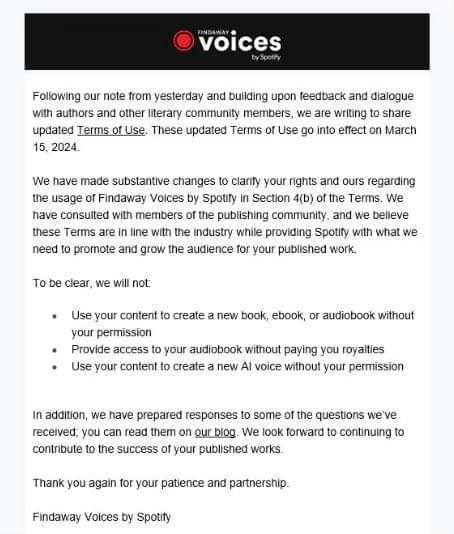
Which is all very well and pretty, but the many, many authors who had contacted them all have a universal response to this: “That’s nice, BUT ONLY THE CONTRACT MATTERS.”
And here’s the revised TOS.
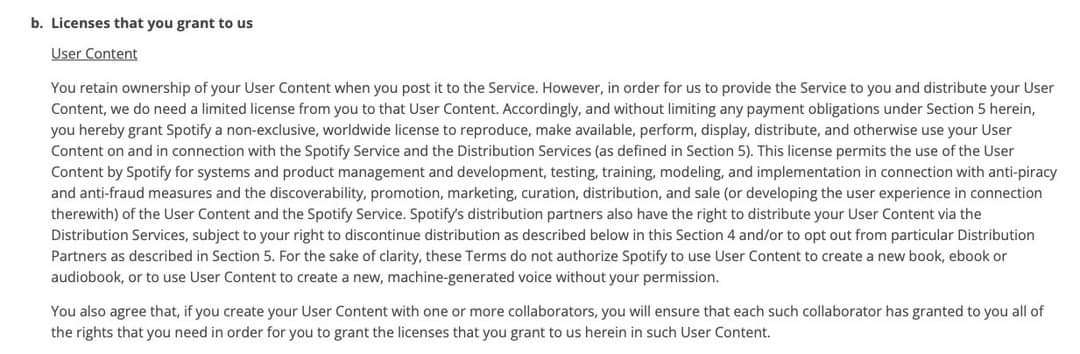
Better.
The only thing I don’t like in this section is that it doesn’t state that the rights are revokable, but that is apparently handled elsewhere in the contract.
And this is why you read the contract…
But don’t take the black pill. Things can get better.




 Mad Genius Club
14 responses to “The problem with pessimism”
I was considering doing business with them. No longer. Intentional or not, it betrays the intentions of someone with the company in a position of power. Maybe they learned their lesson, and maybe not. I don’t intend to find out.
In this case, I honestly wonder if it was stupidity instead of malice. That is, they were looking to do something with comments from their users, and it’s probable that someone completely ignorant of the importance of legal verbiage just went, “Now that comments are going to be merged with all other content, and legal says we have to have this for the comments, so just export the comments stuff to the wider stuff as we move it over.”
Which… sounds about right for the MBA’s that I’ve know. Astounding arrogance that protects their ignorance.
If they even thought to check with legal, it was probably, “Can we just put the comments stuff under the legal verbiage for the wider stuff? No? Well, then, can we apply the legal verbiage for comments to everything? Yes? Cool. Make it so!”
If so, someone has just run into the difference between a wise idea and “The Good Idea Fairy struck again!”
That would fit with “whatever comments you post, we can quote later for promos.”
…I know you aren’t in need of reading this, BUT, lack of malice doesn’t mean it’s not a threat, it just means they’re not “out to get you.”
It means that you can’t trust them to not do stupid changes that can and will be very vulnerable to malicious exploitations.
To paraphrase Charles De Gaulle, businesses don’t have friends, they have interests.
I never trust that businesses have my best interest in mind, because they don’t. They have their best interest in mind, and the good ones are trying to align their interests with their users’ needs.
Always read the contract, with an eye to “If someone who absolutely hated me took over the business tomorrow, how could they use this to screw me over?”
And the nicer the person who is running the company is, the more likely it will be taken by someone not-nice.
This is a mechanism that activists often try to hijack, by trying to fool companies into thinking the very tiny but very loud minority is representative of a much larger silent majority. It’s also why we say “If only one beta reader has an issue, don’t automatically think you must rewrite. If only one reviewer after you publish has an issue, it’s them, not you.”
I was taught it as “for every formal complaint, assume nine others didn’t bother.”
That doesn’t mean you listen to them in the sense of “change it to suit them,” it means you listen as in are aware of this and if possible mitigate it. For an author, it might be “figure out if something about your cover says SPICY ROMANCE!!!! when it’s a comedic military adventure.
“Hey guys, we’re gonna do this thing over here but need permission.” “Yeah, we’ll change the TOS so you have permission.” “Great.”….”Legal says you mated with the dog yesterday. FIX IT! NOW!” “Sorry, we just wanted to be able to do this little thing over here, not rewrite everything for everyone.”
Unintended consequences happen in all fields. Sometimes it’s just someone (2nd Lt. comes to mind) had a bright idea and didn’t think through all of the potential consequences.
Right now we’re dealing with that on a daily basis at my work. Someone decided that it would save a bunch of money to switch the entire university over to ‘company name’ phones that run off the computer, and do away with pretty much all the physical phones on campus. For the vast majority of the campus that works just fine. But alarms and emergency phones still require the old copper wires and pulse/tones due for reliability/safety reasons. Right now, if someone hits the emergency button in an elevator, we can’t communicate with them because our ‘company name’ phone system no longer sends out those pulse/tones. Same with the CodeBlue phones and area of rescue alarms. They’re working on a fix that should have been an obvious problem to the people implementing this, but apparently wasn’t.
Always assume that they knew what they were doing. The legal docs dont draw themselves up, they are directed.
If they try and slip in a fast one, then they are nt worthy of your trust.
On a lighter note: i really miss getting phsyical paper contracts. They gave the impression of an important document and you could review and make your notes.
Which is one of the problems with click button contracts, people dont read them… the writing is so small on devices and paging back and thinking is not intuitive on a device.
I suppose unless you grew up without knowing any other way.
And this sleazeball company at least designed it that way. Read the whole horrifying thing.
http://ace.mu.nu/archives/407742.php
Best advice I heard for contracts:
First, write up what you want the contract to do.
then, go through the contract, and write up what you think it says.
THEN, go to the lawyer, and give him both write-ups, and have him read the the contract for what it actually does.
If you do your homework first, then the lawyer knows how to advise you to change it, AND the lawyer knows where you didn’t understand it.
Because your focus is on “Do The Thing Without Being Screwed.”
The lawyer’s focus is on “Don’t Be Screwed, and maybe screw them, while you’re negotiating to do the thing, actually doing the thing, and afterward.”
The more specific your questions to a subject matter expert, the better the quality of the answer you get.
If you vaguely ask a lawyer for his open-ended advice, it’s going to be based on his focus, and on salvaging negotiations.
If you give him what you want, and what you think it says, he can come back with advice like “We can salvage this, by negotiating that” or opposite, the “How badly do you want this deal to go through?”
I think this is a positive side of internetness? Potential underhandedness gets taken note of quickly? Am I right?
I think so. https://www.sfwa.org/other-resources/for-authors/writer-beware/ I don’t know if we’ve posted this in a while. It is an excellent place to read about things to be aware of, and to look out for. It was and is by writers, for writers, and has a lot of red flags to keep an eye out for.
Another, more current source: https://writerbeware.blog/
So the SFWA is still good for something, somewhere, after all!