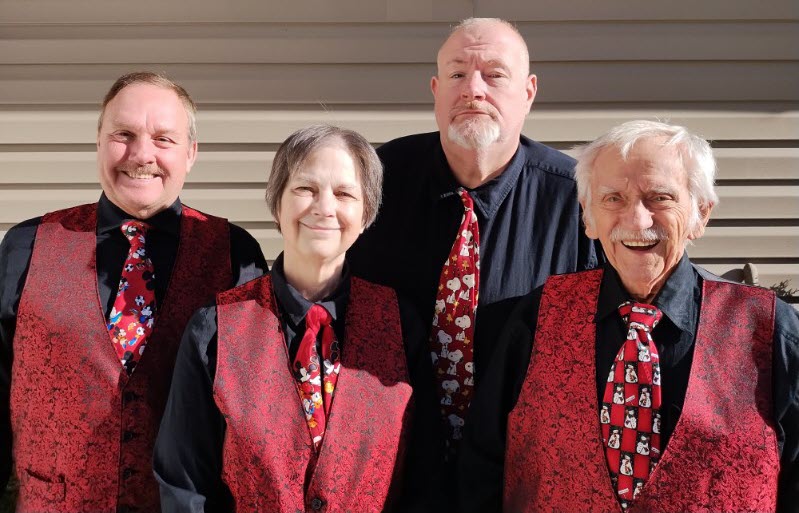
I just spent Valentine’s Day performing with our Barbershop Quartet (“What’s in a Name”) at two senior living institutions. In each location, we performed a half-hour show as part of their holiday celebration, and toured the halls to drop in on half-a-dozen shut-ins to give them a couple of songs, too.
That is to say, we spent 3 hours telling stories to people who wanted to hear them. (Nothing like a captive audience, is there?)
Sometimes quartets like ours offer themselves for individual bookings on the day — boyfriends sending their gals a Singing Valentine at work, typically — but we wanted to avoid the mad scramble that ensues (driving all over town with heart-shaped candy boxes trying to surprise the recipients) and reach a larger audience in a different age group whose members have fewer options.
It’s the nature of the demographics of aging that such groups skew female (which is especially poignant considering the holiday), and of course the song choices for Valentine’s Day are typically the older love songs or doo-wop, all in Barbershop arrangements.
You’d be surprised just how much story you can fit into a 2-3 minute song, and after all — romance being a universal human concern — the isolated bits of the eternal dance steps string together into a larger whole.
First, there’s the inciting incident:
Passed me by one summer’s day, flashed those big brown eyes my way,
and oh I wanted you forever more!
I’m not one that gets around, swear my feet stuck to the ground,
and though I never did meet you before,
I said “Hello, Mary Lou,” (goodbye heart!)
Recognition of the real goal:
My wild Irish rose, the sweetest flower that grows,
You may search everywhere, but none can compare,
To my wild Irish rose.
Persuasion:
Let me call you sweetheart, I’m in love with you,
Let me hear you whisper that you love me, too,
Keep the love light glowing in your eyes so true,
Let me call you sweetheart, I’m in love with you.
Mid-point crisis:
Heart of my heart, I love you, Life would be naught without you,
Light of my life, my darling, I love you, I love you,
I can forget you never, From you I ne’er can sever,
Say you’ll be mine forever, I love you (only you).
Denouement:
Sweet and lovely, that’s what you are to me,
Sugar and spice, and everything nice, you’re all a girl should be,
Soon we’ll marry, you’ll be my blushing bride,
I will smile all the while you’re by my side.
Laying the groundwork for the next series entry:
Won’t you play the music so the cradle can rock?
Play a lullaby, in rag-time.
Sleepy hands are creepin’ to the end of the clock.
Play a lullaby, in rag-time.
So rock-a-bye, my baby, don’t you cry, my baby,
Sleepy time is nigh.
So won’t you rock me, to a rag-time
Lullaby
Now, tell me those little vignettes of the human story aren’t effective.
For an audience like ours, they can just sit and watch, and be entertained. But you can see on their faces — they remember: their lives, and the ones that are gone.
As do we all, writers and readers alike.
You cannot know how far your efforts will go and what impact they may have. Sometimes, after a performance, someone in the audience will come up and tell me a story, and it’s always unexpected. Think of your own favorite books, and how they may resonate with you, in ways the writer may never have imagined.
How do you see yourselves, as storytellers?


 Mad Genius Club
5 responses to “Other ways to tell a story”
Lovely.
i think in terms of making people laugh and making them think (I’m a lay speaker).
The shut-ins are sometimes self-selected, not wanting to mix with others at events. We delighted one of those ladies who literally danced around her room in joy when we came in and sang to her.
And in another room, one told us as we were leaving, with tears in her eyes, that her husband had just passed away the day before.
And all of us were of an age where one visually measures those rooms for one’s own furniture when we visit. What a welter of emotions to mess with one’s breath control.
My job as a story teller is, well, it depends.
At Day Job or in non-fiction, it is to impart information along with telling an exciting (to some, sometimes more so than others) story. As a writer of fiction, it is to entertain and perhaps encourage or teach, but far more to entertain. I don’t preach well, aside from “Being evil/mean/petty doesn’t end well. Neither does being stupid, sometimes.”
First, as a craftsman: designing and shaping the pieces and putting them together to make a sound piece of work. I spent 20 years in civil engineering and another 20 in computer programming; writing isn’t very different.
Second, having written a story, trying to get it out there. If I wrote a good story, someone, somewhere, will enjoy it; if I keep it to myself I’m like the fellow who buried the one talent he was given – that didn’t turn out well.
“How do you see yourselves, as storytellers?”
Can I say “I don’t know yet?” My short stories either have a twist ending or are an attempt at humorous. Beta readers have liked them, but haven’t sold any so far. Longer works are a straightforward story. I hope they’re interesting, at least. Not something people will toss across the room and curse it.