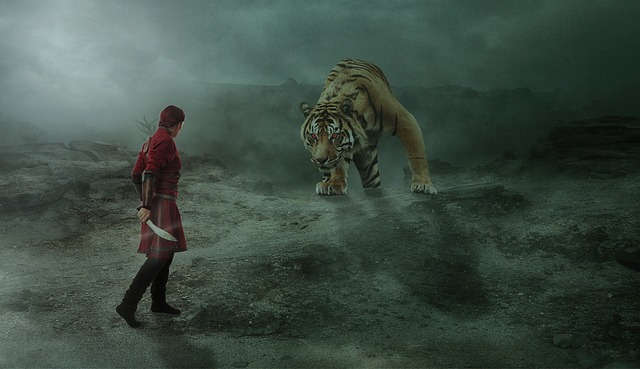
A red herring, a plot feature, and an unloaded gun walk into an editor’s office …
So, there’s this story. And some characters. A minor nusience from a previous story goes missing, maybe. A new dude shows up and decides to take offense at the protagonist, who was, literally, just standing there minding his own business (probably for the first time in his life.) Meanwhile, Life has thrown a major curveball into the protagonist’s world. And trouble in a different form bubbles up to wreak mischief, trouble that might be connected to an old problem, or perhaps to the new one.
At this point, a reader is going to drop the book and run away, fleeing the chaos of plot threads, confusing side-stories, and overall craziness. And you, the writer, are probably going to do likewise if you don’t corral all these conflicts and threads.
So – how do you determine which conflict is the critical one? Well, in part it depends on genre. Romance requires that the relationship conflict be the most important one – will they or won’t they get together? The emotional highs and lows and storms and rainbows are the driver, and everything else just builds on that. Thrillers tend to have one major conflict (assassination/terrorist attack/what have you) and a few minor conflicts that may or may not be red herrings. You, the writer, need to be very clear with yourself about which are which. A thriller with romance has to keep “stop the assassination of the Prime Minister” as the central driver. The romance bit is a distant second.
Which conflict drives the plot? If you, the author, can’t decide, then your readers are going to give up trying. Unless you are writing a seven-volume epic, or you are a Russian novelist in the mode of Tolstoy. Or you are mimicking The Tales of Genji aka a soap opera in novel form. Then your readers have very different expectations, and you can entwine plot threads with reckless abandon (perhaps not wreckless, if you have a modern setting.) Sit down away from your writing and make a list of conflicts. Lightly mark through any that can be removed without damaging the plot structure. That will help you decide where you need to focus your reader’s attention, and which conflict is driving the story.
To return to the muddled warning at the start of this rambling bit of prose, the driver is the conflict with the stranger. The Life event “only” adds to the stress, but the stranger’s actions push another plot thread in certain ways. The older, outside element is not as important to the story*. It could be dropped without losing anything of the main plot. Now, why for once our protagonist gets into a fight without starting it, when he hasn’t had even one beer, let alone Only Two Beers … Readers will find out as the story unfolds.
*It ties into a parallel story, but is not necessary to this book. Think of it as an Easter Egg.
Image Credit: Image by Lothar Dieterich from Pixabay

 Mad Genius Club
14 responses to “Which is the Real Conflict?”
“Think of it as an Easter Egg.”
Or foreshadowing for the next book.
I’ve heard of a toothpick test for a novel: pick a page at random and figure out how many paragraphs are needed to make the conflict clear.
The Stranger Conflict With Protagonist is the driving plot, or starting point, of many a Jack Reacher novel. It’s also useful because the reader is much more likely to side with the protagonist (who was just minding his own business, after all).
“Tristram Shandy,” is an example of a book with too many threads. I tried to read it because two authors I enjoy, Dorothy Sayers and C.S. Lewis, both speak fondly of it. I didn’t wall it – quite. It is six or seven hundred
pages of digressions within digressions, and so far as I could tell, no plot resolutions of any kind. It must be a British thing.
I don’t recall what description of Tristram Shandy set off my alarms – possibly some version of what today would come under the eXpecTAtions sUbVerTed header – but I’ve given it a wide berth for many years and never had occasion to regret it.
There’s a long section in the first part of *Don Quixote,* where Quixote is laid up in an inn and a collection of characters (friends, relatives, whatever) settle down to tell one another stories while they wait for him to recover. For a hundred or so pages. Was Cervantes doing a “Decameron,” was it the custom of the time, or what?
But at least the story did, eventually, get back to the title character.
I remember hearing about a possible movie about a tragic British commando raid into German held France.
It seemed that the representative of the movie company wanted to know “Who Was
The Enemy”.
The man who was proposing the movie said the Nazis while the representative wanted the Enemy to be somebody on the British side.
IE Somebody besides the Nazis.
There’s this obsession among film and TV people with having someone on the main team who’s not entirely trustworthy, but not every story needs a Boromir (or a Han Solo, or a Garak or a mid-series Gul Dukat or a Tuco Benedicto Pacifico Juan Maria Ramirez or a…). That or the studio executive was in love with Where Eagles Dare, where the “hunt the mole” subplot gets so involved that the audience, like Clint Eastwood’s character, can only squint in bewilderment.
Thus presenting one way to manage (or mismanage) competing plot elements that got abused mightily after one person did it well.
The Germans could be portrayed as more of a hostile force of nature than as real people. An incompetent or pettily hostile senior officer, wantonly sending men to their deaths, could very well be portrayed as the enemy. Sort of like Peckinpah’s “Cross of Iron”.
In this case it was more the “Evil Politicians/Generals” mindset.
If the raid failed or was some kind of pyrrhic victory, then “who’s the moron who sent those boys to their deaths for so little gain?” seems like a fairly valid question for a layman to ask, even if a historian would have to answer, “Well, there wasn’t really a single unifying cause of things that went wrong, and certainly not a person who was the source of everything going wrong…”
I agree though that WWII movies tend to be a bad vehicle for antiwar sentiments, and if that was where the studio flunky was going with this, he deserves all the flak he gets.
Sort of like how Kelly’s Heroes is a heist film with tanks set in WWII, rather than a traditional war movie.
Yeah, Kelly’s Heroes is very much an adventure movie first; almost a missing link between The Good The Bad and The Ugly and Raiders of the Lost Ark.