
Let’s face it — you’re in book N of an interminable length series, and it’s finally dawned on you that you’ve got more characters in your back-of-book list than most public school yearbooks. At this rate, the name index will start overtaking the main body page count. How’d that happen?
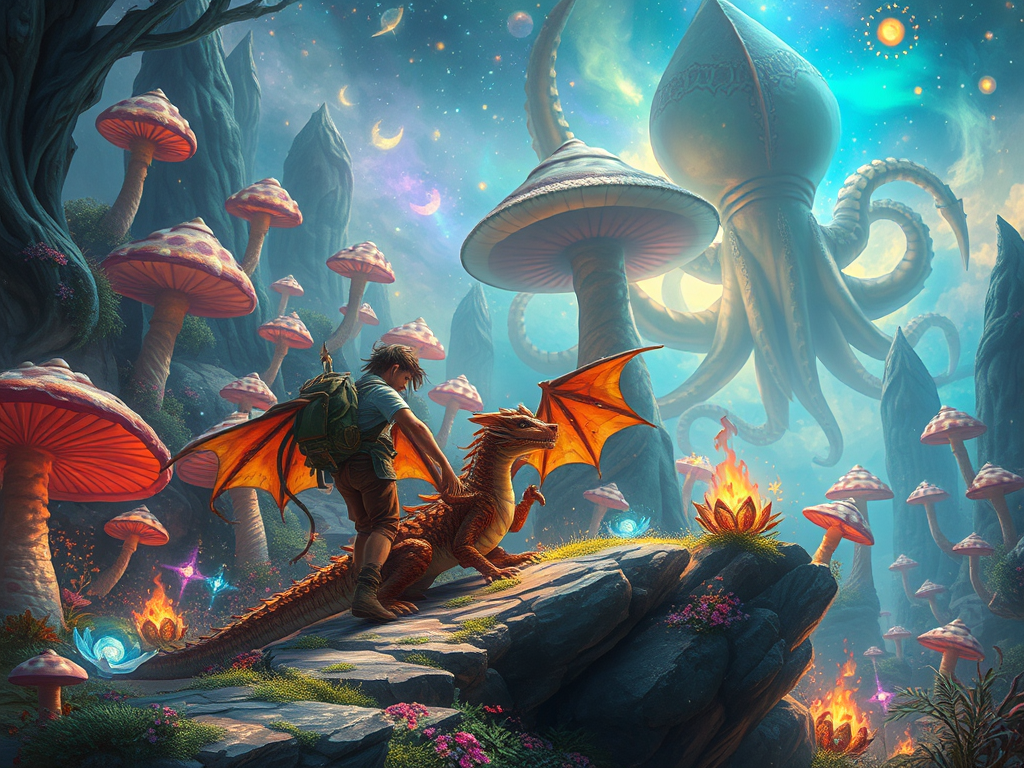
Well, there’s the hero’s buddy, the prestidigitator with all the extra fingers at the bottom of the image above. (Clearly Mid-Journey has awarded him a digit as a token for each book he’s appeared in so far…)
All the others? Sigh… Hard to keep them tidily in their box.
Your typical single-book fantasy-team-goes-on-a-hike-to-fix-a-problem is an easy cast to wrangle. Recruit one small team, assembled at random, and the friends/foes/comic relief they meet along the way, and the cast barely takes up a page.
A SciFi lost in space with dwindling survivors encountering peril is even easier — entropy (and body count) is on your side. Closed-environment murder mysteries have similar constraints.
But those are stories that inherently leave people behind, either by progressing from place to place for the fantasy, or via death-by-misadventure for the initial-but-vanishing cast of victims. The cast may be shrinking instead of multiplying. You may be moving forward in time, where older characters never return. If you change environments (as in thrillers that bounce from place to place), then each one may contribute its own island of characters. One book, many places, few recurring characters.
But… if you stay more or less in one place (city/planet/space station) for many books, then it’s hard to keep the character count from increasing at least a little for each entry.
That’s always been my challenge when I write a series.
Bit characters get introduced for a particular purpose in a particular book, and then… they grow on me. They develop a quirk, they start interacting in important ways with the main characters, and so forth. I find ways to reuse them, look for ways to keep them onstage. They make themselves memorable to me as they struggle to come to life.
But not necessarily to my readers.
I live with my characters, as if they were part of the real world, and don’t have much trouble tracking them. Readers, on the other hand, seem to have a sort of mental box for the characters in a story, and it can only hold so many comfortably. At least, that’s how it works for me as a reader. It’s one of those problems that’s always irritated me in Russian novels.
I try to be careful about challenging my readers to remember who people are. They haven’t got the luxury of drama, where the characters can actually be seen, to help them. Maybe they’ll recognize the character’s name, but if not, I have to take subtle steps to help recall the character to the reader’s mind.
Using a variety of different initial letters can help with potential confusion. Other tricks are to take advantage of linguistic groupings (this group of players has an accent, that group drops their H’s) or ethnic markers (physical appearance) or occupations. Some of them naturally fall into functional clusters: friends, enemies, associates, employees/servants, and so forth.
How do you keep your characters from overflowing the box and overwhelming your readers?


 Mad Genius Club
13 responses to “Corralling your characters in a long series”
I…have trouble staying interested in large herds of characters so I try not to write them. The Destroyer Captains in Spiderstar were maybe as far down that road as I’ve ever gone. One POV is the Admiral in charge of a task force on the bad guy side who is having second thoughts and wants to defect. There’s a certain amount of background chatter between him and his main confidante about the COs of the destroyers in their task force, half of whom are competent, well-intentioned officers the Admiral and confidante can trust, and the other half of whom are useless scumbags who got their positions through cronyism. We don’t actually meet most of the Destroyer Captains, but we hear enough about them to (hopefully) understand that the Admiral and his confidante know them, and have valid opinions about them.
Yeah, naval stories can be their own special kind of hell for tracking characters. Every ship mentioned needs at minimum a Captain, and possibly other officers and crew. If the main character is an Admiral, he / she will have staff officers, military and political superiors, etc.
It’s really easy for characters to multiply beyond control.
And speaking of naval stories, ‘Texas in the Med’, book 3 of my ‘Republic of Texas Navy’ series, is now live on Amazon / Kindle. Yay me! 🎉
Congrats! *throws confetti*
I think I got by with just naming the Admiral, plus the CO of the battleship that served as his flagship, plus the Admiral’s confidante (CO of the other battleship), plus the six destroyer captains. And of course the ships themselves. The bridge crew of the flagship got referred to by job description (helm, etc.)
Take notes. Take lots and lots of notes. This helps with doorstops, even.
We started the Luna City series intentionally, with a large (30 or so) cast of characters … and with add-ons and non-speaking names dropped in to fill out a newsletter or small item in the ten books since then, it’s becoming quite a mob scene. I do have a chart at the beginning of each volume with most of the main named and speaking characters listed… for the readers, but for me as well. I constantly have to go back and check on the spelling of their name, and their relationships.
The peculiarities of their character are all in my head, though. Which is getting crowded…
I adore the Luna City series. Will there be more?
On that note, so many TV writers fall into the anti-Moonlighting trap. They invest too much effort into making sure the main characters are never allowed to just be happy together.
Yes, there will be one more set in the present day, to make an even dozen. We remembered Moonlighting, and Northern Exposure, where the steam seemed to go out of the main romantic relationship once they definitively got together. Rich and Katie are going to marry, there will be a resolution concerning the Mills Treasure and a couple of other definitive conclusions.
But because I am rather fond of Luna City, I am going to set up a new series, with Letty, Stephen, and Douglas and their pals as children in the 20’s and 30’s, helping Chief MaGill solve mild country mysteries. Sort of an American Emil & The Detectives, if anyone remembers Emil and the Detectives!
I thought I could avoid this by really focusing down hard on two or three people a book – but no, the side characters have lives of their own. I end up following a couple people per book, and then often turning to a side character to follow for the next book… But the side characters keep multiplying, and I’ve broken down and started filling a yellow legal pad to try to keep them straight. Even the background ones have a way of starting to make their presence known. as they live their own lives intertwined with their community from book to book.
*Throw hands in air* Control them? Best I can do is run away to another place and hope too many of them don’t follow me.
I’ve read that Rafael Sabatini (author of Captain Blood, Scaramouche, The Sea Hawk, etc.) had a similar problem. For each book, he’d keep a set of small dolls labeled with the names of the characters in the book. When he’d kill one off, he’d knock over the doll so he would know not to use that character again.
I keep style sheets for the book in question and for the entire series (that’s for me).
For readers, I (unless the plot demands it) do my darnedest to keep names distinct and different, along with trying to make them all sound like individuals.
I also provide a cast list at the front of each book giving a sentence or two of description and motivation.
I have a list of characters for each book, major, minor. I don’t worry too much about drive-by characters (appear, get named or described, then vanish.)
Every time I get a named character. (I don’t plan it, they jump into the story) I go and I write down a running tab of them. Occasionally I’ll go and regroup them by class, family, nationality, etc. Whatever makes sense, so that I can find them relatively easily. I’ll also include my first description of them so that Zariza doesn’t turn from a tall, slim, black-haired girl with eyes slightly too far apart to be called beautiful into a short buxom redhead. That’s her friend Elestrin.