
The title for this post was almost a paragraph of 5s. Because I had walked away from the keyboard to make coffee, and gather a thought to write about, and Toast stood on the key. Rather than sharing her kitty signature with the world, though, or talk about the post I saw written by an entitled author complaining that their cover art contract prevented them from stealing all the rights to the art (how dare the artist maintain copyright to their work!), I thought I’d write about something else…
Murder. Or should I draw that out the way you only can vocally into muuuurrrrder? No, that looks like Toast has got back on my keyboard again. With her fuzzy adorable murder mittens. Despite being a ten-month old pampered (some would say spoiled rotten) indoor kitten, she is already an accomplished huntress. Mostly of bugs. Moths are her bete noir, because she can’t quite leap high enough to get to them. She tries, and her ability to go vertical is impressive, but it’s not enough. That’s where I come in, with a butterfly net. Yes, I am her accomplice.

I’ve been reading Ngaio Marsh’s Inspector Alleyn series on my off time, and watching the latest episodes of Midsomer Murders while working – and I can do that because at (checks) 24 seasons, I don’t need to look at the screen to know what’s going on. What is it about murder we find so fascinating? And by that I mean the genteel murders of the murder mystery, not the real ones or even the ones done in the grosser (I mean that literally there) horror genres. I would argue that it’s not the death that lures the reader in, here, but the puzzle. And for some – like me – the more unrealistic the death, the better. I’m not here for the gore and guts, and I’m certainly not here for the technical reality. As I’ve had a long-term interest in forensics and criminology, which wound up with my having a forensic science degree (half a criminal justice degree slapped atop a chemistry degree), certain television shows are more comedy than anything else, and same for the poorly researched books of that ilk. What we’re left with, then, is the puzzle of solving the crime, and I’d also argue that mystery readers are fascinated with human nature. Agatha Christie, Dorothy Sayers, Margery Allingham… the grand dames of death. All of them experts in character development.
I’d tried to read Marsh years ago, and had bounced off her work, despite loving all the above. Well, with Christie it’s interesting, I liked Poirot and Tuppence and Tommy when I was younger, but it’s only in the last few years that I have been able to read, and enjoy, Miss Marple. I liked Miss Silver of Patricia Wentworth’s work much better on first encounter. She’s not nearly so arch and patently elderly as Miss Marple is, and it wasn’t until I’d read a few of the latter that I saw what Christie was doing. Miss Marple uses the elder and infirm status as a blind. Not that she isn’t – she is, the author shows us – but that she can do things under that guise no one else would be able to get away with. Which is, in a way, where Inspector Alleyn of Marsh’s series has an advantage as well. Not that he’s elderly, but that he has a blind where he can hide, underestimated by those around him. His is being upperclass (hardly revolutionary in the genre, see Campion and Peter Wimsey, both of whom were kept from being policemen by their births, although both were admitted to the intelligence game and played it professionally, which is an interesting British quirk related to the birth of policing as we generally know it. The Surete was a very different beast… but I digress) which both gives him an entre into the world where most policemen were required to use the servant’s entrance. I still haven’t yet decided why I couldn’t read Marsh when I first tried in my late teens, as I was devouring Sayers and Allingham at that age.
Mystery was my first genre, and my most enduring, in some ways. I’ve not yet attempted to write much in the way of mystery, perhaps because I know what big shoes I’d have to fill, and I dislike starting something unless I know I can be decent at it, at the very least. Conceited of me, doubtless. Still, it’s my comfort read. I enjoy the puzzles, and the people, and tend not to read the more technical or gruesome mysteries that proliferate, and a lot of cozy mysteries are too idiotic for me to enjoy, either. I enjoy working out the obscure, the cryptic, dismissing the red herrings, and finally relishing the denoument. When I’m tired, and not wanting to pay much attention, it’s a comfortable place, coming back to Midsomer, the most deadly spot in all of Britain, and watching the episodes unspool with soothing regularity. When I want to wake my brain up and look at people passing by on the pages, I pull down my Sayers volumes from the shelf. It’s rarely that I add new authors to my comfort reads, but I think that Marsh may finally take her place with them. I’ve been slowly buying the ebooks as they go on sale (I still refuse to spend ten dollars on a ebook, particularly one that isn’t a new release by someone I know and trust to write a very good story) and like my newly-collected Mrs. Pollifax books, am looking forward to a nice binge… of murder reads.

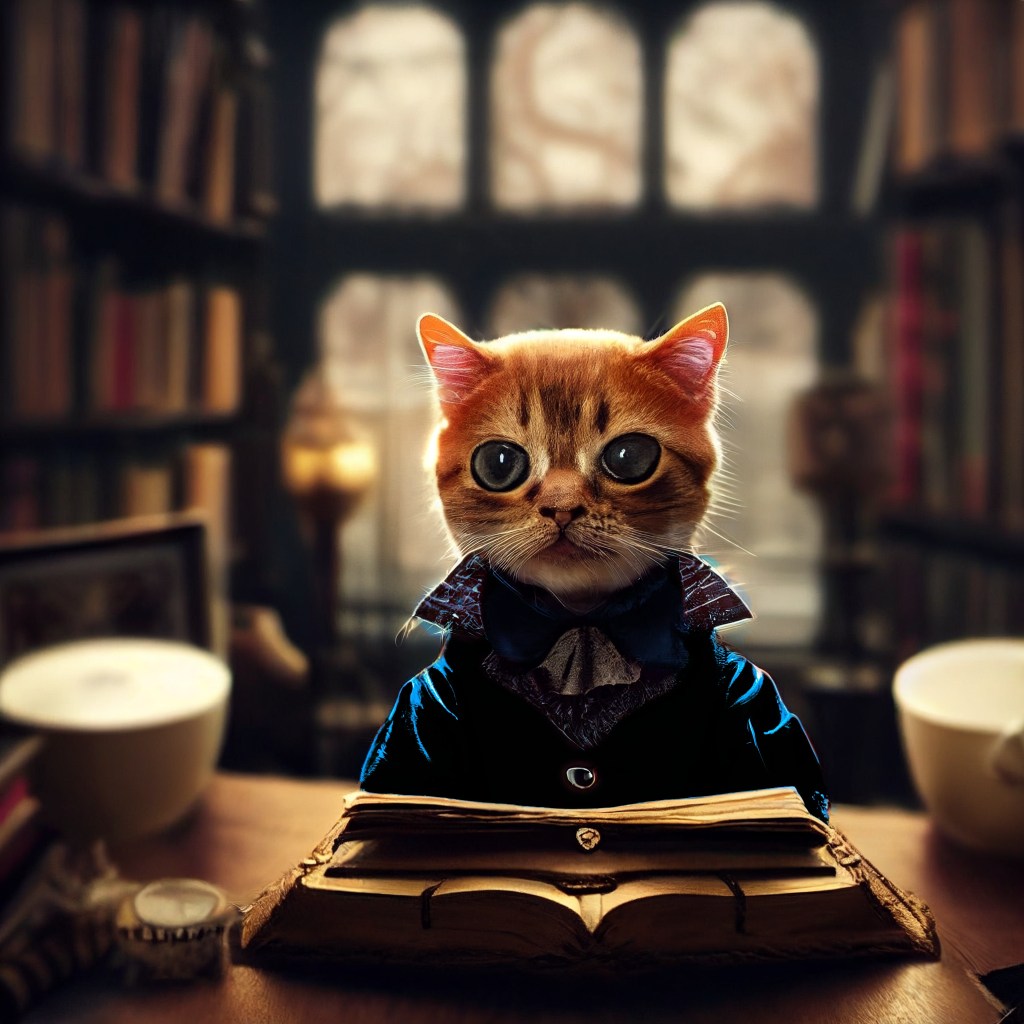
(illustrations for this post by Cedar Sanderson, rendered with MidJourney)


 Mad Genius Club
19 responses to “A Side of Murder”
I love Marsh and Inspector Alleyn. And Troy. I have most of Marsh in paperback since I started bingeing her in the late ’80s (I think) based on a friend’s recommendation. So, if you need to read one and it’s not available in ebook, lemme know. I probably have it.
I never could get into Allingham’s books. But I do love Marsh’s Alleyn series, which shows wonderful character development and does a good job of modernizing the setting over time. In the earlier books Alleyn seemed to me to be a precious imitation of Wimsey, but the later books are almost procedurals and very readable. The suspects read as real people and are interesting in themselves.
I tried Marsh as a kid and couldn’t really get into her. Maybe I should try again.
Mystery tends to be my comfort read; I have a Christie Omnibus next to my bed, and it’s what I read when I’m too tired to read anything else. Sometimes I exchange the one that’s there for a different omnibus, but I always have one.
I tried a couple of the early Marshes and found them boring, but the later Macbeth-themed one I ran across was pretty good. She worked in the theater, and the early ones have so much emphasis on the forensics of the case – placement and condition of physical clues, layout of the place where the crime happened – that I kind of assumed she got her theatrical start as a properties manager.
How curious – I’ve been going back to read mysteries as well; a number of books by British writer of a mostly cozy-type: Robert Barnard. He wrote a couple of detective series, but most of his books were stand-alone – really more short novels with a mystery element (usually involving a sudden death/murder) which are really very good. I think his two best are Skeleton in the Grass, which is a study of a very well-to-do family of feckless intellectuals in the late 1930s, and Out of the Blackout, which involves a young man with no history appearing as a five year old WWII evacuee in a small English village. He spends his adult life trying to figure out where he came from, based on his few brief memories, and some places and items that he recognizes. But all of his books are pretty good. Since he never really created a strong, consistent detective series, his books have never been made into a TV series, which is a pity.
‘Wonderful ,’ Nicola said, ‘actually to be asked by a publisher to write.’
A great quote for MGC from Hand In Glove by Ngaio Marsh.
Mysteries are my comfort read, especially the classics, including all or almost all of Doyle, Christie, Marsh, Sayers, GK Chesterton, Rex Stout, Chandler, Hammet, Gardner (Perry Mason, Cool & Lamb (clearly his best work) and the D.A. series), along with good amount of others such John Dickson Carr, Ellery Queen, Edgar Wallace, R. Austin Freeman, E.W. Hornung (Raffles :)), and too many other Victorian and golden age authors. I’m not a huge fan of modern “cozies” (whether set in the 1920’s or 1930’s or more modern; to me they’re lacking something) or more modern detective fiction (so 1970’s and on).
In the past few years, I’ve been re-reading most of Christie and Marsh (thanks to good deals on Kindle). Marsh’s best books IMHO are the ones involving the theater, New Zealand, or New Zealanders. Her first couple books are definitely weaker, and I find Nigel Bathgate super annoying (although my sister says “I kind of like him!”)
I like Christie’s psychology driven stories the best; they’re worth re-reading even if you remember who done it. This would include most/all of the Miss Marple novels, and many of the Poirot ones. I also have a weakness for Tommy & Tuppence; they’re a lot of fun, especially the Partners in Crime, where each adventure is done in the style of a different detective popular at the time (half of which have been forgotten by now). I also love Ariadne Oliver 🙂
Since this comment is getting too long, I’ll just add a few notes on some of the other authors:
— Victorian short stories: if you haven’t (especially something like Cedar who likes art), get some books with the original Victorian art work, both for Holmes and his contemporaries (I’ve keeping my “Original Illustrated Sherlock Holmes” and “Rivals of Sherlock Holmes” books forever). It’s amazing. Holmes is still the gold standard, but some of the others are pretty good, too.
— Gardner is definitely an easy comfort read, and very formulaic, but I admit I do enjoy Mason’s courtroom scenes, and his skepticism towards prosecutors (especially given what’s been going on recently in the US). Cool & Lamb is always a fun romp, too, and you get to learn about hacking slot machines, faking gold mines, and more.
— Ellery Queen can be very good (although he can also be repetitive); I’m especially fond of The Four Johns, but that’s partly because it’s set in the SF Bay Area and Central Valley.
— I love the Archie Goodwin/ Nero Wolfe interplay.
The Goldie Bear catering mysteries are about the only modern cozies I had much patience for, and that’s undoubtedly down to the food angle. I’m not sure if I count the Cat Whos as modern cozies because she wrote the first few in the late sixties early seventies IIRC.
Someone here or at ATH recommended the Anty Boisjoly series; I enjoyed them as period farces (nails the period and the language better than most things of their kind) but they’re basically PG Wodehouse fanfic with vague pretentions to be mysteries.
One thing I loved about the Jeremy Brett Holmes series is that occasionally they would recreate one of the illustrations from the stories. One that I still remember is a shot of the butler looking around after being caught studying his master’s map in “The Musgrave Ritual.” It was exact.
Oh yes. To me, he was the definitive TV Holmes. I know some people prefer Basil Rathbone, but Brett felt much more true to the original stories.
My interest in mysteries surges then wanes. Ones I’ve liked include Sherlock Holmes, Allingham’s Campion stories, Arthur Upfield’s “Bony” Bonaparte series (set in Australia, protagonist is half-Aboriginal), and the early Tony Hillerman novels (Joe Leaphorn more than Jim Chee). The first five or six “Cat Who” stories were also fun.
The setting has to be as interesting as the story for me to really enjoy mysteries. Make of it what you will.
If Hollywood were not in the process of doing a slow-motion modern dance interpretation of the Hindenberg, I would say that author had a bright future as a movie producer.
A little unfair to the Hindenburg, with its 66%-ish survival rate 😉
I had not realized anyone on board survived except for one dog.
I know, right? I was shocked to learn the majority of the people onboard survived as well. I mean, 35 fatalities out of 97 people (13 out of 36 passengers and 22 out of 61 crewmen) is still a tragedy, but you look at the footage of the thing on fire, hear the zeppelin’s name coupled with the Titanic as a synonym for catastrophe, and you expect alot worse.
Was that author trad pub?
It seems like they were using the same attitude towards cover artists that trad pub has towards authors.
They were not, and yes, that was how it struck me as well.
I’ve never been a big fan of mysteries beyond Sherlock Holmes including pastiches such as ‘Dr. Jekyll and Mr. Holmes’ and ‘Sherlock Holmes and the War of the Worlds’, which includes Professor Challenger for added fun; Solar Pons, who is basically well-done Holmes fanfic; some Father Brown; and the Judge Dee mysteries.
The Judge Dees are some of my favorites simply because when I got interested in them I suddenly found the books offered up everywhere for a dollar or so each. They were at library book sales and in some of the last few local used bookstores. Some were free. I think I got the whole series of 16 books for about $12. The only time that ever happened to me again was when I hunted down Fraser’s ‘Flashman’ novels.
One of the reasons I adore Rex Stout’s Nero Wolfe mysteries is that they’re the best possible melding of the Britishness of the Holmes stories with American hard-boiled mysteries. To wit, Wolfe is more or less an American Mycroft Holmes (absent the government ties), a genius but inherently lazy. Archie Goodwin is better than Watson, because first, he’s an American wiseacre, and second, a major part of his job is goading Wolfe into taking on clients so they can pay the bills.
Another reason is that they are less mysteries (only a couple are actually superior mysteries, as such) and more comedies of manners about how the sedentary, cerebral Wolfe and the active, witty Goodwin manage to get along. (In one novel, Wolfe calls their relationship “a continuing miracle”.) That makes their rereadability high, because even if you know the mystery, the mystery only kind of matters.
Most of the stories I read are mysteries. Oh, they’re not generally “whodunit” murder mysteries. They’re novels where the central plot element involves solving some sort of mystery by discovering clues. And that is a surprisingly large percentage of SF/F stories. The good, early Harry Potter novels are all mysteries: “What’s really going on?”
Sometimes the mystery is, “How are they going to survive and prevail?” Some are slotted into the action genre, because action without a plot is not only boring but exhausting. Sometimes the mystery is, “How are they going to pull this off and get away with it?” For example, “Leverage” was a TV mystery series involving Robin Hood style heists.