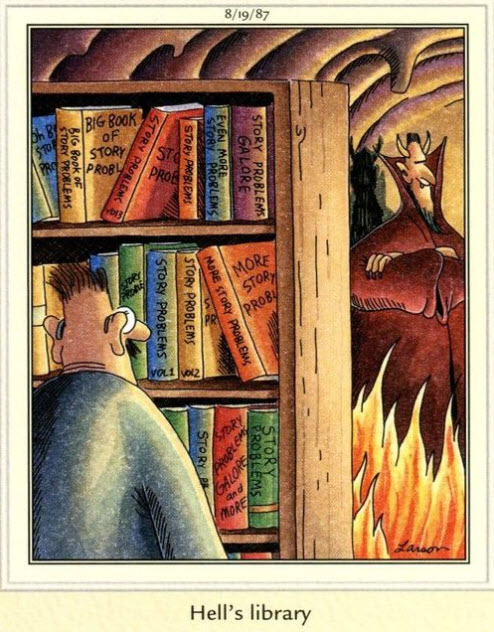
There are a great many things I like about writing fiction. One of them is Story Problems. In the cartoon above, Larson meant the term to suggest those irritating examples of applied arithmetic you may remember from grade school, but I use it as my personal label for those situations where your fiction story has wandered off into the Tepid Swamp of Niceness, or the Crippling Boulder Field of Inconsistency.
What’s to like, you ask? Well, the first time it happened to me I was delighted that I could even recognize the issue before I got any significant distance beyond the offense. (“Boo — a flaw. Yay — I noticed.”) The perception nagged at my brain and wouldn’t let me proceed until I could identify the trigger.
Now, I could pretend to be writing novels primarily to earn a living (and, yes, that would be nice) but it would only be a partial truth. I really write for the fun of telling a story like a real storyteller, for the buzz I get from the process of building the story and, eventually, the final result.
So instead of despairing when a Story Problem pops up and gives me a raspberry, I rub my hands together. This is the good part, the part where my brain froths and spins like a carnival ride. Wandering “what ifs?” pay a visit, new characters show up, old characters sprout unexpected backgrounds, entire provinces pop into existence.
The delight when it stops hurting — when a solution surfs into your seething brain and makes the entire story more interesting — man, that’s worth all the irritation of the original flub. I get my best plot and character moments because of problems like these, when my brain spins without a governor. I may build my 4-act plot architecture like a rationalist, but I end up filling it in detail like an improv troupe.
What walls have you run into, where your applied demolition methods have resulted in overall improvement you would never have been forced into otherwise?

 Mad Genius Club
6 responses to “Story Problems”
I had a scene when writing fanfic in which I 1) had to introduce a minor character and make her interesting, 2) make her relationship to one of the major characters believable and 3) use the scene to advance the plot. Basically I slogged away at it, writing dialogue until I struck a spark that felt right, and then focused on that spark. It was the toughest part of the piece to write, and I am still proud of it though it is not a large or standout scene.
I had a book that introduced a character and that person went nowhere, then the ending of the book just … flopped. An astute outside reader spotted the problem, and with some work, the new character became a driver for a chunk of the story, and I added material at the end that fit both the world and the situation. So now I often look at the story and ask, “OK, what if this element in the story-world comes into play?” Sometimes it helps, sometimes it would go in a useless direction, so I know not to use that.
” write for the fun of telling a story” I resemble this. 😉
I don’t know that it improved anything, but I recall a short story I was working on where a character did something that indicated he was left handed, while I had an earlier scene that implied he was right handed. I decided that I liked him as left handed and edited the previous scene. Kinda sad that the scene that triggered the change didn’t make it into the final version.
Lately, I’ve had the most luck just writing out the problem longhand and brainstorming options, inspired by Rachael Aaron’s three-pillars approach.
Sometimes there’s an element of cross-fertilization going on; the hero in my upcoming novel has a kind of wistful protectiveness towards children which a). is the result of me watching too much Don Matteo, which cranks that Italian wistfulness about children up to eleven; b). also the result of me wrestling with a fanfic about a romance between two thirty-somethings who seemed to have frustrated parental instincts in the source material; and c). it turned out to work well with some of the other stuff about the hero’s backstory and subculture.
I realized that the only person who could actually solve the problem was a minor character, barely fleshed out, whose miniscule background (marital problems of all the stupid . . . ) put him in the perfect position. Had to completely bulk out the story with him as a POV character.
This describes my writing completely. Something happens. I don’t know why, and often I don’t even know who this person is that it happened to. My characters then go along and find out what to do about this big problem.
Such as, from Unfair Advantage, how do you beat a Von Neuman machine infestation of nanotechnology that has set up shop in our solar system? It can go anywhere. It can lie dormant for hundreds of years before starting up again. It can create ships, weapons, even soldiers out of whatever it happens to be sitting on. It’s an impossible opponent.
Our Hero starts out with giant tanks and robot girlfriends, but that is mostly to manage the humans and keep them out of his way. Something shiny for the cops to look at. Beating the Von Neuman infestation will take a lot more than that, or his robots will be warring against this thing all over the solar system for thousands of years while it drops rocks on the Earth. He needs an unfair advantage that the nano can’t beat.
Took me the whole book to figure it out. ~:D Interested parties can follow the link to my blog and scroll down the right hand side of the page for an Amazon link.