[ — Karen Myers — ]
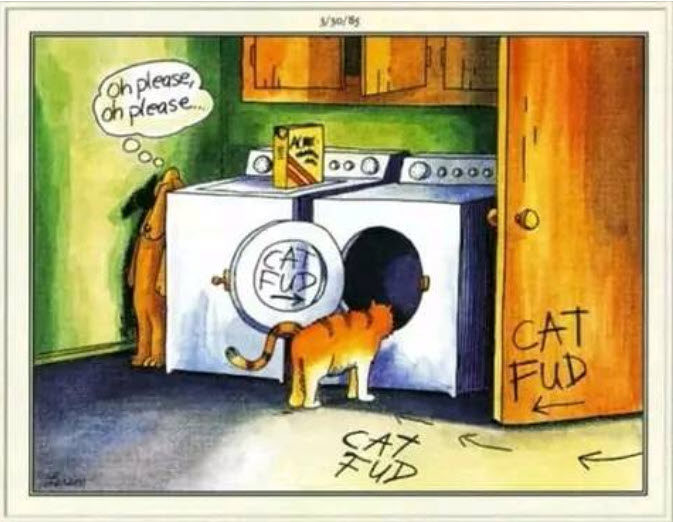
A single-panel comic is always some sort of distillation of its topic. I look at this one, and think: this is the moment of trial, where the hero (or it might be the villain) awaits the result of all his planning. We look at such a presentation and our story-telling mind spins out in all directions trying to fill in the blanks:
- Why is the hero doing this?
- Is this his first attempt? What happened last time?
- Why is the target going along with it? Gullible? Greedy? Deceptive (just sussing out the full threat)?
- How did the hero design this version? Who helped him?
- What if it doesn’t work? (What if it does?)
Suspense doesn’t work without advance planning. The reader has to know that something’s coming, that something’s in the works, even if the target doesn’t. (And even if he doesn’t know all the details until the trap is sprung.)
The particular seriousness of the trap also matters to our sense of suspense. A prank can be funny, it can be a running gag, it can illuminate character interactions and background, it can even have an unexpected important result — but serious suspense is an edge-of-our-seats issue which might have existential results for the participants. It might even be the primary crisis of the story, or part of some other important story point.
There are a lot of moving parts on the way to the trigger point of the suspense setup. With work, they can be made to bear the weight of a long build-up, visited from time to time every few pages, from different POVs. Maybe the actual moment of execution can be poised… and then maddeningly delayed. Maybe it can happen offstage, and then be only recounted later, or flashbacked, leaving the outcome in horrifying doubt in the meantime, where the reader knows more about what’s about to happen (or what may have already happened) than the characters can know, and really wants his world and theirs to synch up again.
The stakes can vary, from comic pranks, or sardonic commentaries from a theoretically indifferent universe (it always rains when the circus comes to town, so the target keeps skipping the (planned to be deadly) tight-rope act), to there’s-no-stopping-it-now deadly consequences with people that matter to us.
I like to tangle up side characters in their own problems, too, and have them carry some of the weight of enticing the readers to keep going, in a hurry to find out what happens. Then, when their suspense is resolved, let the readers run down the path of the greater threat still to come, for characters we care deeply about, and dread the possibilities.
Got some notable suspense work you’re proud of? What worked, and what didn’t? How do you use it?
** Note the cultural reference for the borrowed brand name in the illustration (ACME, courtesy of Coyote & Roadrunner). Clearly this is a moment in a long-running contest, where only the ACME brand will do. And note, it only takes that one word to bring in an entire universe of thwarted attempts.


 Mad Genius Club
9 responses to “Suspense”
Nimitz’ biography has an intense description of his command room during the battle of Midway. Everything has been building up to the decisive battle of the Pacific war, and now that it is joined, they can do nothing. They can’t even tell what is happening because it’s occurring during one of the many solar storms that jammed radio communications during those years.
All they can do is try to piece together a wildly incomplete picture of what is going on from the few snippets of radio chatter that break through the noise. And missy of those are ships calling for help in plain text. And not everyone was handling it well.
Interestingly, nearly every major battle of the Pacific war happened while a solar storm was disrupting radio communications. My suspicion is when radios were working both sides had a good enough knowledge of the field to avoid unfavorable engagements. It was only when radios were disrupted that the admirals or captains made mistake S that got them into bad fights.
The Battle Off Samar was, in part, not a crushing Japanese victory because all the American ships were misidentified and the Japanese did things that would have been necessary for the greater force they expected.
Not that it made it less suspenseful for the Americans.
The only time I really worked to build suspense was a 24 fanfic. I had spent a long time working on the villain’s character, which developed over time to become less risk averse, and I think that raised the stakes.
I’ve tried to build suspense a few times, with mixed results. I often end up having to go back after I finish the draft and add foreshadowing and adjust timing in order to get the tension and build-up that I need.
One rule I would say of story plans is that they can never completely work. There must always be some complication when contact with the enemy occurs. “We make a brilliant plan. And then we execute this plan,” is about as boring a story as I’ve ever encountered.
I don’t know …. What if the bad guy does get what he wants, in far greater quantities than he’d dreamed of? “Yep, you’re now ruler of the planet. Congrats. Here are all the crises, here’s the war that’s looming because of [alien entity] you cheesed off, and there’s a hair-pulling fight among your wives and concubines that you probably need to go take care of right now.”
Actually, plans can work. The trick is to not show the plan being drawn up, to prevent duplication.
I learned this from Brandon Sanderson: things never go right. Either you see the plan, and then it goes awry…
…or, like in heist movies (and Mistborn, which is a heist novel on same structure), the viewpoint character is kept in the dark about parts of the plan, and everything going awry turns out to actually be the plan.
The unseen plan doesn’t even have to be on the protagonist’s side. The villain’s monologued plan will go awry, but… “You fools! This was all part of my plan! Muahahahaha!” is perfectly acceptable.
And for advanced versions of this, there’s the Xanatos Gambit.
Order of the Stick normally goes for plan goes awry, but there’s one where it comes off perfectly. So we see it from the attacked party’s point of view.