[– Karen Myers –]
When I feel my fictional world is skimpy, not fleshed out enough, too much of an improv stage… why, then I go looking for a way to add more details. Not just any old odds and ends, you understand, but a whole bolus of complication that can spread through the soil layer and sprout in all sorts of unexpected ways, inserting complexity into the environment.
Here’s a recent example. Let’s talks about cats in my current complicate-the-world-building mission.
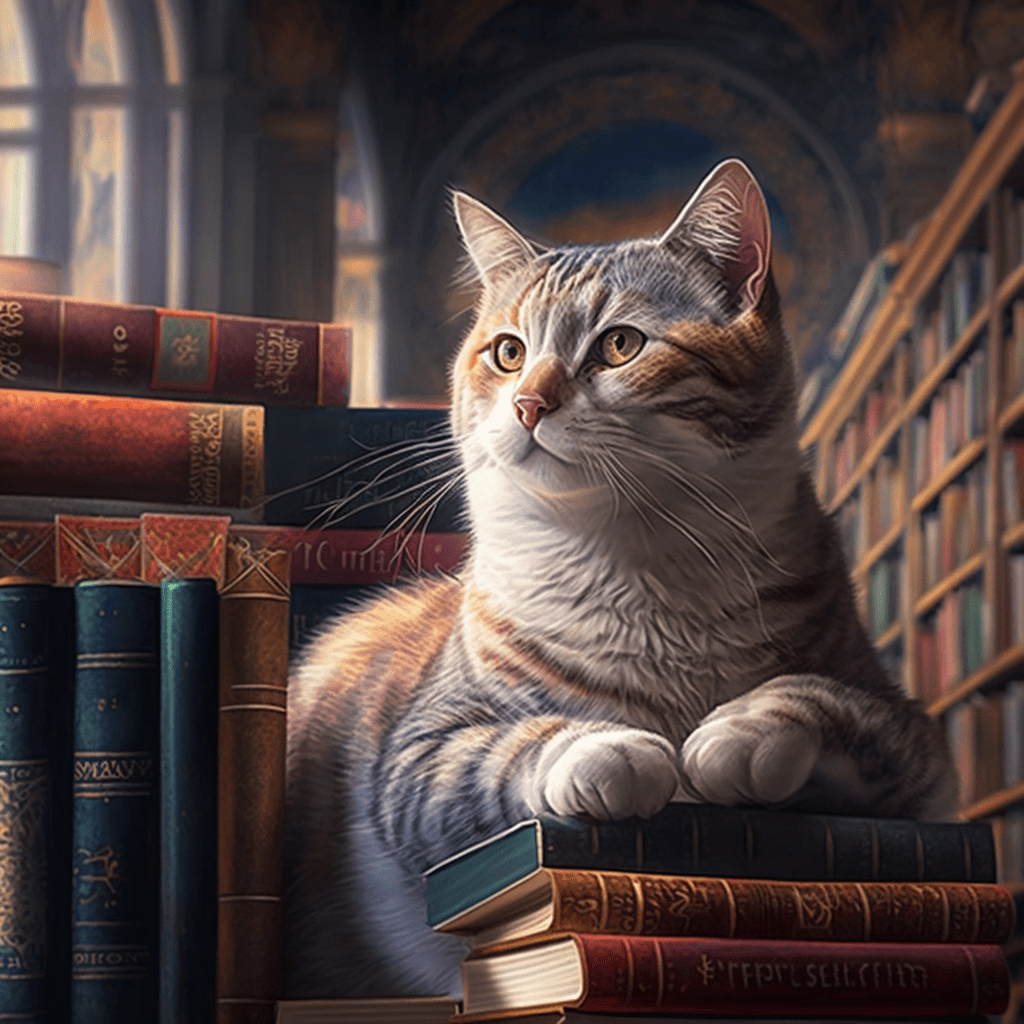
Premise: institutions and similar large buildings with a rodent problem (a century or two ago — and even now) kept working cats. So why don’t I add that to my story, where the primary setting is a wizard guild hall with a massive (6 floors) library?
When I start daydreaming about how to apply that to the manuscript, all sorts of issues with potential suggest themselves.
One cat or many? Let’s have a whole clowder of cats, volunteers who wander in, mostly, via the stable yard, and like the look of things. That lets me show different characters trying to remember the names of a changing mix of cats. This can be a character trait showing some differences between the people who remember vs ones who don’t. Memories of specific notable cats. Cats with preferences. Cats with opinions.
Let’s stipulate that we want cats in human spaces to be neutered. Well, I don’t have to worry about that being a luxury or technical issue in the faux-time period, because one of the other wizard guilds specializes in animals and has turned that into a lucrative business, a business which is beneath some of them and competed for by non-wizards, adding some complexity to local businesses. I wanted more details about other guilds, and this is an easy way to add some.
Let’s also stipulate that the groom/coachman/stable-manager acts as the Master of the clowder. He has a separate area in the stable with its own access from the yard where the cats are fed from individual servings in closeable cubbyholes, reducing competition for food within the clowder and allowing the Master to inspect the health of each as needed. All the feeding is done there, so the indoor staff doesn’t need to provide or clean up from the task.
We’ll have an outdoor midden in the stable yard, with (covered from rain) access from the guild hall. Cat doors were scarce in the real version of my period, but I declare them to be not uncommon, complete with a latch arrangement. That leads to things like usable cat doors at the base of doorways (in the door posts) for working spaces whose (human) doors can be closed, and the occasional latched cat door in the doorway of a bedroom, indicating where a cat in the past used to have access, providing some background for the character in the past who had one or more special favorites.
When my primary character sneaks into the stable via climbing a wall from the alley in the opening scene, now he’ll be greeted by a curious cat also on the tiles.
When he sorts the papers of his dead uncle in his dismal room, he can now share his thoughts with a stand-in cat from the clowder who has come by to see what’s going on.
When he runs experiments on some caged rodents as carriers of a magical property, he is observed by one or more cats underfoot who are determined to do something else with his test subjects.
Maybe an outside love interest has a cat of her own. What happens if they both try to move in?
Different sorts of people react differently to the presence of cats: primary characters, servants, students at the academy which is part of the guild hall. The cats react individually, as well. What do they make of infants or small children (run, hide, bap)?
Visiting lawyers, bankers, etc., may comment on this guild’s institutional cats vs their own.
When people are having conversations in the hallways, there might be cats (all or some) who make use of the furniture and have opinions.
When people use the library, they may notice a traffic of occasional cats going by, often with a dangling rodent. Some cats specialize in a single floor or area, others are travelers. Some cats will congregate as if they were sorting out the day’s responsibilities. (Or the night’s — rodent depositories may come into existence overnight.) Some cats may avoid certain spaces. Academy students might wager on their actions.
In a moment of comic relief, a stray volunteer cat may enter the stableyard to check it out. How does the clowder react? Individual members? Cats who are part of the clowder might occasionally wander the local streets and be encountered by their own people from the guild hall.
This wizard guild hall has a very large amiable dog. What will the dog think of the clowder, or they of him? Individual preferences? Buddies? Scaredy-cats? Mutual sleeping cushions?
The names of the cats (however well-remembered) are opportunities for references to all sorts of world/cultural objects: gods, heroes, villains, foreigners, famous people, attributes (some archaic – Fluffy vs Fido), etc.
Whew! That’s a lot of depth and worldbuilding complexity based on a single basic concept which is not part of the working story plot. It’s like adding an entire additional dimension — it can intercept everything else if you want it to, adding another concrete and vivid presence.
What could you add to a world you’re working on that seems insufficiently fleshed out? Maybe a critical resource could be scarce? Maybe the weather is changing? Maybe someone far away has died and the political ramifications are still approaching? Maybe a fashion is about to be overturned? Maybe a scandal has unpredictable consequences?
Stir the pot — you never know what you might come up with to help your world feel more… lived in. Complete with pawprints.


 Mad Genius Club
17 responses to “Amplifying your world-building”
Fun to have world-building interfere with the hero’s quest. Like, a religious festivity slowing him down.
Hmm, thinking about real examples from Spain and such that could be inspiration:
1) All the food markets are closed because it’s a feast day / holiday. (Don’t know if that still happens, but 40 years ago it certainly did).
2) Trying to escape Pamplona on San Fermin / the running of the bulls.
3) Accidently getting in the middle of the blood orange war in Italy
In two stories
1. The heroine could not consult a library until two days after the evening she arrived
2. The hero had to make excuses because he wanted to leave the village before the feast.
The archive closes between noon and two, because that’s just how it is. Or part of the museum closes when 2/3 of the staff go to lunch (Paris, 2011). The character goes to the bakery to meet his contact and discovers that it is closed on Thursday, because it is the only one open on Sunday and stores have to close two days a week (small town in Germany).
Ah, yes, siesta in Spain, although I recalling it sometimes being between 2-4 PM.
Or the restaurant you were supposed to meet at is closed for a week because the owners are on vacation (Jan 2002, Bologna).
Or you can’t get the product made because the company is shut down for two weeks (Italian companies in August; Chinese companies during Chinese New Year; probably Spanish companies in August too).
Pretty much in southwestern Europe from Italy to Spain to France (can’t vouch for Portugal or Belgium) shuts down in August. Too hot to do anything.
Farther north as well. Germany, Austria, parts of them close. Britain just has “silly season” when the news gets Odder (or used to.)
Vienna closes from noon on Christmas Eve until roughly noon on the 26th. Even ORF TV and Radio switch from the usual news, sports, and other things to religious broadcasts and Christmas programs. Only the worship services seemed to be live.
Be wary!
Such inconveniences may alert the reader to the hand of the author. It requires a deft touch.
A visit to the south coast of Nova Scotia decades ago revealed a restaurant that was closed for lunch, at lunchtime.
Oh, I hadn’t thought of cats. What fun! The thief who steps on a cat’s tail, the boyfriend who gets dumped because he doesn’t like cats . . . .ooo, the would-be victim of an assassin who is alerted by a sneeze.
Those are good 🙂 .
I have a underutilized placeholder character in the first books – the reclusive librarian (ex-Academy student with a backstory not yet revealed). She will become the generic favorite human for many of the cats, especially because it’s her domain that provides the best hunting. They love to show her their success. Rodent depositories are created near her desk, for her exasperated admiration.
I’ve been bothered about what to do with her for ages to give her more life — such a simple solution!
Of course, a volunteer cat that’s already pregnant could show up and create chaos in the clowder (and no doubt among the humans and the dog) via the different reactions to kittens underfoot, giveaway plans, adoptions, etc.
Road construction–or a desperate need for same. Emergency equipment of various sorts. Street vendors. The smell wafting from a bakery . . . yeah, just a mention now and then can really make a World immersive.
I feel like cats are one of those things you have to be careful about putting in your story, because they tend not to be content with a sidekick role.
I gave a character in one of my Christmas stories a cat, just to try to add some personality and make him less of a stereotype. The cat ended up not only taking over that story as the main heroine but a sequel to it as well.
Very true. The less I refer to them as individuals, the safer I will be. But it’s a similar problem for all bit-players — I have a bunch of servants where the light occasionally shines but not as a real issue.
In both cases, in a long series where there are lots of books needing varied opening scenes to kick them off, there’s a real utility for a new entry with a “problem from within” vs an external problem: a servant with an issue, a cat-related incident, a mysterious stranger, miscellaneous bad news, etc. — complications and plot to follow for the next 100K words.
I was describing the town of Neustadt in the current WIP as a relatively recently built place (too new for city walls, for instance) with a thriving trade in something or other (the heroine’s the main narrator, and she doesn’t know or care). It occurred to me to lay it out hub and spoke style, having been overly impressed by the Place de l’Etoile/Charles De Gaulle when I was in Paris. Might come in handy if the baddies attack, right? And since it’s secondary world fantasy, it doesn’t hugely matter whether this was a common layout for newish towns in the eastern half of the Hapsburg Empire in the 1880s, right?
Well, the baddies did attack, and a seasonal festival showed up demanding to be staged in the hub/plaza area, and the hero needed to talk to the priest whose circuit includes the dinky nearby village of Altstadt, and it turns out that all the local priests live in a presbytery just off that central hub, and so on. It was a stupid little thing I added because it appealed to me and it was an easy thing for the heroine to notice and navigate, and it’s paid huge dividends.