Hi, everyone. I’ve been down with a dreaded flu this week, so I have not come up with a new post. In the mean time I thought you might be interested to read an older post on getting around the solar system with new orbital schemes.
Enjoy. . .
When I thought about getting somewhere in a spaceship as a 13 year old it seemed pretty simple – just point the ship in the right direction and hit the go button. Most SF seems to feature ships with plenty of power, certainly for interstellar travel it seemed a case of point and shoot.
But travel in the solar system is all about conserving the precious fuel. The latest navigational schemes are all about maximising the efficiency, usually at the expense of the time of travel. Of course we are talking robotic probes here, so preserving the human cargo is not an issue, just the patience of the organisation that sends the probe (and the engineers and scientists anxiously watching it do its thing).
When Apollo 11 went to the moon in 1969, it followed the Hohmann transfer orbit (see below).
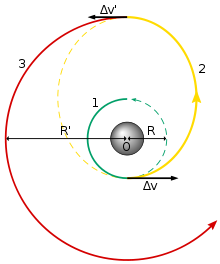
Relatively straightforward in concept, this basically takes the ship from one orbit to another orbit (1 to 3), with one half of an elliptical orbit (2) as the intermediate transfer step. This is nice and neat if you have high-thrust engines that can accelerate or decelerate (i.e. for going the other way) from orbit to orbit in a way that’s virtually instantaneous. In reality, you might have lower thrust, so the orbits are changed over a number of timed bursts, gradually increasing the orbit. These lower thrust manoeuvres require more Delta-v than the two thrust orbit transfer, however a high-efficiency low-thrust engine might be able to accomplish them with lower overall reaction mass. This is an advantage for small satellites where reducing the total fuel mass is critical.
The other alternative is to use the slingshot effect. The principle here is conservation of energy. The spaceship uses the gravity of a planet to increase its speed. The planet is slowed down by the smallest of margins, but for very little applied thrust the ship can pick up a real burst of speed. The Cassini probe used this approach when it journeyed to Saturn. It first set off toward the centre of the solar system undergoing two close encounters with Venus, then swung back past Earth and onto Jupiter before turning to Saturn. Again, like the Hohmann transfer that took us to the moon, this is all about swapping orbits via an intermediate orbit. What about just changing directly from one to the other?
There is another subtle approach that is being used to bring spacecraft to their destinations while using the lowest amount of fuel possible. This exploits strange regions of chaos that can occur in areas where the gravitational force of two (or more) bodies cancel out. The most well known of these are the Lagrange points in the Earth-Moon system, where I still imagine the O’Neill colonies spinning away.
This approach exploits the orbits that intersect with these ‘null’ points. Once inside the null point, a ship can apply a very low amount of fuel – and taking its time – cruise out of the zone and straight into a new orbit without having to blast away its fuel in a high-cost Hohmann transfer manoeuvre.
This scheme was used to bring the Japanese space probe Hiten back from Earth orbit to the Moon after it had all but run out of fuel. Edward Belbruno, an orbital analyst at JPL, came up with a scheme that allowed the probe to visit the Moon’s Trojan points (where gravity and centrifugal force cancel out) to examine cosmic dust. The scheme used the L1 Lagrange point.
Astronomers have observed a strange orbital network in the solar system where natural bodies take advantage of the ‘chaos’ in these null zone to swap orbits. One example is the comet Oterma, which was orbiting the sun in 1910, it changed orbit a few times, orbited Jupiter for a while, and then orbited the sun in a new orbit that brought inside the orbit of Jupiter. Then it had enough of that and went back to orbiting Jupiter again, then looped back outside the orbit of Jupiter to orbit the sun again (where it is now). Crazy but true.
Natural bodies seem to have a propensity to ‘change stations’ at these cosmic transfer points. The strange thing is that these points are truly chaotic – there is no predicting what will happen if a body crosses into them. They might emerge in the same orbit, or into one fundamentally different. We can exploit these by forcing the change – using a precisely timed bit of thrust. Of course the down side is it takes longer.
Just think where we could travel in the solar system if some form of ‘suspended animation’ and the length of journey was not such an issue?
Nice to think of these natural orbital transfer points housing space colonies and tourist resorts. Maybe casinos?
Cross-posted at chrismcmahons blog.




 Mad Genius Club
6 responses to “Weird Orbits”
Hmm, a casino located in a natural nexus of chaos . . . there’s probably a story in there, somewhere.
Yeah, if time weren’t a problem, you could get just about anywhere. We need artificial super-hibernation, so the body barely ages while cold. Not just because of running out of time to spend at the goal, but “sleeping for a year” no matter how much time passed on the outside, would be very bad for the muscle tone, even if pressure points and nutrition issues could be addressed.
We’d get a little blotchy, the way you make it sound.
For anyone not already familiar with them and wanting more information about orbits and space flight, I highly recommend these two websites.
Atomic Rockets
http://www.projectrho.com/public_html/rocket/index.php
Basics of space flight.
http://www.braeunig.us/space/basics.htm
The basic tradeoffs for traveling between worlds is between thrust, ship mass (including cargo and propellant), and travel time. The thrust available to rockets today require relatively low mass and long travel times to get between the worlds of the solar system. You need either fusion, antimatter or other high energy systems to reduce the travel time or increase the carrying capacity. Even then it can take an awful long time to get anywhere.
There are three ways to avoid the tyranny of the rocket equation.
1. Figure out a way to control gravity,
2. Ignore it.
3. Make the solar system smaller.
I’ve been looking into ways to do number 3 and have been trying to design a miniature solar system.
Any thought, comments or suggestions about this would be appreciated.
Very clever idea, the small solar system. Also, thanks for the other links,too. The WIP is about remediating orbital debris, and I’ve spent a lot of time with Wayne Lee’s To Rise from Earth. It’s about the right speed for me, although I do feel like an 8 year old with the big color picture book.
“The spaceship uses the gravity of a planet to increase its speed. ”
Does this mean something more than a planet’s gravity increases the spacecraft’s speed because the spacecraft is going toward the planet? I always puzzle over that one. It’s either very obvious or very subtle. I hope it’s the former, ’cause the latter looks really hard.
It always sounds like magic to me, but NASA makes it work. It’s the combination of the gravity plus the planet’s orbital velocity around the Sun that does the trick.
From the planet’s POV, the spacecraft comes in, whips around the planet and departs. So long as it stays out of any atmosphere, there’s no friction, so the departing velocity is the same as the approach velocity, just in a different direction. Now pan out. The planet is moving, That approach velocity is actually the combined velocity we saw from the planet _plus_ the planet’s forward speed. So that departing velocity is also the spacecraft’s velocity plus the planet’s forward speed, no matter which direction it is going as it leaves. So from a distance, we see the spacecraft zoom off. Depending on the angle of approach and departure, it could have gained as much as double the planet’s velocity. Go figure. Technically they transferred momentum. I still say magic.