by Chris McMahon
Since I’m off in the forest somewhere camping, being completely low tech, I thought I would do something completely different and natter on about modified steam cycles. Hopefully this will be of interest to SF types, or even steampunkers.
The conventional steam cycle, as used in typical coal-fired or gas-fired power plants, is the Rankine cycle. It is based on the use of water as the working fluid in the system, and so is limited in the temperatures of its application by properties of steam.
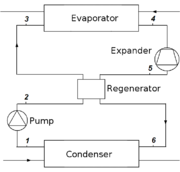
The typical arrangement of equipment is shown in the schematic above. The working fluid is heated to a dry, saturated vapour that expands through a turbine, delivering work (the Expander in the diagram). It is condensed back to a liquid and pumped back to the Evaporator where it is heated back to dry vapour. Typically a Regenerator is added to increase efficiency, preheating the condensed liquid before it enters the Evaporator.
Heat cycles are commonly depicted on Temperature versus Entropy diagrams – or T Vs S diagrams. They are a convenient way of visualising how the heat moves.
A typical steam Rankine cycle might operate between pressures of 0.06 and 50bar, which would require the boiler feedwater to be heated from ~40C to 265C, as shown in the T Vs S diagram below.
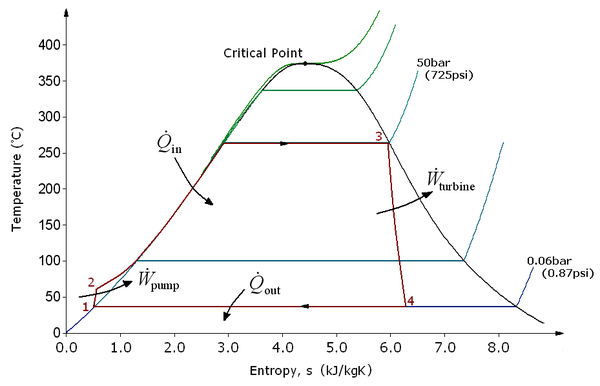
That means that there are immediate constraints when you want to use the conventional steam Rankine cycle to recover heat. For the example above, the heat source has to be above 265C. But waste heat might be available at 150C – or in an even lower range from 50C to 100C – so there needs to be alternatives.
The Rankine cycle can be adapted to waste heat applications by using more exotic organic working fluids that allow it to be applied at much lower temperatures as an Organic Rankine Cycle.
There has been a lot of work on Organic Rankine Cycles (ORCs) for small-scale and renewable power installations. There are now various commercially available “off the shelf” ORCs for applications up to 1MWe (1 mega-Watt electrical power).
Organic compounds are used for the working fluids in these systems because of their thermodynamic properties and also because they generally have a higher molecular mass than water. This gives relatively small volume streams and results in a compact size ORC unit. It also enables high turbine efficiency (up to 80%). Some examples of some typical compounds are CFCs, freon, iso-pentane, toluene, ammonia and silicon oil. There are also various exotic fluids developed by vendors and other refrigerant mixtures.
Recovering waste heat from an industrial process is not only energy-efficient, but also leads to a reduction in overall greenhouse gas emissions, as well as potentially producing a new income stream from generated electricity.
Hot stack gases are a prime candidate from waste heat recovery. Unfortunately the standard Rankine cycle (steam cycle) needs higher temperatures than most stack gases can provide, which is why organic fluids are used in a modified version of the cycle called an Organic Rankine Cycle (refer to last weeks article for more information).
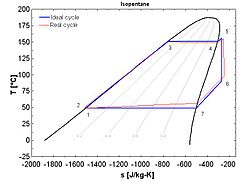
A T Vs S diagram for an Iso-pentane ORC Cycle is shown below.
Over the last few decades continued development of the ORC working fluids has extended their range of operation. Multiple refrigerant mixtures have been used to extend the range of potential heat recovery down to 24C. However you can’t really escape thermodynamics. There always needs to be a ‘hot’ and ‘cold’ reservoir. Accessing heat at such a low temperature requires that you reject the heat to a cold reservoir at even lower temperature – say 5C.
There is also a maximum limit to how much work you can extract from any engine working between two temperatures – this is called the Carnot efficiency (H). This can be defined as:
H = 1- TC/TH
The conventional steam cycle above might operate between a rejection temperature (i.e. cooling water temperature) of 30C and the 50 bar steam temperature of 265C (temperatures have to be converted to degrees Kelvin):
H= 1 –(30+273)/(265+273) => ~44%
Conventional steam plants operate at a typical efficiency of around 33%, which is as close as practical considerations allow operators to get to the theoretical maximum of 44%.
The efficiency of the ORC systems for the recovery of low temperature heat – even though better than other systems – will be low due to thermodynamic constraints.
For the above low temperature ORC example (recovering heat from 24C):
H= 1- (5+273)/(24+273) => ~6%
Only 6% of the incoming heat can be potentially captured. This is the theoretical maximum – what you could achieve in practice is much less, perhaps half. For this reason, very low temperature heat sources are rarely pursued. At 3% efficiency, 97% of the incoming heat has to be rejected through the condenser. In practice it is a high capital investment for little return in power.
Most ORC applications will be recovering heat from above 80C, and may have actual efficiencies between 10% and 20%. The fact that electricity is such a valuable commodity often makes the investment worthwhile, despite the low efficiencies.
One way to improve the efficiency of ORC cycles is to use a supercritical cycle.
Supercritical fluids are compressible like gases, but have a density much closer to liquids. Their properties allow close temperature matching to the heat source. They also still retain enough density to usefully drive a cycle. This makes them excellent candidates for modified thermodynamic cycles where their properties enable increases in efficiency over standard cycles.
A supercritical cycle is capable of giving a 40% lift in efficiency e.g. for a potential Carnot efficiency of 36% at 200C, ORC might deliver 16%, the supercritical ORC cycle will deliver 20%.
Well – I hope you found that interesting. Meanwhile, I’ll go and boil the billy. . .




 Mad Genius Club
5 responses to “Taking the Old Steam Cycle to New Places”
Nice,
More science/information/research posts are always welcome.
You know, I keep coming across “steampunk” where they didn’t even hang the thinnest veil of verisimilitude. Or to quote my son “Steam doesn’t work like they think it does.” From now on, I’ll send them here. 🙂
Hmm, remote, untrammelled forest–with internet. 😉
Sorry, couldn’t resist. I love this future, even while I miss the past. Every once in a while.
Supercritical fluids sound very interesting. Getting rid of heat is a problem on spacecraft. I wonder if a large vessel could utilize waste heat for generating a bit of extra electricity, thus lowering the total fuel usage, before finally radiating it all away.
If you have a fairly constant demand, and not a large one (say, for instance, running the habitability systems on a starship), there’s also always the option of bimetallic thermocouples. They don’t give you MUCH power, but the right combination of metals can yield measurable output at almost any temperature. Make a web of them between layers of the hull, compartmentalized for damage-control in the event of a micro-puncture, and vent waste heat into a fluid moving through that web? A fluid that reacts to micro-punctures the same way platelets react ro a cut fnger?
Excellent post, for MANY reasons. Not least of which, I now have a bona fide not-Navy-related source I can point to when I need to explain things I learned on my old job … 🙂
On the subject of recovering waste heat, most specifically stack-gases: Circa thirty years ago, the Russians dabbled with the idea of Frankenstiening a HUGE magnetohydrodynamics (MHD) stream onto the waste gases from an equally huge (half gigawatt-range) coal-fired plant. Though it DID reach engineering breakeven — more power recovered from the MHD than it took to run it — the plant never achieved economic breakeven (even with the cost-avoidance it gave them by cooling the gases to the point that they could be scrubbed for ecological compliance much more cheaply). The problem was largely being a victim of their time, though, I suspect. The materials and systems for operating the magnets weren’t up to the task. Those areas have seen prigress in thirty years …