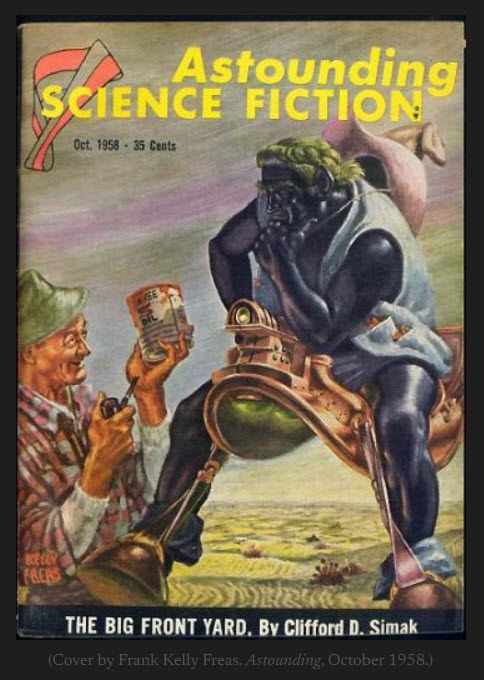
Clifford Simak: The Big Front Yard
Novella Written 1958, won 1959 Hugo for best novelette
Link to Text It’s free, it’s not long, go read it — it’s a classic for a reason.
(AI Overview: https://www.google.com/search?q=clifford+simak+story+the+big+front+yard&ie=UTF-8)
(I remember at the time that it was fascinating seeing how commercial computers were thought about, following the missile launch era, when TV’s were getting color… and thus what getting a “spare computer” was like in 1958 (and, yes, I read this well before I ever saw any real computers more sophisticated than modified Friden machines (having been reading SCIFI since I was a child in the ’50s).
At the age I read the Simak story, I was already making a run at my childhood “I’m gonna be a mathematician” ambitions (until that fizzled when confronted with my limits in college, and I fell back on dead languages and Tolkien-esque sources, aka traditional tales, and it awakened in me an interest in this strain of traditional tale-telling, no less a convention than the old Norse stories or even the Matter of Britain, not to mention Homer. I hadn’t really noticed the American roots of such things before this — not exotic enough.
***
I bring up this story here partly as a general recommendation (you ought to know it) and partly to comment on the well of “quiet Scifi” tempered with humor and cussedness and Americana — its focus not on high-tech but on the can-do down-home characteristics of the just us normal clever undaunted folks here. We’re getting some of that attitude back in a few of the indies I’ve encountered, and while a lot of the public discussion points to historic inspirations like Heinlein, I see people like Simak as an equally strong source… more focused on tying the genre neatly to practical confrontations and humor and American story-telling traditions than to military or heroic or world-ruling actions. In the world of Fantasy, I see Manly Wade Wellman occupying an analogous role in tying American story traditions to the “modern” speculative/horror genre and providing continuity of a particular flavor. Both of these authors are out of fashion, to some degree, but they’re both at the heart of their movements, and for good reason.
Who else is part of this older Americana trend in speculative fiction, in its various flavors (SciFi, Fantasy, Horror, etc.), in the swell of the paperback revolution as it matured, marching along before the genres fully modernized? It’s a fashion that had a good long run, clearly shaped by the magazine reader preferences of the time, like some of the other WWII popular books of a similar ilk that refused to completely modernize yet. Even today, some of the low-key mil-sci-fi where the focus is on cleverness of problem-solving rather than fighting or strategic skills reminds me of some of this period’s tropes. Better to be a cunning-man than a fool.
Do you see these sorts of traces of the older tales in these genres?





3 responses to “Pastoral Science Fiction”
A set of detailed reviews and commentary: https://sffremembrance.com/2022/08/10/novella-review-the-big-front-yard-by-clifford-d-simak/
Wellman and a few others also fit into the “regional” category, something that is still popular but no longer published all that much. These are stories with a universal plot core, but also shaped by the lore and culture of a particular area. “Cowboys vs. aliens” in its various flavors might be one, or A. D. Foster’s “Mad Amos Malone” tales. Since younger generations don’t get exposed to the originals, and in many cases to regional folk lore, the sci-fi and fantasy versions have become scarce on the ground. I hope that changes soon. People think that the US has become homogenized, but it really has not if you start to dig.
The UK as a whole ”regional/rural horror” subgenre where the supernatural is a strong element in many cases.
Nelson Bond doesn’t get enough love or credit for his own strong America-centric stuff.