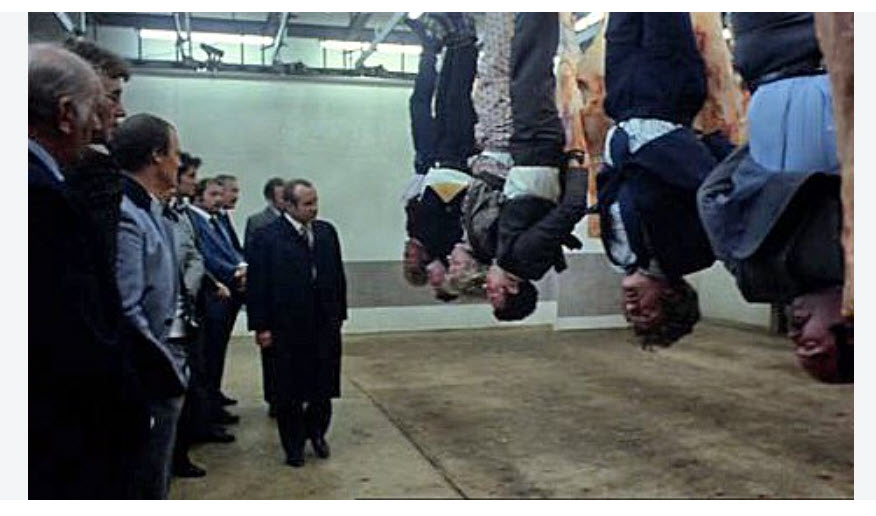
One of the great strengths of cinema vs text is the ability of film to present the commentary of non-player characters or non-speaking characters without a word spoken. (And if you’ve never seen these two sample movies below, I highly recommend them.)
(The image above is from The Long Good Friday, where an interrogation is in order and the “guests” will be asked to cooperate.)
Think of the ending of The Long Good Friday, where the gangster hero (Bob Hoskins) who was planning to become respectable is trapped through no fault of his own and is about to exit the scene (as well as his life), and never speaks a word for a long silent inescapable ending headed offstage. All we see is his facial expressions from his captive position in the back seat of the car that is whisking him away to oblivion. Every emotion, every bit of dismay, all the ruefulness of his unexpected failure, all the regret, the certainty that he was doing the right thing, those he leaves behind… you can see each of these thoughts eloquently cross his face, as the curtain closes. Nothing needs to be said.
The ending of The Long Good Friday: https://www.youtube.com/watch?v=VmUcgPmWyVY
Or take Blood Simple, the debut thriller movie of the Coen Brothers, with its equally eloquent ending. There are any number of villains and good guys, and a surfeit of people who have no idea what’s going on and what anyone is doing, or what their motivations are. The movie is a tribute to people who are clueless but active, each with their own motivations, good and bad. At the end, the major bad guy fails to kill the (sort of) good girl, and, as she almost accidentally sets him on his path to mistaken identity destruction, the last thing he sees, after realizing that she doesn’t even know who he is and what he has or hasn’t done, and has come to stupid conclusions about the whole plot he set in motion to his own destruction, is a gathering heavy drip from a defective faucet about to inexorably hit his face on a bathroom floor. Death, accompanied by ignominious plumbing drip. The fact that he was brought to this at the end by this particular mistaken girl is almost immaterial, and he laughs in appreciative chagrin as he pointlessly dies.
The ending of Blood Simple: https://www.youtube.com/watch?v=CNVp2akDDGE
Mind you, every Coen Brothers movie is replete with eloquent objects that often know more than the characters, and occasionally remind the viewer of this via an unexpected shot. Everything is alive. Everything has an opinion, whether it makes a sound or not.
We forget this sort of thing on the written page. We feel it necessary to describe everything that matters, and we have a tendency to narrow that class to sentient beings with agendas. But what about the rest of the inarticulate world? The broken heirloom that reminds someone of ambition? The smear of dirt that calls attention to a recently closed window? The pigeon in the street that distracts the concentration of the horseman? Some of these presences can aspire to speaking parts — the stray dog that later indicates a villain — but most operate at second hand, reminding the reader, and possibly a character of something relevant to the story itself.
Characters can be defined against each other by what they do or do not notice, by what they do with the items they encounter. Or the author can speak directly to the reader by hints, direct or subliminal.
Personally, I like this sort of thing. I like fictional commentary from the scenery, especially when it seeps into the consciousness of the characters and shapes bits of the story mechanics. It allows me to keep a stray dog on a street when I can’t easily adopt it into a character’s household for the long haul.
What do you do with non-speaking clues and scenery?



Leave a Reply