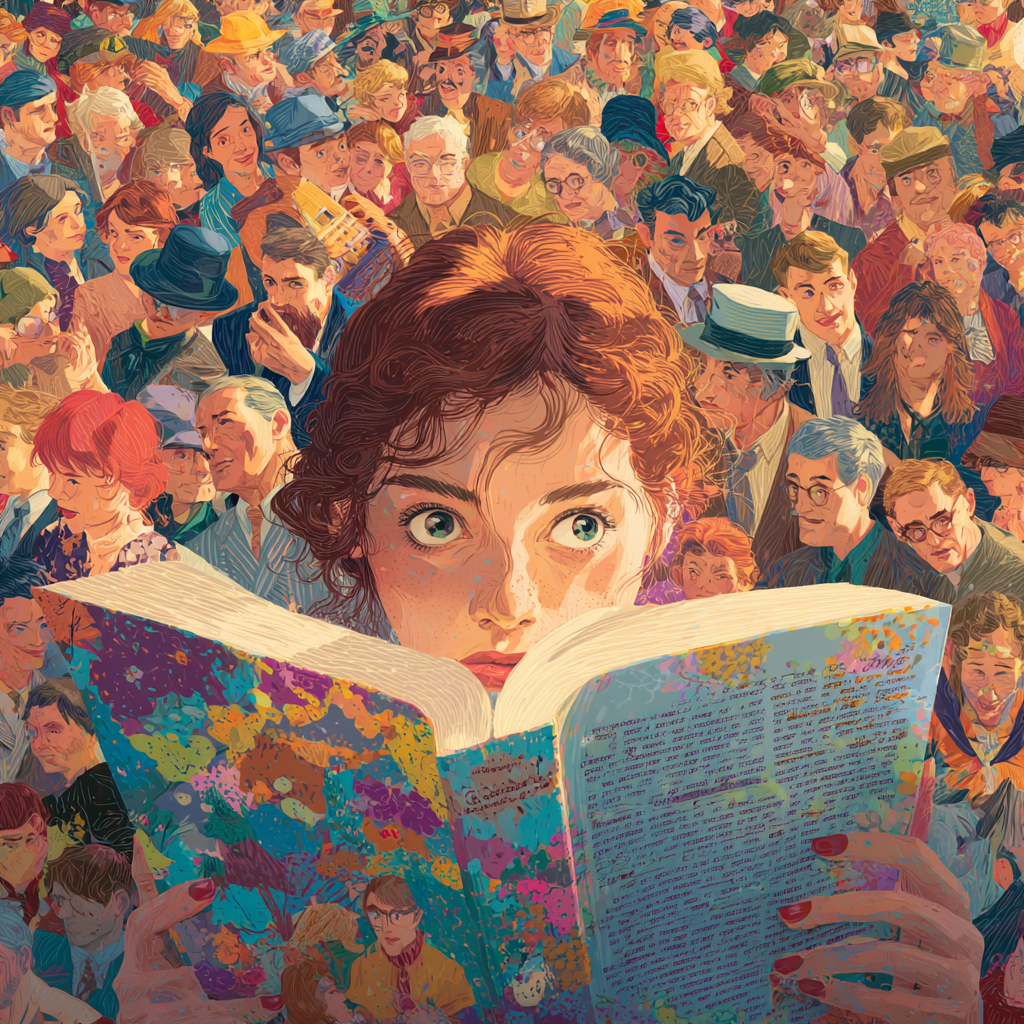
I like a series as much as the next reader, and that’s pretty much the form I write in, myself. So I’m reasonably comfortable with stories that have quite a few persistent characters in them. That being said…
These days I’m disheartened when I pick up a series entry in some genres where the first few pages are concentrated dumps of family members in multiple generations, and/or all their friends and acquaintances, too. I’m not getting any younger, and I dread trying to keep them all straight, when they resurface halfway along in the action, or (worse) three books down the line, when I’m supposed to remember their relationships from way back when.
Romance and Mystery/Criminal categories are both high in this, but Romance is the larger irritant. (At least you get to keep knocking folks off in the criminal categories.) I want to see the characters in individual books get through their lives, in small groups, not entire clockwork ensembles of the ones from the previous three books, and their descendants keeping the machinery going.
Hell is taking it into the next generations, not to make some grand Victorian point about inherited sins, but just to keep the clockwork ticking away, going down the list of siblings. It’s all too completist for me, and I never liked Russian novels.
Practically speaking, in my own Fantasy work I think of my core characters as an ensemble that assembles slowly and changes slowly, with visiting inputs from new friends and foes mostly local to an individual book. Police procedurals mostly work this way, too, with the forces of order as the core ensemble, and the villains and victims mostly local to individual entries.
How do you keep order in your own corrals? How many characters does it take to be stuffed into something you’re reading before you fling things at walls?

 Mad Genius Club
14 responses to “Overpopulation”
As a writer, I’ve got lists. Which I try to keep out of the actual writing. I’ve got several core groups–like the detectives in one city–and some recurring characters, like judges, or their bosses . . .
And while I’ll occasionally have one of the Main Characters from one book show up in another . . . I get complaints from my early readers “I don’t remember who that is!” so I’m trying to limit it.
As a reader, what I really hate are those “early introduction” chapters, where the characters get named, get titles, get relationships, and then the dialog tags “avoid repetition” by swapping between name, title, and relationship.
It makes it sound like there are three or four times as many people there. “Smith”, “the Earl”, and “her brother” all being the same person . . .
It makes it sound like there are three or four times as many people there. “Smith”, “the Earl”, and “her brother” all being the same person . . .
Like so many Russian novels, which have at least three different names for each character, depending upon to whom they are speaking.
Like Pam, I’ve got the protagonist, close relatives of business associates, and that’s it. The one “group of characters” semi-series I started, the main character and female lead get married at the end of the book. The next book is about two girls and two of the guys from the earlier story, with the others shifting to supporting roles. Ditto the third book. This is a convention with certain types of Paranormal Romance, even though these books are not PNR.
Otherwise it is a small cast, because trying to keep up with a Weber* of characters? Not possible.
*One Weber – a hundred named and described characters. Ten Webers equals one Tolstoy.
Love your Weber scale! 🙂
And the classic Chinese novels are in the multi-Tolstoy range.
I’ve never particularly had a problem with this in romances. It’s just a convenient linking mechanism. I have occasionally had trouble with mysteries that did a bad job of distinguishing between suspects, but most mystery writers worth reading only do this towards the end of their career, due to either age issues or substance abuse issues. For genres involving complicated military action with many POVs (which arguably means Tolkien & imitators as well as Weber & imitators and Clancy & imitators) I usually got pretty good at skimming to the POVs I cared about.
In answer to your questions at the end:
I had ambitions to read Solzhenitsyn’s Red Wheel series about the Russian Revolution, but I’m stalled at page 135 (of 850) of the first book August 1914. I should have been warned by his Gulag Archipelago, which I’ve still never finished although I read at least a third of it. Of course it doesn’t help that most characters are referred to by several names/nicknames. I know, Russian novels. Sigh. Just to be helpful it has a listing of names, birth-death dates, and single sentence bios of the 56 historical characters that feature in the novel. Just way too much for me. I suppose that’s an extreme example.
On the other hand, there is my wife’s SF thriller China Harbor: Out of Time. She has 13 major characters in some 400 pages, but each are introduced as they interact with the protagonist or intersect with her story. All of them are brought vividly to life, and all figure prominently in the story’s action. I don’t think I’ll ever be able to pull off such a thing.
I have no plans on writing a series, and I guess I’ll stick to the few characters my brain seems capable of holding.
Well, I wound up writing a family saga, but each of the volumes in it focuses on a relatively small portion of the cast of characters – the other kinfolk might be casually mentioned.
Just to keep it straight for myself, and for the Alpha reader who first suggested it – I put a family tree at the back of each book in the series. One of the first families that I focused on had nine children, eventually – and I did have to keep reminding myself of their names, and how old each child would have been in such and such a year. I didn’t want to do the family trees at first, because it would give away certain plot points in advance (marriages and deaths, et cetera) but eventually I saw the sense showing how each group of characters in an individual novel were linked to the others in the series.
I created a spreadsheet for character ages at certain points in the story for my 40 year family saga (only 7 children). It was very helpful.
I had a spreadsheet also, with that information logged into a column. I also had a column for current events, controversies – things that people at various times would have been talking about, or events that would have been of serious local concern. This helped, especially when weaving the plot around them, and dropping in comments about them in casual conversation between characters. This is enormously helpful in writing historicals.
It annoyed me no end in the Mel Gibson movie The Patriot – that although seven years passed from the beginning to the end, the children didn’t age at all! Serious continuity error, there.
Yeah, important dates are a big issue with my new novel. Advance Guards was set in the future and not involving world events, so I didn’t have that problem. The new novel is set in 1968-1969, so it’s very important to keep to the period. I already have a long list of songs that were playing on the radio in those years and a list of dates where big events happened. I don’t trust my memory from a half-century ago.
Yeah, family trees don’t help me much. Probably because I’m spatially retarded. Birth, death, and marriage dates aren’t enough for me to connect the dots about who was an old man when another character was in their twenties. But that’s probably just me.
I’m definitely a Eurema’s Dam kind of guy.
I am working on sequels to Even After and deliberately giving the families in the fore-front few children. Others have more.
There’s a long-running anime where multiple generations of aliens and humans have this clan that goes and does things out in space. I could never get into it because the backstory you’re supposed to know is huge. Aunty Bunny who dresses so cute is also the one that killed a dragon one time, and you need to know that for the jokes to land.
My character list is probably too big. Every book a few more people arrive to join in. The series is long, so now there’s a lot of people rattling around doing stuff. I have had to make lists of who lives at what house just to keep continuity. If even I need a list, the reader is going to be buried.
So each book may contain references to other people from other books, but they don’t all need to be in it. I try to keep it down to five or six except for parties. ~:D