Well, that partly depends on the definition of “good for you”, doesn’t it?
One sort of harm we recognize is immaturity. We can debate the details of that, with regard to things like pornography, but I still remember, more than 50 years later, the impact of the material in The Painted Bird (Jerzy Kosinski) when I chanced across it on my mother’s bookshelves (she was auditing classes in the local college) in my mid-teens. It wasn’t the sexual stuff that was so disturbing but the detailed demonstration of torture and indifference to harm that made it so viscerally indelible. No doubt that was the author’s point, with regard to the causes and evils of war, but it was the first time I had encountered such an authorially-fascinated exploration of evil, in a world where corrective justice is absent for the story. (And perhaps, in reality, since these events or events like them happened).
Well, why should this matter in a fictional story? An author should be able to write anything, and I should be able to read it… it’s just words, after all. But in the worlds I create, I have moral opinions, and that didn’t come from nowhere — I have them when I read, too.
For me to sink into a story, I have to sink into the characters. I expect the author to define them and then demonstrate their behaviors and goals. Certainly they’re not all admirable characters — where would we be without villains? And even villains aren’t all despicable — many have a great sense of humor. Opposition isn’t immoral, necessarily. And it can be fun laughing at incompetent (or unlucky) villains.
But the morality does matter to me. It puzzles me — I’m not religious (years of convent school at a tender age cured me of that). But something slipped in. Something civilizational. I can accept a good guy losing, in the end — that’s what we call tragedy, fatal flaws and all. But I can’t accept not wanting him to win. If I end up cheering the opposition leader at the end, it’s because he’s made himself a hero to me instead of a villain.
This guides the stories I buy as well as the ones I write. The stories I want to read all have some sort of moral compass, and the ones I write, even more so. There are people who don’t give up, people who have to make mistakes and learn, people who are unlucky but trying, and people who deserve to die. I perfectly understand that there are other sorts of stories, and those have merits, but it’s not what I do.
What about you? And why?
 Mad Genius Club
9 responses to “Are all stories good for you?”
“…it’s just words, after all.”
This is the type of post-modern argument I find so trying in the young. No, it isn’t “just words.” If it was, no one would bother with it.
That’s why there’s no torture in my stories, no horrific murders, no sex. Because it isn’t just words. These are events that become ‘real’ to the reader. They’re just as real as a newspaper story. Maybe more real, given newspapers in 2025.
I stopped reading around 2012 because so many of the books I picked up seemed aimed at harming their audience. Death, destruction, betrayal, apocalypse, I don’t need to hear about it. Y’all can keep that s**t to yourselves.
So in my books, nobody dies. That character you like will still be around at the end. Even the bad guy doesn’t die. Many will decry that as pulp, but I’m the author and I get to say how it goes. If you want disgusting, go read Charles Stross. He’s got it down.
I read graphic post-apocalyptic fiction, and some graphic sado-sexual stuff, far too young. That warped me, or rather, strengthened a warped part of me further. I did NOT need that. It was not good for me. Now, I want good guys to do well, evil to be punished or at least defeated, and a sense of “there is right, and wrong, even if it not the same as ours. And some things are over the line.”
There’s enough darkness in the world without me adding to it, or dragging other people through it.
I’ve written enough bad stuff for a good long time. Enough fascination with the yuk that its ick by now, Enough gore porn to be over and done with it.
Now though? I write things that aren’t so bad, mostly. Good is going to win. Bad stuff will happen, but it won’t be glorified and adored. Characters will die, some tragic and some frustrating, but all will be part of the story even after they are gone. My stories demand challenge for the heroes. They can’t fail, grow, or adapt without it.
Endings where it’s all grimdark awful and all that’s good gets a tragic pointless ending is boring. Those heartstrings are too bloody easy to yank on. Producing things like believable hope, honest respect, and true virtue are much taller mountains to climb. Too saccharine and you lose your readers. Too fake and they get kicked out of the story.
Goodness needs a firm foundation to fit right. There needs to be layers to it or else the mind rejects it as unpalatable. It needs reasons and actions both. The virtues need to be refined over time without overemphasis. Not an easy task.
And goodness *needs* an opposite for it to truly shine. The more vile the villain, the more virtuous the hero, as it were. If there be darkness, let it be chained to purpose and not simple ebul for ebulsake. Heroes without opposition become hollow and may end up going bad.
I remember getting through the first two seasons of the British House of Cards, and ending up not wanting to see what happened in the third season.
Not because I didn’t want him to fail, but more because spending more time in that world felt unclean.
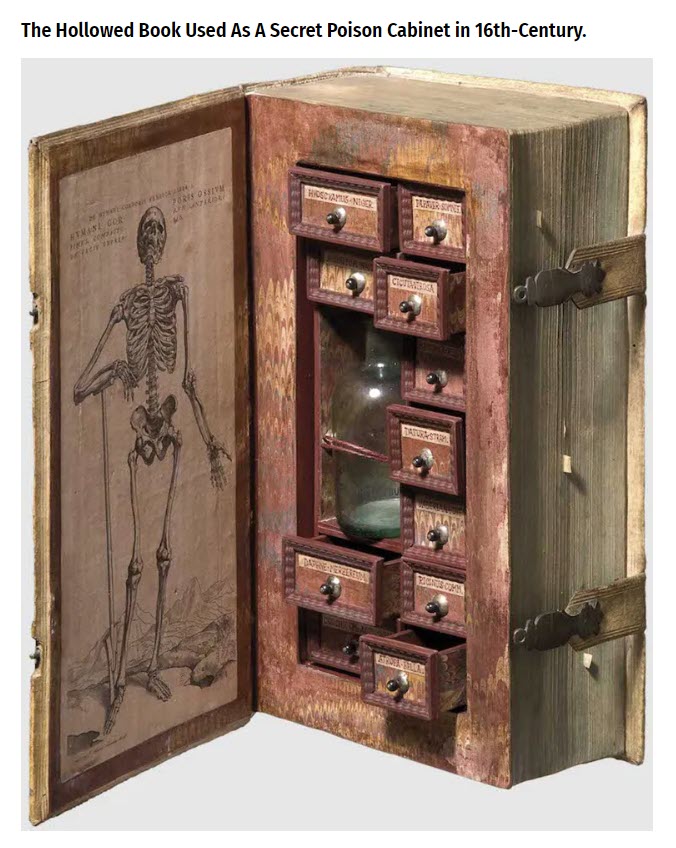
I have a hollowed out book. It’s not filled with a secret poisons but owning it thrills the part of me that loves hidden rooms, secret passages, and revolving doors.
There’s plenty of stuff out there that I don’t want to read. Even if evil getting away it is “realistic”, well I am reminded of a quote from L.M. Montgomery “Pine woods are just as real as pig sties and lot pleasanter to be in.”
If it’s just words, it hardly matters which ones you read, then? So there could be no possible harm in censorship. After all, the stuff prevented is just words.
I remember reading some gruesome stuff as a boy/young teen. Though looking back I think it did less harm than a steady fictional diet of that sort of sneering cynical mockery presented as “humor” in which everything decent and good is treated as stupid at best and as more commonly as sheer hypocrisy.
There are certain books, and styles, that I like. And there are certain other ones I don’t care for, sometimes avoiding them completely.
I tend to avoid erotica, mostly because it’s just not a genre I care for. There have been books I’ve read with sex scenes that made sense within the story, but there have been others that stuck out as unnecessary and out of place. Another genre I avoid is stuff with torture. It’s not so much the gruesomeness of it, as I’ve read stuff both fiction and non-fiction that have used it to make a point, but that most stories don’t require it and seem to add it as some sort of depraved attempt at sensationalism.
Dystopian fiction requires me to be in a certain mindset to enjoy. Whereas a good hero’s journey, like a western, though formulaic, can be read at any time with any mindset.
Interesting topic. And I do wonder if the number of stories of highly detailed, questionable morality by its villains and heroes is part of the problem with our current western society. The end justifies the means. Steven Brust’s Taltos series about the life of an assassin is a fairy mild example. The Arrow series on TV started with Oliver Queen as a vigilante killer. Martin’s Game of Thrones (both TV and the books) is probably among the worst of the most recent examples of gratuitous gore and depravity. (I honestly could have done without the Bolton torturer scenes.) And John Wick? Small wonder we have people taking shots at our law enforcers doing their jobs to clean up the violent, vile, and depraved.
Shooting at law enforcement is not Robin Hood and his merry men taking down King John’s tax collectors. But a lot of people have picked up this idea that they can be the anti-hero and the admiration of the world, when the reality is they’re still the bad guys doing evil. Literature about bad and evil doesn’t make people bad or evil; but it can fertilize what’s already there. I think the question a writer should ask themselves after they’ve got their draft written is whether the detailed evil is necessary to the story, or if reference to it is sufficient for the reader to know it happened, and engage their feelings of threat, horror, or disgust without making them wallow in it.