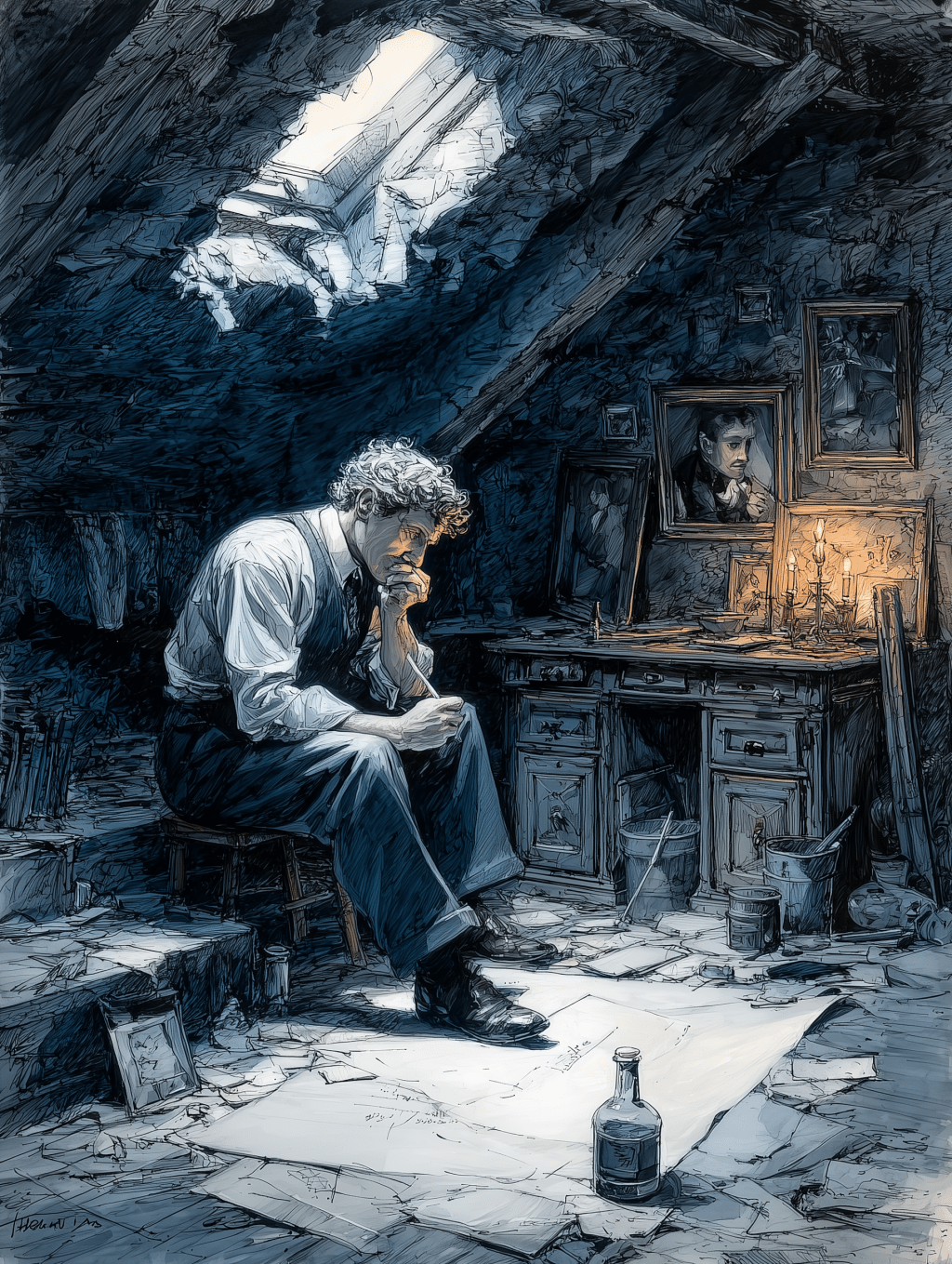
We all know the mark of a true artist is that they’re never successful in their own day, right? So, if you’re a truly great writer you should not expect to ever make money.
You’ll be poor all your life, living in a drafty attic with mice for their sole company.
ARRRRRRRRRRRRRRGH.
The myth has some support from people like Van Gogh. But they are the exception, rather than the rule, and usually the reason they didn’t make money was more their personality (and in Van Gogh’s case mental issues, obviously. I mean we’re all a little mad, but he took it to extremes) than the quality of their work being so superlative that mere humans couldn’t understand it.
Most artists, writers, etc. who are later judged to be great did quite well in their own time. Yes, there were also people who were loved in their own time and afterwards judged to be not so good. That’s fine. Every era has their silly infatuations.
However, very few artists/writers/etc who died in obscurity become great after their death, for the simple fact they weren’t heard of. Ever. Even if they had in fact been great, they disappear without a trace.
People who never heard of you can’t suddenly realize you’re great.
And there you have my entire problem with the “real artists starve; if you’re successful, you sold out” myth.
It encourages several forms of self-destructive behavior.
1- It encourages you not to try. No I don’t mean it encourages you to give up before you even start. It might do that too, but that’s secondary.
But it encourages young artists/writers/musicians to be afraid of success. Because if they are succeeding, their stuff must be cr*p, right?
No, not right. Not working consistently, refusing to take that step up to being more professional, etc. don’t make you a better artist. You know what makes you a better artist? Working every day. As hard as you can.
2- It encourages artists and writers (particularly writers) to be obscure and hard to understand, in the belief this somehow makes them better.
This is stupid because art is many things, but the thing it is the most is communication.
If your art isn’t communicating with the reader/viewer/listener, it’s not art. It’s just onanism. Because it involves only one person and it might give that person great pleasure, but communication it ain’t. (Don’t forget to wash your hands.)
3- It makes writers and artists feel guilty and somehow less important if they’re making a living from their art.
After all, if they’re doing it for the money it must not be very good.
That’s nonsense. In our place and time, money is the sincerest form of appreciation. I want people to spend their beer money on my books. That means it’s worth something for them.
4- It encourages all forms of self-sabotage, from truly appalling, horrific covers because “it’s what’s inside that counts” (you know who you are) to a resolute determination not to publicize.
Now, guys, I’m one to talk on this, though my problem is mostly that I’m so fascinated by the writing I can’t figure out how to promote. I mean, I ran an ad on Amazon, but I must have done everything wrong because I didn’t sell a single book from it. So, obviously more study is needed.
BUT I do at least do some promotion with the songs about the book, and the sound track and short stories in the world (Okay, that was accidental) and all sorts of things like that which… well, they’re not setting the world on fire, but they do keep the book selling, little by little.
— and now I need to put my money where my mouth is, and go put butt in chair and hands on keyboard to finish Witch’s Daughter. (At least I’m sleeping! Which helps.)
Just…. come down from the attic and do make an effort at creating understandable art (or craft. Really good craft works) and let people know it exists.
They can’t buy what they don’t know exists.



 Mad Genius Club
13 responses to “Artists in Garrets”
For some branches of academia, obscurity is a badge of membership and honor (See Roger Scruton’s Fools and Firebrands, an evisceration of philosophy and linguistics, for depressing examples. Or don’t.) Literature? Maaaayyyyyybe, for some kinds of literature (Gene Wolf and John C. Wright don’t count). For genre fiction? Oh heck no.
I’m not an Artiste. I tell stories. It’s just that some of them have footnotes and formal bibliographies. Others don’t.
PRECISELY this.
I know what you mean. When I was on the law review editorial board, I suggested to an author-professor that he add a cite to Barbara Tuchman’s The Guns of August to a discussion of the outbreak of World War One. The prof pushed back on the grounds that Guns of August was too well known and therefore not scholarly enough.
I would say that for writing in particular, it also encourages our worst instincts. Let’s face it, almost none of us got into writing due to our outgoing personalities and our infectious charm that lets us subtly promote our work without it ever seeming like we’re bragging. For most us, it’s something we have to work at—and something that many of us would seriously consider shoving hot pokers through our eyes before doing. Being told, “No, a real artist would never try to promote. A real artist will just accept that his art will be accepted organically, probably not in his lifetime” gives us an excuse to do what we’d rather do anyway.
Unfortunately, it’s not true and won’t work. I mean, have you seen the rents on drafty attics these days? And even the mice aren’t going to come around to keep you company unless you offer them a nice spread on a charcuterie board for an appetizer. Cheese isn’t cheap!
“Let’s face it, almost none of us got into writing due to our outgoing personalities and our infectious charm that lets us subtly promote our work without it ever seeming like we’re bragging.”
I take issue with this as a generalization. YMMV. As writers we’re storytellers, and storytellers crave an audience. Now an in-person audience may be scary, but there are certainly Ray Bradburys and Harlan Ellisons among us. Even Joe Straczynski, who is the worst introvert in the world, knew he had to invent the persona of J. Michael Straczynski to do his public speaking for him. Of course many of us may be awkward socially, but we only tell stories because people fascinate us, even if only as a puzzle to be solved with our overly analytical minds.
As to the “not successful in their own lifetime” nonsense, I just say, “Yeah, like Shakespeare and Dickens.” As to promoting, I doubt Amazon ads ever worked.
As to promotion/marketing, I try to follow my wife’s lead (she was the smart one). We had gone to lots of Cons in the 90’s and aughts, and she noticed that writers would get thrown to the wolves by their publishers with no hints at what to do. Everybody would be asked to introduce themselves and think that the longer you could talk, the better your promotion would work.
That resulted in nobody talking about the topic of the panel until 15 minutes into it. When we eventually heard the discussion, we would find somebody interesting and not remember who he was and what he was selling. When they made Sharon a moderator, she told the panel, “Tell everybody your name and include one or two sentences about yourself and your books. About halfway through, I’ll have everybody give a longer spiel about themselves.” That had two good effects. By that point, the audience knew who they were interested in hearing more from, and the writers had usually calmed down and were happy just to mention their books and how to find them.
I’m happy to see that at the Cons I’ve attended in the past year that old trend of long, painful introductions seems to have disappeared, but the basic point remains, “Say something that makes you seem interesting, and then you can introduce yourself and what you’re selling.” https://www.youtube.com/watch?v=nXi7mCd7JAQ
I’d say there’s also such a thing as work being so well-done but also so niche that the audience for it is too small. Vicky Wyman’s anthropomorphic swashbuckling fantasy with romantic elements ‘Xanadu’ from back in the late 80’s comes to mind.
It also didn’t help that she had health issues with her eyes for years, was the main support of her ill mother, kept bailing a certain relation out of trouble again and again, and got racked over by her publisher. Who wanted to turn the comic into a serious animated made-for-TV drama, right about the time the Simpsons started up. Yes, he had real Hollywood connections, but still. He asked Vicky to “do nothing” with the series while he shopped it around. So she didn’t, even though fans like me were clamoring for more, and eventually he stopped trying to peddle the show. But forgot to tell Vicky about it for years.
I suppose that what I’m saying here is, if you have a partner in your work, make sure you both have the same goals from the very beginning.
Sorry but I got issues regarding #2. No, not that #2 (teenage boys, even in the minds of adult females! Those teenage boys, they get around, don’t they?). The issue is single, but thick enough to choke a mule.
I detest fame. Utterly. Even as I’m somewhat of a public figure in job 1, against my inclinations, it’s necessary to put cat fud in a little dish on the floor for the little fu zi hellions to nom upon. I don’t wanna! No, self promotion is superbadawfulnastyness and probably has cooties. Or syphilis. Probably social syphilis.
Despite these inclinations, I do a *little* bit of self promo. Occasionally. Where nobody can see it, of course. That’s totally going to work. I should do it never. I mean more. Yep. Definitely the last one.
I ALSO hate fame. BUT I want the books to sell.
Aye, there’s the rub.
[…] SUFFERING FOR YOUR ART DOESN’T MEAN THAT: Artists in Garrets. […]
Even freaking Woody Allen, whose movies mostly made so little money that the critics felt comfortable respecting him as an artist, mocked the idea of the failed artist being the only kind of genius. In Bullets over Broadway, which is a clever meditation on art and talent, there is a character who is a playwright whose badge of honor is that he must be a genius, because nobody will produce any of his plays (played quite amusingly by Rob Reiner, weirdly enough).
[…] Read the full article here: MAD GENIUS CLUB – Artists in Garrets […]