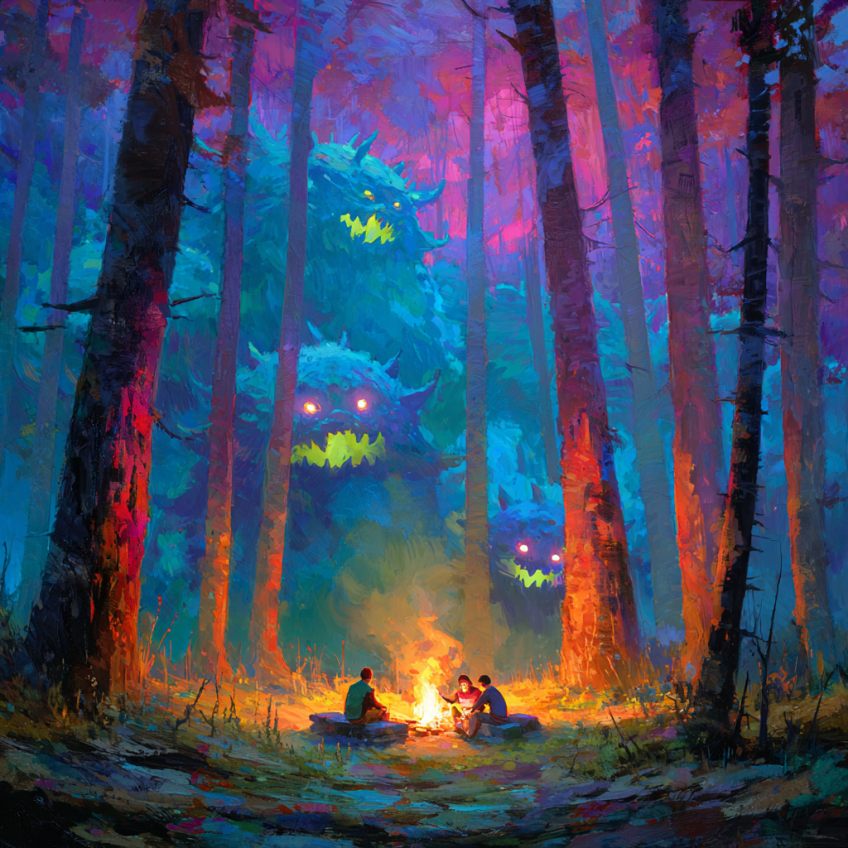
Now, I gotta say… the Horror genre is not really a big favorite of mine. I like the critters well enough (fan of mythology and fairytales that I am): the vampires, werewolves, etc., being put through their paces and what-ifs, almost as if they were so many aliens, and I admire some of the classics, from Frankenstein thru Dean Koontz and Stephen King, for their story-telling chops, at least. I can learn from their competence.
But I don’t care for the extended and intimate depictions of evil, even if it’s defeated in the end. I recognize the very real anxiety that the genre typically induces in me as part of its signature, and it’s not an emotion I treasure.
Recently, I stumbled upon an interesting book, via a Substack interview with Coltan Scrivner, the author of a recently published book, hosted by Razib Khan, an interesting genetics-focused analyst whom I follow (recommended for those of you who enjoy human genetic studies).
Link to the book being discussed
An excerpt of the interview follows.
Today, Razib talks to Coltan Scrivner, a behavioral scientist, horror entertainment producer, and author, whose work centers on the psychological and evolutionary roots of our fascination with darkness, horror, and true crime. He is affiliated with the Department of Psychology at Arizona State University. Scrivner also serves as the executive director of the Nightmare in the Ozarks Film Festival and founded the Eureka Springs Zombie Crawl. He has been featured in The New York Times, CNN, The Wall Street Journal, NPR, TIME Magazine, National Geographic, Scientific American and Forbes. He is the author of Morbidly Curious: A Scientist Explains Why We Can’t Look Away, where he explores how our fascination with horror functions as a survival-oriented, yet deeply human, impulse.
“Though working in psychology and behavior, Scrivner’s original training is in the biological sciences, and Razib first probes him on the possible evolutionary origins of our persistent interest in horror, and why we might actually be attracted to the phenomenon in the first place. Scrivner also explains how the horror genre differs from other narrative forms, in particular, the power imbalance that makes heroic action and tension much more difficult. Horror, in fact, primarily leverages our intuitions about how predator and prey interact, more than a battle between peers. Scriver also discusses the relationship between fear and our dreams, and the various psychological and evolutionary theories for why we might have so many nightmares.”
Well, OK. This is more like it. This is pushing all of my anthropological what-if story buttons. I haven’t read it yet, but I will. Some of the things I expect to find would probably resonate with my own dislike of straight-up Horror as a more deep-seated anxiety, which is perhaps an inherited trait responsible for all my ancestors having survived to breed. If they hadn’t dreaded the possibility of the troll, maybe the troll would have feasted.
— Comment on whatever you like…. the genre, the anthropological concepts, the balderdash thereof, if you think so… what have you. If you embrace Horror as a genre, why is that?

 Mad Genius Club
8 responses to “The Roots of Horror”
I’ve dabbled in horror, but my stories aren’t the evil lurks under the bed type of stories. I have a couple of deal with the devil type stories and one that’s more creepy than anything else. Never been a big horror fan. To me the most frightening scene in The Exorcist was when they had the young girl in the hospital for all their tests.
I’ve only touched on it from the ‘how to deal with dealing with something you cannot beat’ angle.
Useful when one is dealing with things one cannot win at.
My imagination is good enough that I have to avoid most horror. That, and so much visual horror has become a gore fest. I’ve seen that in real life, no thank you. I wrote one horror sort of story, and that was sufficient.
The eerie, implied, spooky sort of tales I do appreciate, things where the horror element lurks in the background, there but not in-your-face.
I remember recommending Koontz’s Watchers (about a genetically engineered smart dog, a genetically engineered baboon Jem Hadar thing, and assorted humans) to some relatives and advising them to skip the POV scenes with the (human) psycho, who I think was hired by the government to clean up the loose ends. I didn’t feel like he became relevant until very late in the proceedings, and he was just such a messed up character, he made the Jem Hadar baboon look tragic and poignant by comparison.
I feel like horror as such (kind of like sex comedies or grossout comedies) is a pointless exercise in being transgressive that almost always gets overwritten by the next outre thing that comes along. It is the things that horror books/movies do in between the setpieces that make them worth remembering. Dracula the novel is a pretty decent gaslamp/monster hunter fantasy even if it’s no longer anything special as horror. The character work in both versions of the The Thing (1951 and 1982) is what makes them enduring IMO, less so the special effects. And so on.
I’ve always viewed the horror genre as a way of facing/coping with the inevitability of mortality (and other anxieties) in a “safe” realm in the imagination.
In cinema, the slasher genre, much derided in the ’80s, usually dealt with teen anxieties about growing up and taking responsibility. A Nightmare on Elm Street can easily be understood as a playing out of the question “What if my parents are monsters, and I never realized it before?”, for example.
Another source for Nightmare was Wes Craven’s own childhood. In the following interview, he relates a story of how he first understood that people could be evil when a strange man scared him simply because he could.
Even when horror films are playful, as in much of the work of Vincent Price, they can be a way of working through one’s darker urges, as lovingly portrayed in Tim Burton’s early animated short Vincent (narrated, of course, by Price himself):
I do not like it. I do not either watch or read it.
Personally I love horror, as long as it’s actual horror-horror and not torture porn disguised as horror such as Hostel, Saw, and the like. It helps mightily when good wins in the end. I vastly prefer Stoker’s Dracula to Shelley’s Frankenstein, even if they’re both classics for just that reason. I also tend to favor a lot of pulp horror — Wellman, Seabury Quinn, the Unholy Three of Weird Tales (Howard, Lovecraft, and Smith), heck I even liked some of those trashy in all the good ways horror novels of the 80’s and 90’s until they got lost in the need to lecture the audience. I can take a trashy fun book that is shameless about being trashy fun; one where the author decides they need to tell you what an awful person you are to be reading this makes me toss it at the wall.
I’m also a big fan of monsters and have been ever since that weekend in my childhood when I discovered Godzilla, the Universal classics, Famous Monsters of Filmland, and Marvel Comics in about three days. Especially Marvel back in the day, where you had monsters like the Thing, Hulk, etc., who were good guys (usually). Given how I was being told constantly that I was a monster for a variety of reasons which don’t bear going in to here, many related to things like ancestry and my own appearance that I couldn’t help, seeing that being monstrous didn’t mean you had to act like a monster was eye-opening.
I don’t think I’m capable of writing true horror; probably the closest I get is very dark fantasy. As Dave Freer wrote in his post earlier this week, I’m a Narnian, even if there is no Narnia. I’m not going to visit universes where evil is overwhelmingly powerful—and I’m sure as heck not going to create them.
That being said, though, looking through calls for stories on the various websites, there are a lot looking for horror, much more than almost any other genre. So I’ve been working on my dark fantasy, trying to see if I can create some that will appeal to horror fans.