Humans are a story-telling species, and we have developed all sorts of cultural media for the purpose. I enjoy spotting it “off the written page”, so today let’s look a little bit at what music has to offer for telling stories, just in one small genre, and how that works.
I’ll reference a popular musical form that originated in circa Civil War America and retains its popularity still, in somewhat obscure venues: Songs in the Barbershop style.
Lots of the Barbershop style is just the popular music of the period (post Civil War), followed by Vaudeville and later influences, but over time a certain specialization resulted in explicit musical practices for the genre.
The music style of Barbershop is the telling of a story (like all popular songs) in a cappella four-part harmony, using not just words but a particular musical style featuring cascading chord progressions that guide the listener’s perception of emotional responses: yearning, disappointment, uncertainty, hope, regret, joy, sorrow, resignation. The words tell the story, and the chord progressions illustrate the story, in a way that only music can. Like Jazz, it’s the specific harmonic styles that define the genre.
Modern Barbershop enthusiasts have gone all the way, milking the possibilities of the genre, competing formally for best chord progressions, most elaborate chord resolutions, and so forth. Still, ignoring the formal enthusiasms of the cognoscenti, there’s no denying that the harmonic movements of the accompanying music echo and enhance the story emotions presented in the words.
How do you tell a story in the Barbershop medium? The words provide the background, the skeleton of the situation, but the musical arrangement is deliberately presented as a cascade of tension, suspension, and release in chord structures that can be brief or elaborate and extended, as required.
This is such a fundamental component of the endings of Barbershop songs, that an entire sub-genre exists of just the tags, sung by themselves. A tag is the final complicated-chordal-movement at the end of the song that distills all the tension and release of the song’s story in brief, like the last line in a haiku.
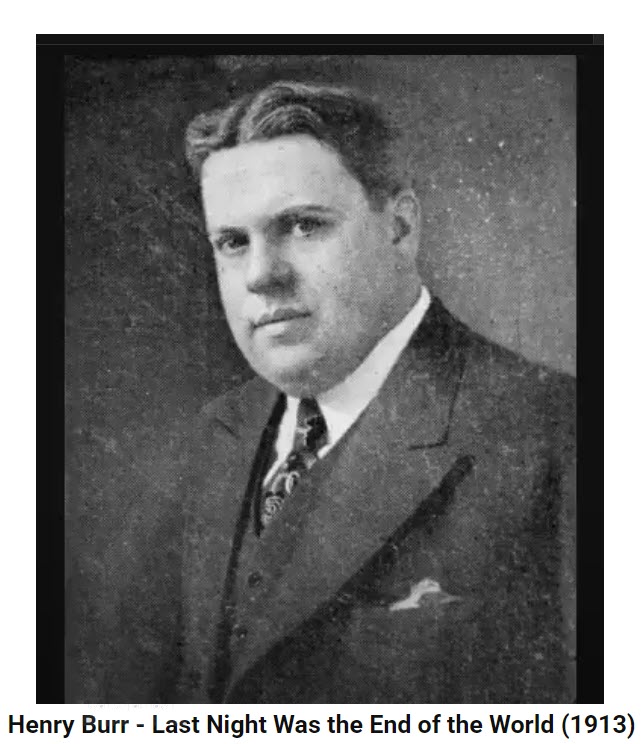
I’ve picked as an example a Barbershop version of an old song that non-barber-shoppers have probably never heard, despite its original popularity: “Last Night Was the End of the World” (1912). It’s quite short — give it a listen.
Tag Performance
Tag Score
Full Song Performance
(The original Vaudeville hit by Henry Burr (1913). It was #1 for 6 weeks, but in the top ten for 22 weeks—a feat not matched by any other record in the era before 1920.) Henry Burr bio.
Notice that the classic songs in this genre don’t tell long and complicated stories. Typically there’s a brief display of the situation, followed by a happy or sad result — a tension and release. The tag is a brief ending that sums up the impact/message/result of the story, to ring the most distilled emotion it can thru the tension and release of the musical harmonies that are its medium and thru the resolution of the initial situation: joyous, reverent, or heart-broken. It’s a highpoint of the art/craft of sentimentality.
This is a miniature of the tension-and-relief that structures storytelling in general. Short stories in fiction also aim for brevity of situational description and terse summary endings so that the emotions can shine against the background. Haiku, for example, are similarly abbreviated, and linger on the intimate single aperçu at the end for their effect.
Other examples? How about horror stories with their inexorable structured progression of incidents? Isn’t that rather a lot like longways Dance Music — all rhythm, all the time, where the dancer is led in patterns to an unavoidable conclusion, trapped without escape?
Do your stories take advantage of rhythm and movement in a similar way? Do they tug at the heartstrings when they sing?
FYI: I’ve been a tenor all my adult life, and I’ve (read and) sung far more words than I have ever written. I’ve sung and/or published in many genres, from Classical and Early music to German Männerchor to Traditional Folk and Sacred Harp, and currently (Mens’) Barbershop, in the Altoona Horseshoe Chorus, and in the What’s in a Name Barbershop Quartet.
I’m also a fiddler of traditional Scandinavian dance music. (With dance music, as a bonus, you get to move actual people around, not just their emotions, sort of like puppets in your hands. If one of them screws up and makes a wrong step, he falls down. If the fiddler screws up, they may all fall down…) 🙂


 Mad Genius Club
5 responses to “Tension and Release in Stories — Parallels in Musical Storytelling”
A while ago, I took lessons from a very skill trombonist. He observed, quite correctly, that the difference between him and someone like Christian Lindberg, was he may have been technically better and had a better sound, Lindberg could tell a story with the instrument.
That is something all artists can do to remember: the tools and technical mastery are only part of the equation. They are not the ends of the art in and of themselves.
I cut my teeth writing horror. That genre, aside from vivid descriptions of gore, gross out, and violence, teaches you *pacing* unlike any other I know. Tension with no endpoint is exhausting to the reader and causes TBAR. The human mind needs space to “breathe” in between the action scenes.
A good horror balances the tension with the release masterfully. Actually, a good *story* does as well, but horror allows very little room for mistakes. You screw up, you’ve lost your audience. They don’t tolerate screwing about with their addiction. I am quite rusty in the application of tension/release. But those habits are coming back, albeit slowly.
As an aside, I once was something of a musician back in the day. I lost the ability to make music decades ago, and only recently ( a few years or so? Five or ten?) have been able to appreciate music again at all. My stories have a certain tempo to them that as a writer I feel while putting the words down. Action scenes are quick and brutal. You don’t see all the action in PoV, just what’s behind the character’s eyes. Non-action scenes have lesser crescendos, but they are there.
The betrayal is a sharp one (ascending notes, quick and hard). The revelations are another. The race to save a life is a rising tension point. The wampus cat is the relief, as is dinnertime, as is the few moments of research stolen here and there.
A fine tool in the writer’s toolbox is to reprise a scene in a different key, as it were. Echo a similar and significant event of the past with a slightly different twist. This helps to show character growth (crack to readers) and imply movement over time in the plot.
For the non-musically inclined, this may seem like gobbledegook. But trust me, it works.
I got nuthin’, so here, have a barbershop quartet scene from Music Man
Absolutely every Barbershopper, men’s or women’s voice, ends up singing the “Lida Rose” medley/duet at some point, just to get it over with (and because audiences still have fond memories of the movie). The movie was like a recruitment poster for a generation.
From the movie — the duet in context (the volume alas is low)
More often sung just for the men’s part by itself. (Better )
There’s even a modern trend for people with sufficiently versatile voices to sing all 4 parts. And by god, they can do it. Proof.
Mind you, this was a unique Broadway Show, not an ordinary Barbershop context. It represents an outlier for the much broader and more diverse/elaborate arrangements of modern Barbershop groups, much less the traditional original developments from decades earlier.
I’m glad it’s well-remembered in the barbershop community! I think I chose this scene over the more iconic Lida Rose because Hill’s line about “sustained talking” kind of felt like it was in dialogue with with your comments about music vs print story-telling.