Most stories I read that stick with me do so because of their story and characters — those are what I remember best. But that’s not always the salient part that grabs at me in my recall. There are some I admire for their setting, more than anything else.
To keep this short, I’ll adduce just a couple of rather different examples.
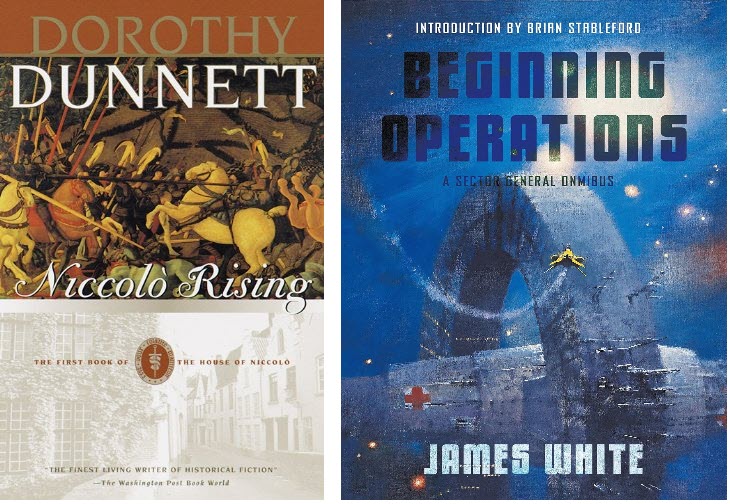
In “serious” fiction, what comes to mind, for some reason, is Dorothy Dunnett’s “The House of Nicolo“ series. These are (quite well-written) historical novels set in the Renaissance centered around the rise of Merchant Banking and political intrigue. Most of the early books are set in the Netherlands.
When these books came out, about 40 years ago, I personally knew some of the history of the period (not nearly as much as I do now) but I had never read fiction in that setting. And the setting! My mother was a war bride from Antwerp, and I had an interest in mercantile history which I hadn’t much explored yet (there’s just not an abundance of lowland Renaissance business novels kicking around.) This was the first extensive fictional work I encountered that brought the sight and smells, the intrigues and deals, the fun and games and sports and laws and politics and daily choices, physical risks etc., etc., to life for me.
And I didn’t care for the story or most of the characters. I found them way too conniving, cruel, dishonest, real-politique for my fictional tastes — not my kind of heroes. It’s a style of storytelling I’ve never much enjoyed. So, I didn’t much like the plots of the books, but I loved the mise-en-scene, even if I couldn’t embrace the story or the characters. I’d never encountered that particular setting before and flipped through the series entries ignoring the main plots to get more of it.
For a less complex example, here’s a straight-forward classic Sci-Fi series that I remember from my youth — James White’s Sector General books from the 1960s. Even as a young teenager I recognized these were not, um, complex deep stories — this wasn’t Asimov, or Heinlein, or Anderson. I found the characters that carried the stories unusually bland and perfunctory (even for Sci-Fi), but I thought the “Sci-Fi” gimmick of how-to-classify-a-novel-alien-species to aid in emergency medical treatment intriguing and clever, compared to the non-biological focus of rockets and inventions and speed of light and superpowers so popular to the period. The characters that carried the plot were just there to provide background to the clever definitions and diagnoses of aliens, and that was fine with me.
Now, as a writer of SFF, I write about characters, not settings. Though the settings are necessary to understand the story as a whole and to provide flavor, the focus is on the choices and actions of the characters. The settings are as real as I can make them but the characters are what carry the stories.
Where do you fall in this set of choices? What do you prefer to read, or write? Do you visit those worlds for the scenery, or for the thrills/spills of your friends? Or (sometimes) a thorough mix of both?
 Mad Genius Club
12 responses to “Story vs Setting”
I remember the Sector General books. And you are right, that was a wild cool setting. But that’s almost all I remember about it, beyond the one spinoff story that basically argued the humans were so strong that the rest of the galaxy of alien races had to be continuously puffed up and humans continually pulled down to a lower peg to ensure things stayed stable.
Well, not the greatest of characterization, etc. But I thoroughly enjoyed the trials and tribulations in the one about the chef. (Maybe because, when a beginner, I tended to over-spice things, although I never poisoned anyone with too much nutmeg.)
Two book series that I’ve read where I love the setting, the stories, and the characters (well, most of them) are the Judge Dee mysteries by Robert van Gulik, set in what’s supposed to be T’ang China but is more like the Ming dynasty, and the Flashman stories by George Macdonald Fraser. Both do an amazing job of bringing another time and place to life, both have great stories, and the characters are wonderful.
Yes, good exemplars, both.
Contemplating that, my mind immediately suggested Kipling’s Kim, where the interesting character interacts strongly with the interesting setting(s) in ways that are not so easy to find elsewhere. The sense of setting is so strong in many of Kipling’s India books that it’s surprising the characters (and their story) aren’t overwhelmed by it (e.g., The Man Who Would Be King). That’s a hard balance to maintain.
I remember the Sector General stories too. In terms written stuff where the milieu is a large part of the charm, I guess i could count Heyer’s Regencies and a fair number of Golden Age mysteries. The surrealism/magic realism that Chesterton, Carr and Allingham all seemed to dabble in particularly intrigues me. It’s a bigger deal to me in movies. The handful of gothic horrors I own are because I am fond of the stars involved but most of them also have darned good production design for what were comparatively low-budget movies. Also, when we went to the movies recently, we saw Fantastic Four, not out of any particular brand loyalty but because one of the group didn’t like Superman as a character and the other two, including me, are gaga for Mid-century Modern design.
Stories instantiated in cinema form provide an immediate boost to “settings”, since so much of that is visual or aural.
The “focus” on settings from art movies that use objects or scenery to comment on story elements are particularly instructive (Fellini, Hitchcock, Wells, etc.)
I often read for setting, if the setting is the larger environment (like Conrad Richter’s Sea of Grass, Dune. Often, the setting is a character of sorts, or mirrors the characters in some way.
For fun I read character stories, if they are in a decent setting. Some … let’s just say that if I can’t pin down where the characters are (town? country? farm? space station? yes?) then the book goes bye-bye
Mmm, yes. I read Dune and some of the sequels for the setting. One of the few things that I somewhat enjoyed where I wished ALL of the characters would just go ahead and die, already.
I liked Duke Leto, on the page and in all adaptations (I think William Hurt’s take on him in the Scifi Channel miniseries is the only William Hurt character I don’t hate). I like Duncan Idaho, in all his variations. I like Gurney Halleck. I don’t hate the book version of Stilgar, and I have a soft spot for Paul’s daughter, whose name escapes me now. But when you consider HOW MANY characters there are in the Dune series, that’s really a pretty tiny percentage of them.
film nerd pops his head up
Hooray! Somebody knows the term mise en scene and uses it correctly!
film nerd vanishes back into introversion
As for settings, I do like it when a place becomes a character, at least sometimes. Lankhmar. Ankh-Morpork. Arrakis. Barsoom. (And, to bring in film, Casablanca and postwar Vienna both come immediately to mind). It’s not primary for me as a reader, but when done well, I do love it.
Story. I seldom have a setting idea except in the most abstract set.