
I’ve been working on cataloging my library this week. I started in on it because I’m frustrated with being unable to lay my hands on research books or references easily. I know I’ve bought duplicates of some books. I’d gotten the fiction sections in order a little while ago, but the non-fiction felt like a bigger task and in some ways, more important to my daily functioning as an author. I wrote up the system I’m using to catalog books over on my Substack.
Yesterday I was at the point with the catalog where I was working on the close-in book cases in my office. See, I’m doing a modified Dewey Decimal system, keeping like books together in topical sections. However, the books I touch the most live in the office: on the book case next to the coffee station are folklore and mythology. In the case between closet doors is natural history. And on the built-in bookcase to my right as I sit at my desk are reference, poetry, and pedagogy. Even though I am not teaching my own children any longer as they are grown and gone, some of these books are targeted at me, the writer. Others are family heirlooms, and I wanted to share one of those with you today.
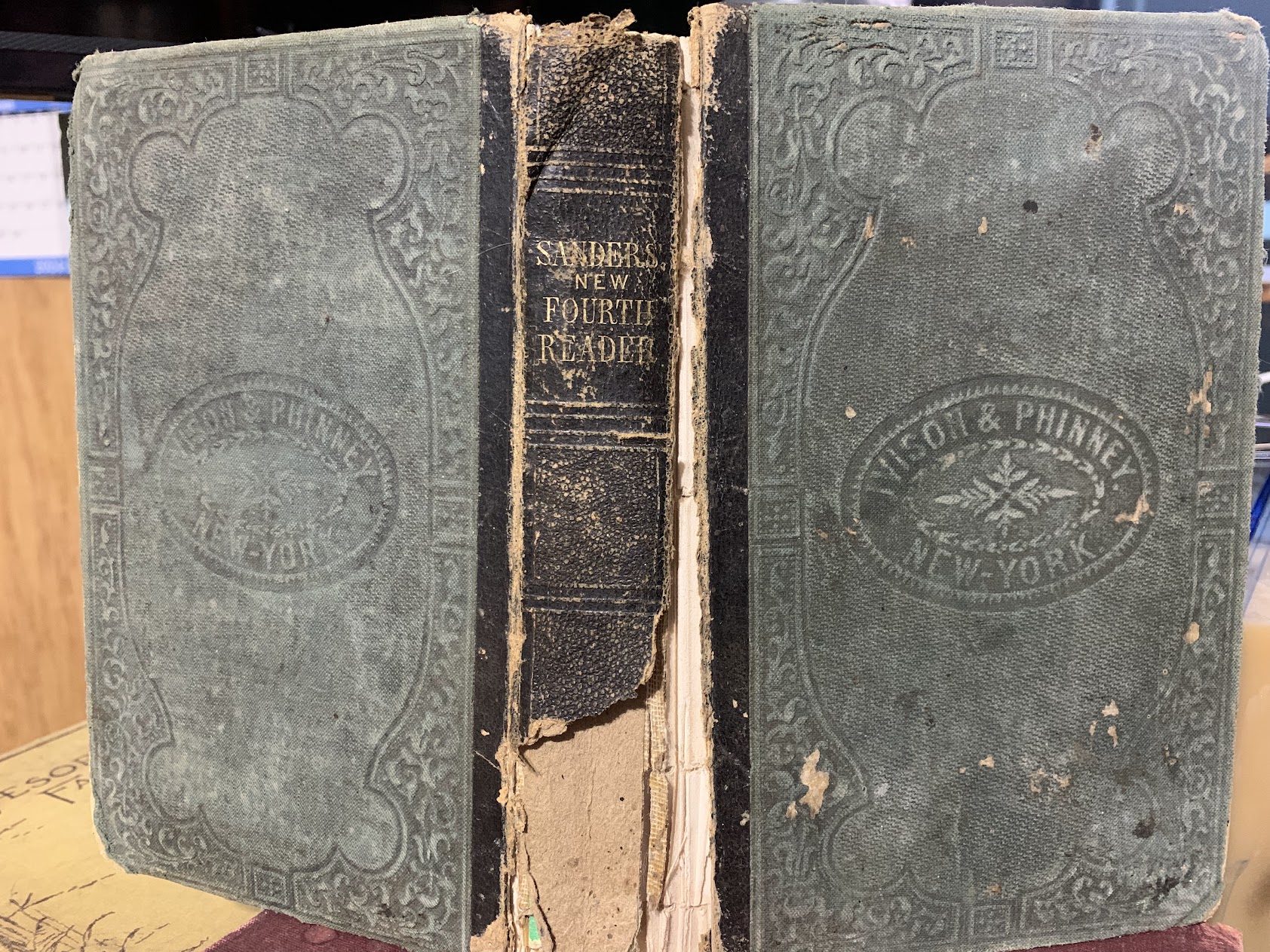
Sanders’ New Fourth Reader
Published around 1856, this may be the oldest book in my personal collection. It was the property of my great-great-great grandmother, and it likely made the trip across the country in a covered wagon on the Oregon Trail.
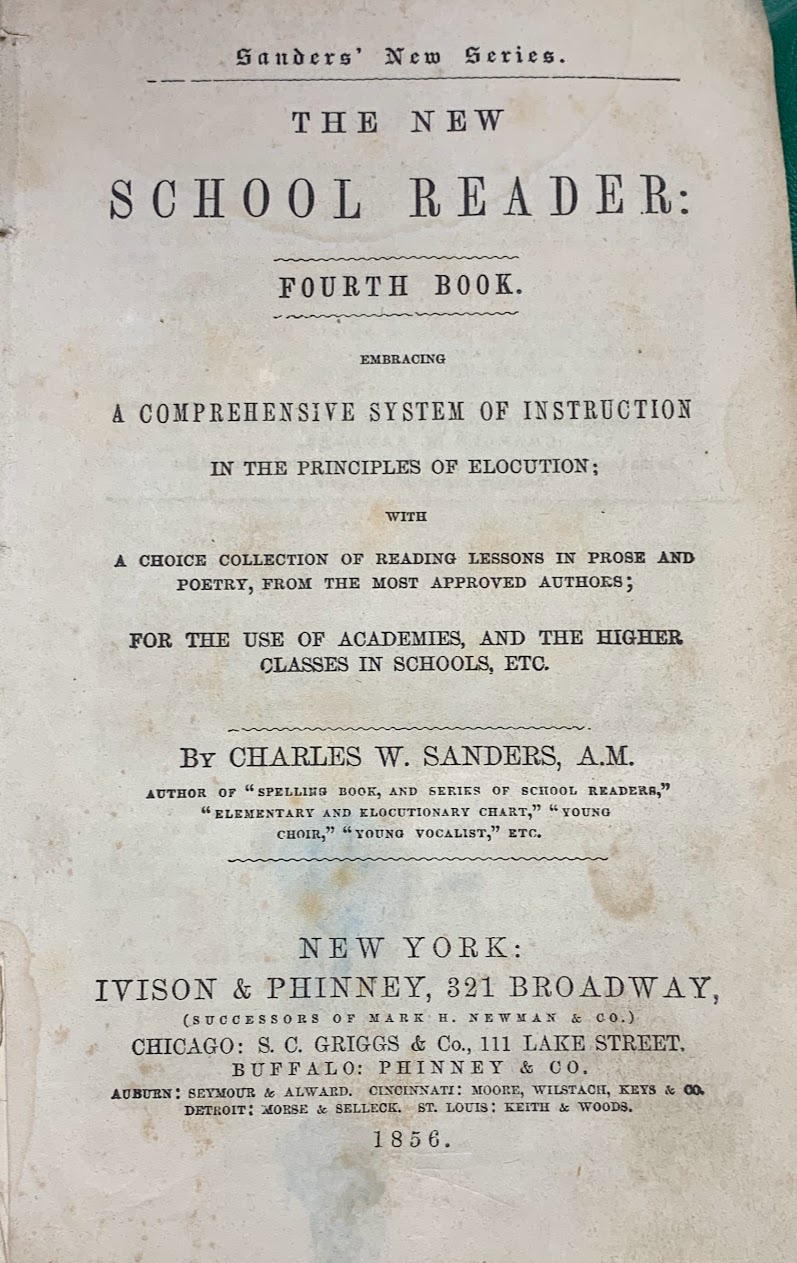
From the first page, the summary:
Embracing a comprehensive system of instruction in the principles of elocution; with a choice collection of reading lessons in prose and poetry, from the most approved authors; for the use of academies, and the higher classes in schools, etc.
My grandmother sent me a note along with the book to explain it’s history:
Probably used by my great-grandmother [Emily Vanderburg] before and after the family cam “Across the Plains in ’64” to teach her children and others. From 1865 the family lived in the Coos Bay, Oregon area. Great-grandmother Emily Vanderburg had a school in her home for the Vanderburg children and neighbors. Some of her pupils were grown men!
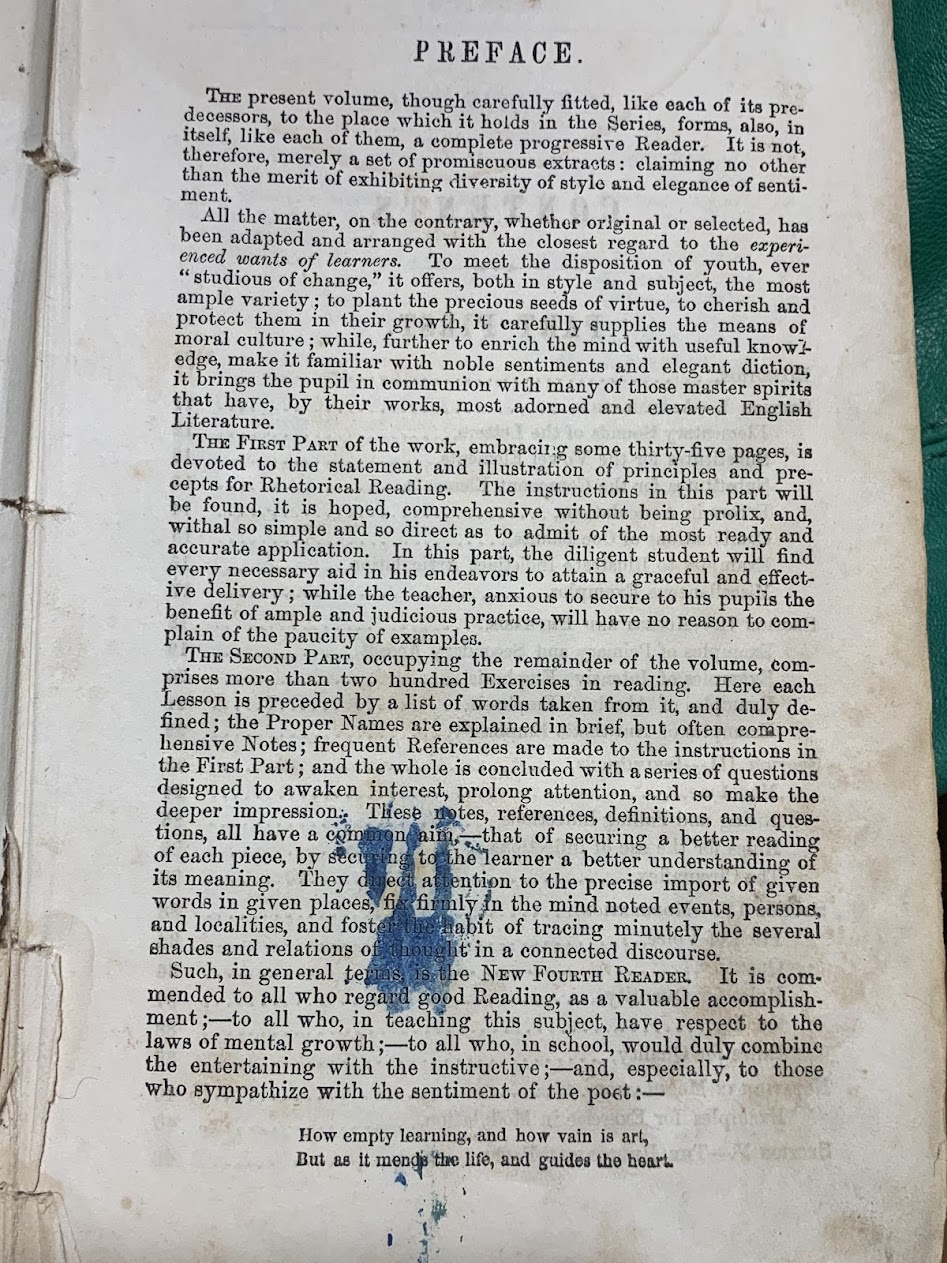
I’ve long collected antique textbooks. Partly because when I was a young bride, I envisioned being able to teach my children at home, and planned to use them in that instruction. Unfortunately, my late husband did not approve of that plan, the old textbooks were seen as valueless, and they were left behind in a move early on. Still, I have a few that remain, and they still speak to me of what I saw then: educational standards are not what they once were.
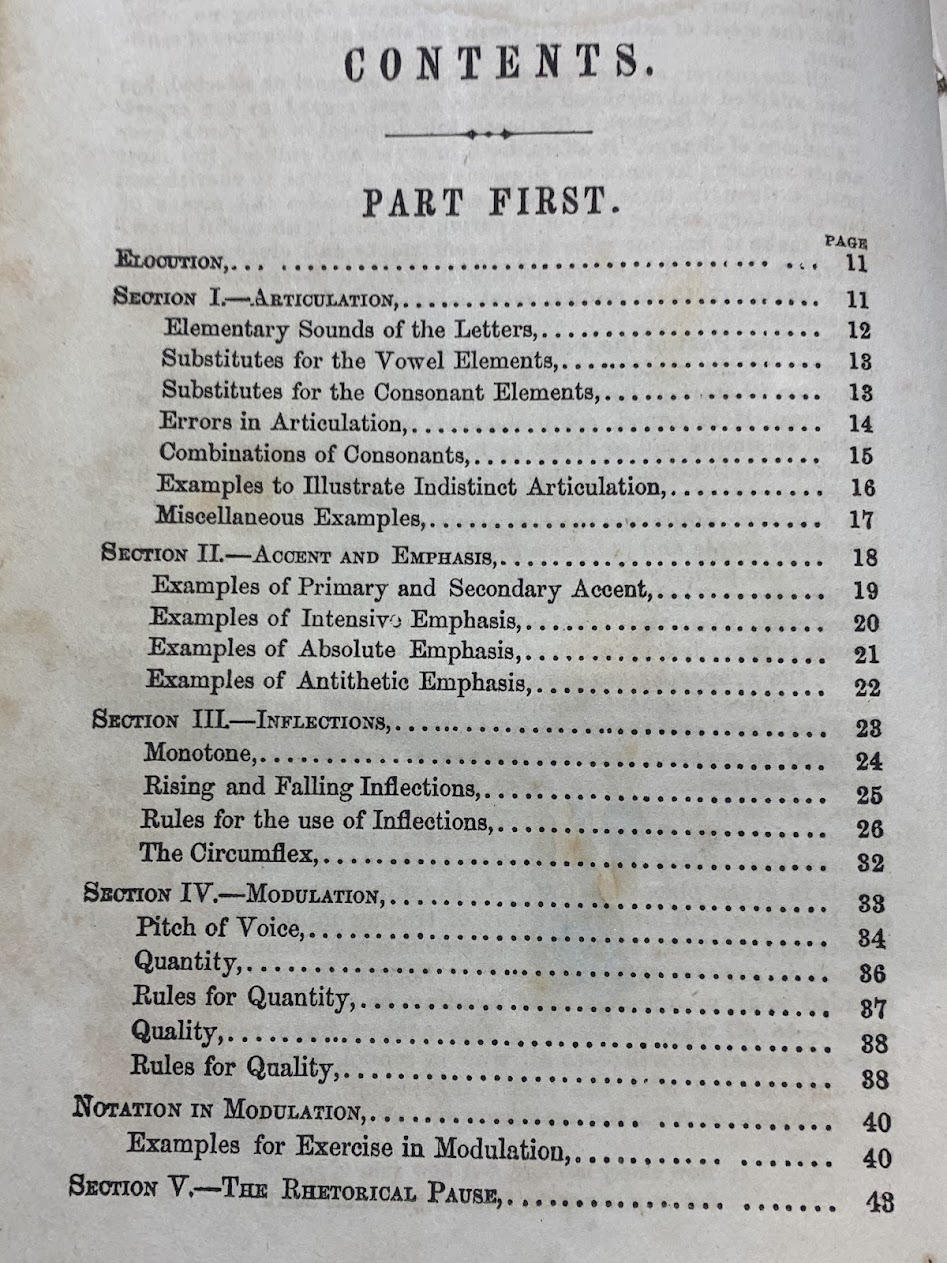
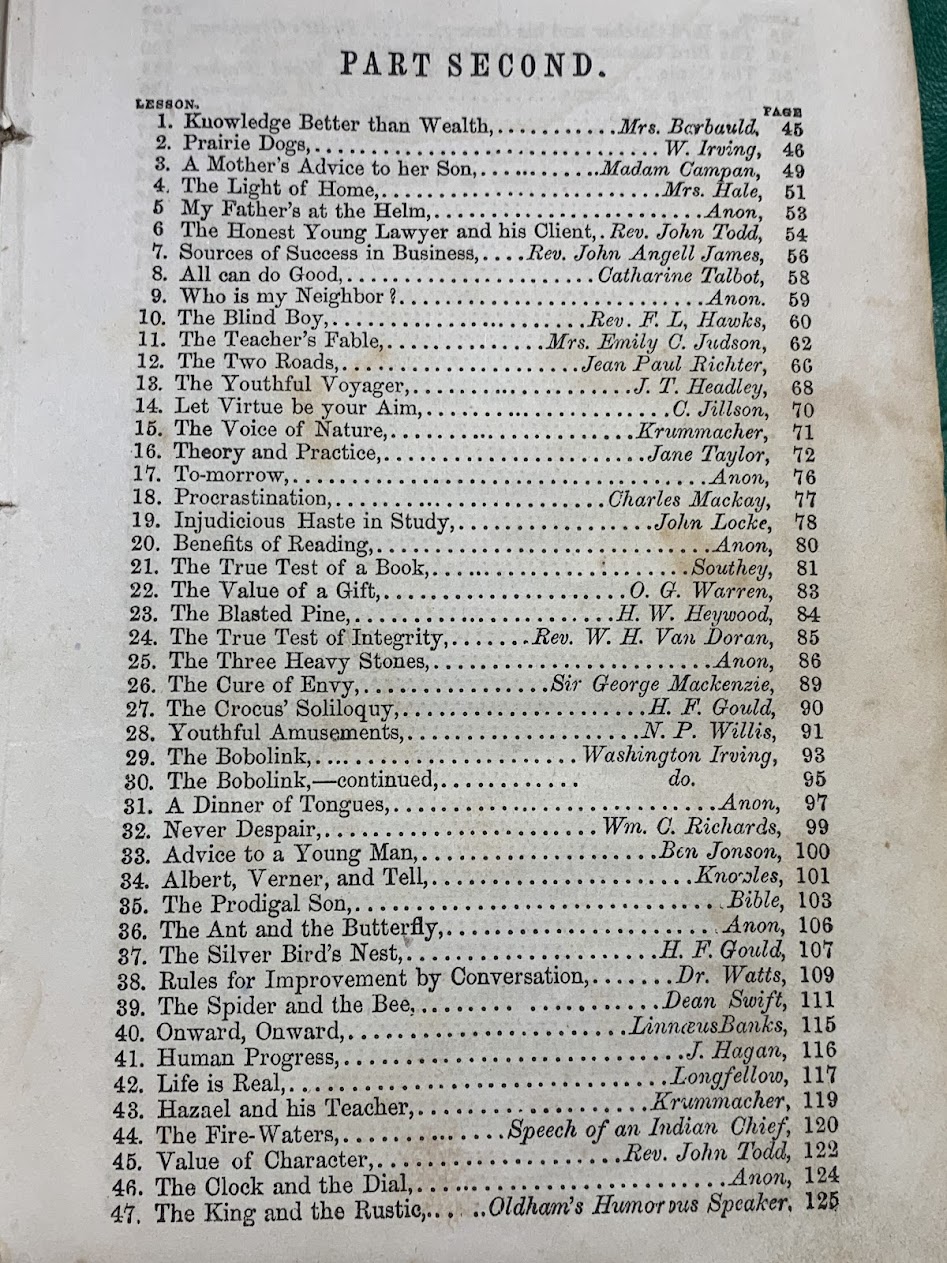
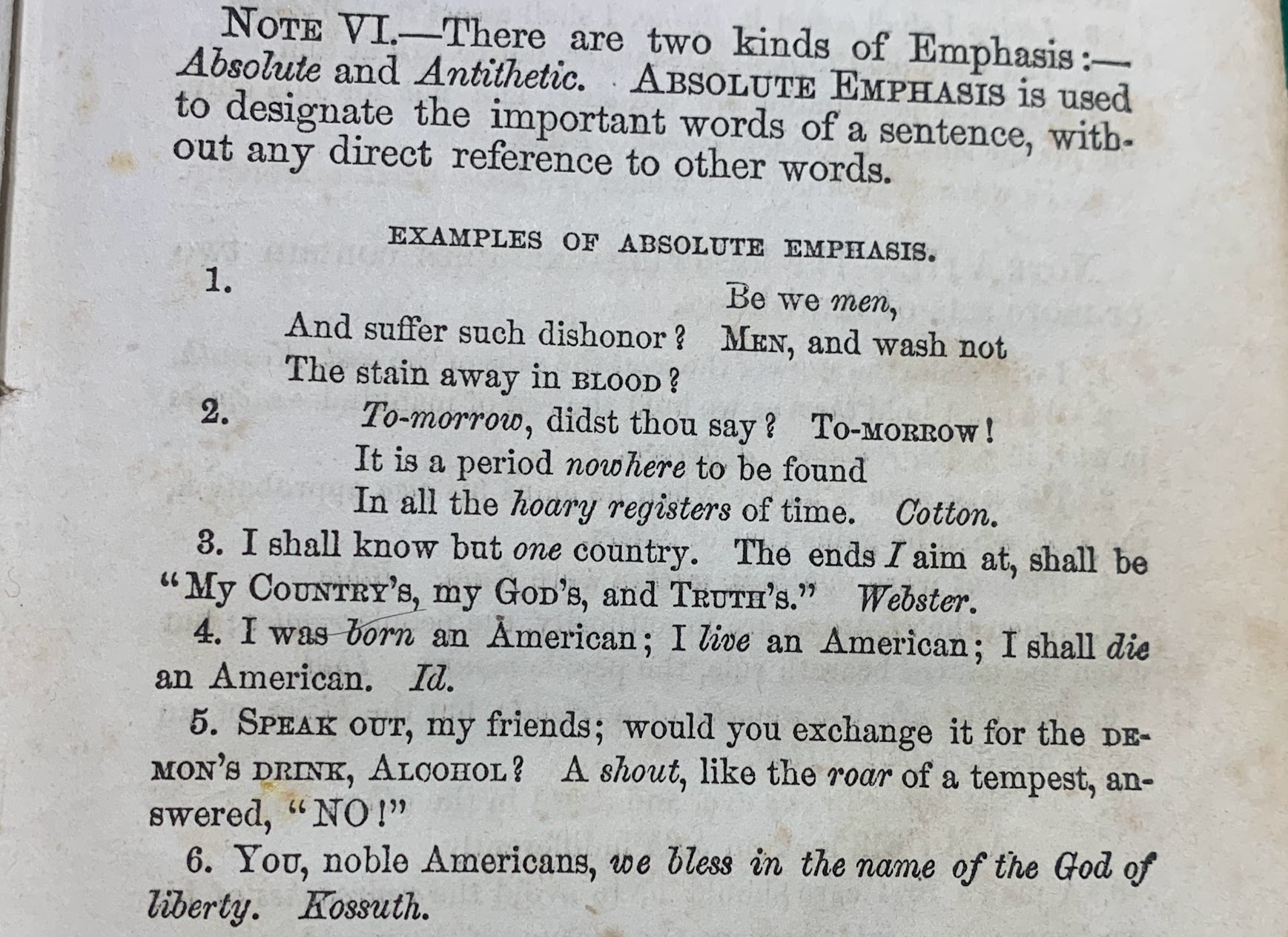
Which is not to say that all children of that era were educated highly. See my grandmother’s note that grown men came to Emily for more education when they had reached a point where they needed it or wanted it. Many students left school early – this is a fourth reader, so when you hear a past generation mention they only were in school to eighth grade, this is the book they would have missed as it was targeted for higher schools. Which you can also think of as roughly a college level now. Having been recently in colleges, I can tell you the speech class did not approach this depth of instruction which the Fourth Reader contains in it’s first half.
In the reading section, once the student has learned how to speak, we find samples of poetry as well as stories and philosophy. The reading samples are chosen carefully, and there are questions following each section. I mentioned recently in my illustrated poetry project that poems have perhaps suffered most at the hands of the modern educator. If she has carefully taught her students to loathe reading books, even more has she inculcated a loathing of this highly skilled and challenging wordcraft contained in poems.
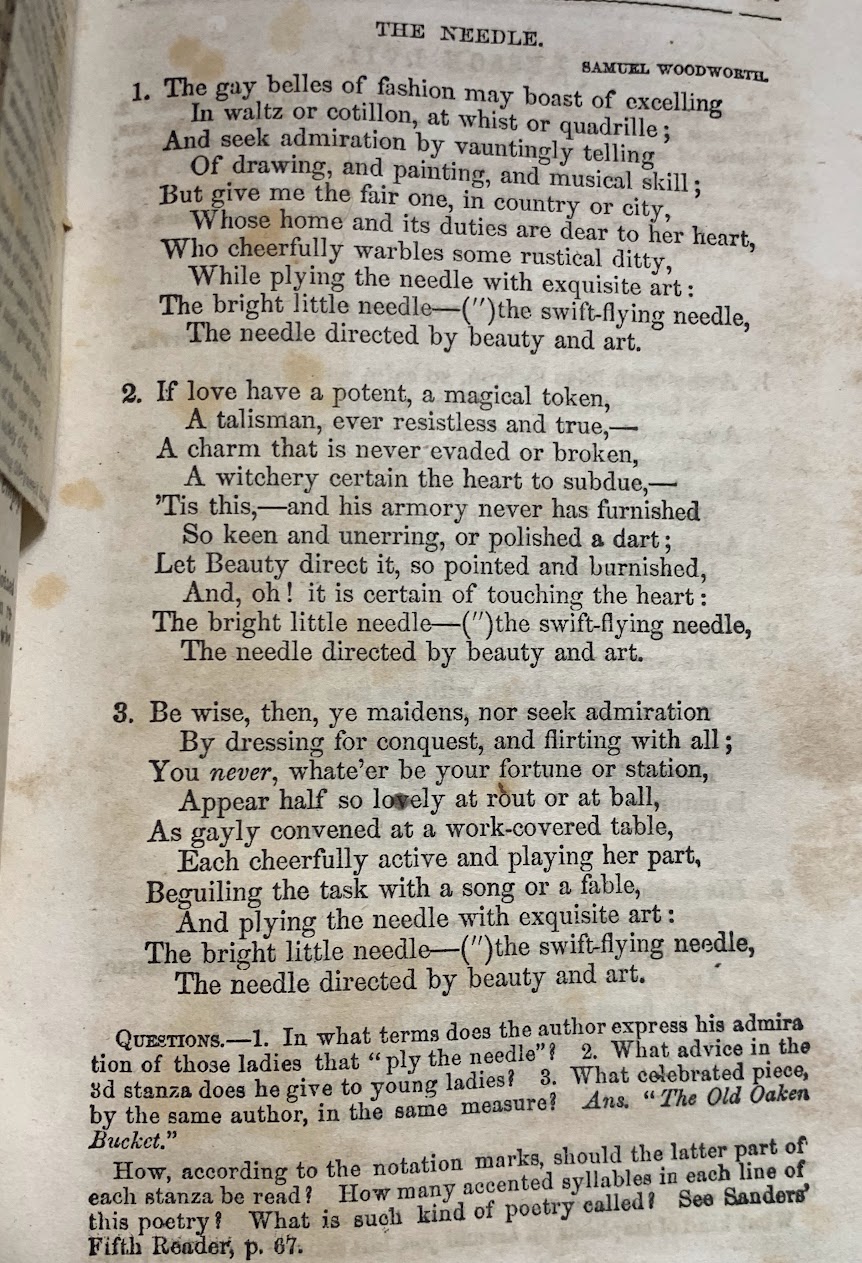
That last stanza! I can picture her there, the smiling girl happy at her work, singing, or telling a story, and engaged in making something beautiful for herself or her family. She was industrious and her “home and its duties are dear to her heart” can you even imaging that being taught in a public school today? Instead home-work is denigrated as valueless. The exact opposite of this poem and the lesson with it.
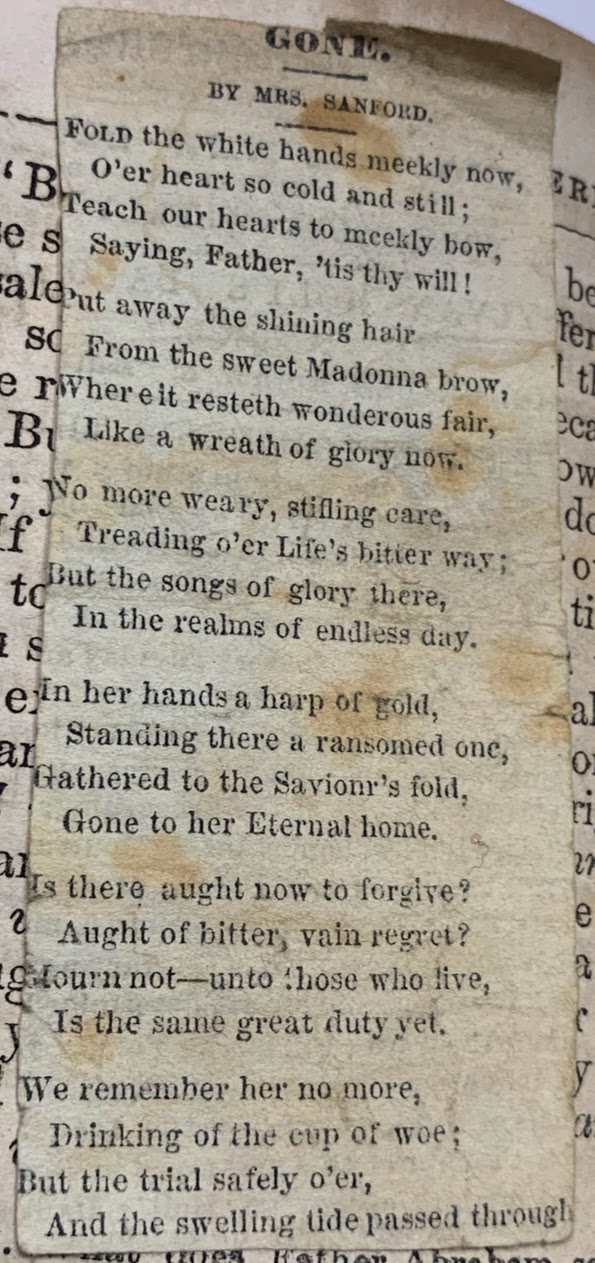
I opened to this poem because tucked into the book was a piece of ephemera. Cut from a long-ago newspaper, one of my lady ancestors preserved another poem. Critics today might deride it as shamelessly sentimental, and decry that the author’s name is hidden behind ‘the patriarchy’ but there’s nothing wrong with being tender and emotional, is there? There’s a great deal of hope in it.
Finally, I’ll leave you with something that struck me in the lesson questions following an essay titled The Cultivation of the Mind, written by Humphrey.
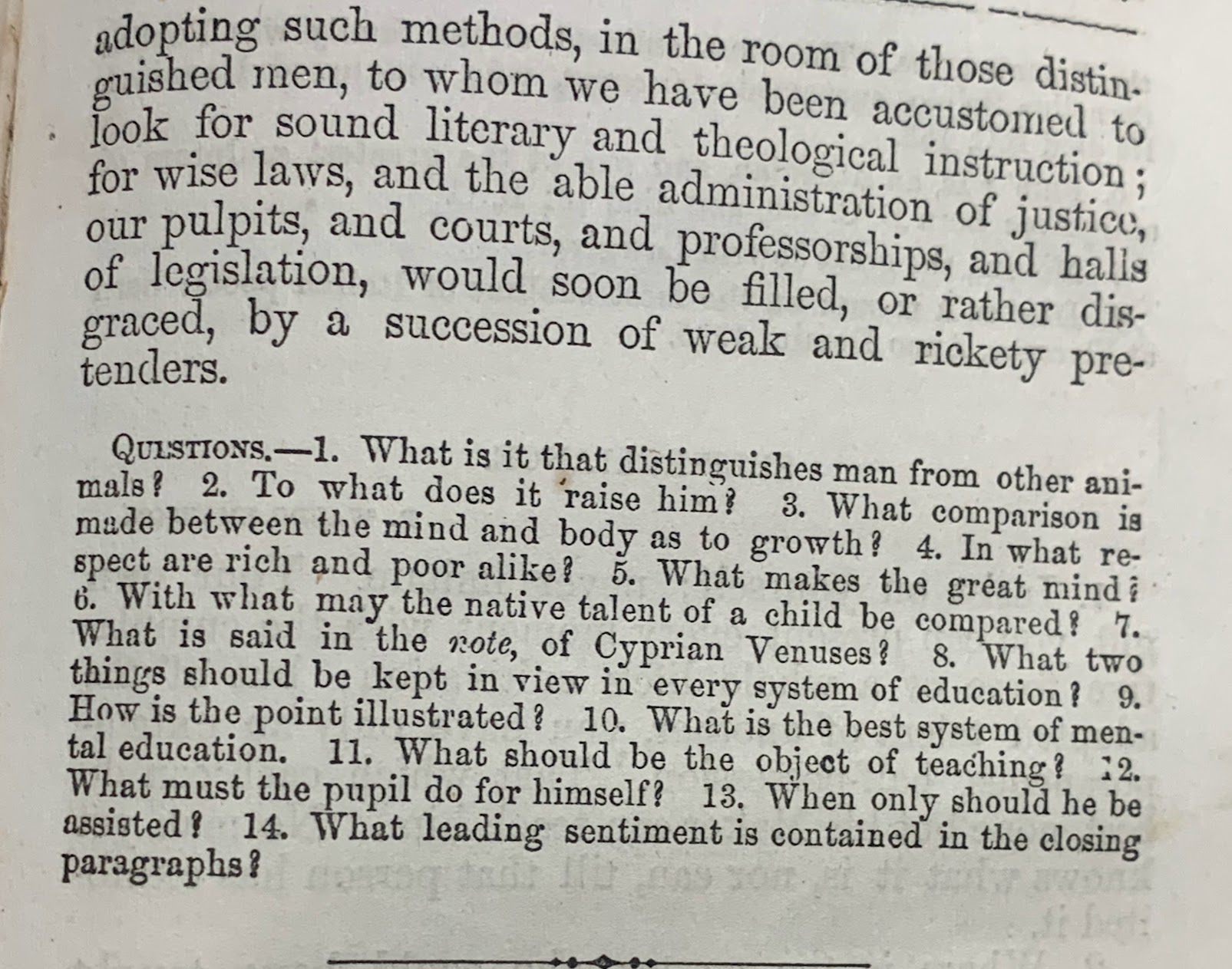
What should be the object of teaching? And that line about “a succession of weak and rickety pretenders.” Whew! That hits hard when I compare the pedagogical methods of my Grandma Emily’s time to what my children sat through during their years in public schools.
I realize this blog isn’t about teaching, per se. However, we writers would be the better for working through a couple of the old books on my shelf here. Not the books on ‘how to write genre’ which crop up so prolifically claiming to help teach a writer how to make more, sell more… no, the way to learn how to write better is to read good writing and then to ask oneself questions. I also have to say that learning elocution will likely make you a better reader and writer. Being able to read a story out loud, even if it’s to yourself in a mirror, will improve the story.
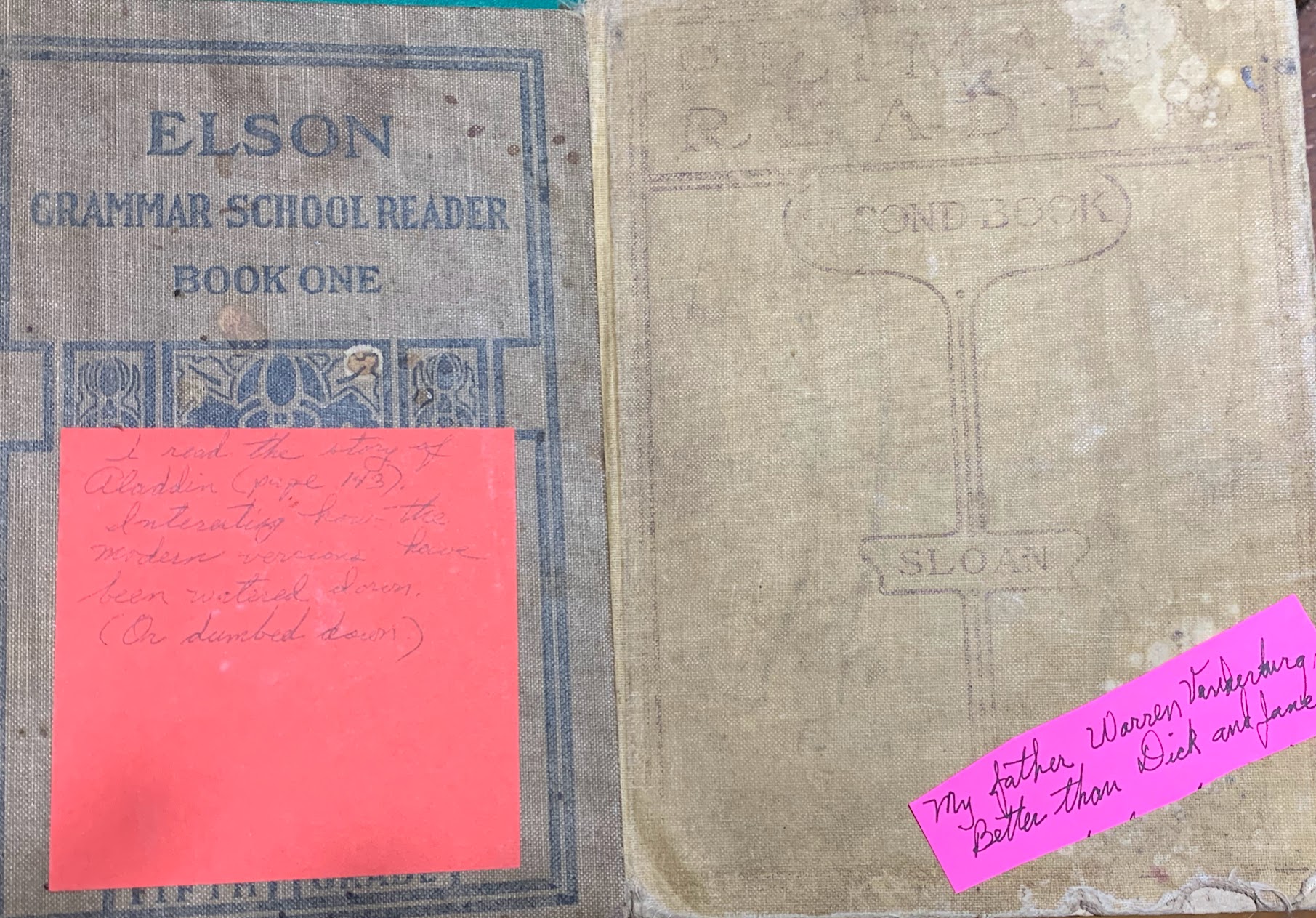
How reading has been taught has changed and weakened over the years. Little wonder children don’t enjoy it and avoid doing it – or seek out the easiest books with little to challenge and stretch them – after they are freed from the confines of the classroom. I’m hopeful that we can change that. We have to, if we want as writers to have readers around. Besides which, a world without books doesn’t bear thinking about!




 Mad Genius Club
16 responses to “A Different Time, a Different Method”
I grew up with McGuffey’s Readers, along with the public school books, Kipling, and other things. Yes, some of the readings were, by today’s standards, sappy and overly-perfect*, but I gained an appreciation for virtues, and for well crafted prose and poetry. I have trouble imagining modern 6th graders working through McGuffey’s 6th Reader. Some seniors would have difficulty with some of the longer prose pieces, because we don’t write like that today. But it would be good practice!
*Said critics never, ever read German Kalendergeschichten, the uplifting and inspiring stories that were on calendars. Or looked at an issue of Gartenlaube, The Garden Gate, a women’s and family journal. They’d have the vapors from the over-sweet, heavy-handed writing.
Well, Kipling isn’t sappy or overly-perfect! Just compare Stalky & Co with Tom Brown’s School Days.
I’d say a lot of woke literature is just as sappy and overly-perfect, just in a different way.
Did they have a crystal ball, or a time machine? Because they were definitely seeing the future. The one we live in.
What’s wrong with Education today — well, there are a lot of things, but one seems most insidious and pervasive to me — is that left-wing ‘educators’ (as opposed to teachers) are more concerned with ‘feelings’ than results. “We must not make any child feel bad!”
So any lesson that requires even one student to struggle, and possibly fail, is removed from the syllabus. The lessons are progressively dumbed down until even the stupidest, laziest student can complete them with ease. The fact that they hardly learn anything is irrelevant; they have Succeeded! Even the ‘educator’ gets to feel good about her/him/itself despite failing to teach.
I saw a Yoo-Toob video of a presentation by an Asao Inoue at some ‘education’ conference including choice lines like:
Because teaching ‘the dominant English’ discriminates against black children. No, they have to be taught a pidgin ghetto patois for ‘equity’. ‘The dominant English’ must be reserved for the Ruling Class!
Inoue apparently believes black children are too stupid to learn ‘the dominant English’. I say they’re smart enough to learn anything they’re properly taught. Which of us is the racist, again?
“The dominant English’ must be reserved for the Ruling Class!”
I’ve said this elsewhere: “If modern educational theorists and urban school administrators were white supremacists *trying* to keep black people as a permanent underclass, would they be doing anything different?”
I worry that we’re moving into a post-literate society. At the moment, I would say that most adults can read, but really don’t do so very much. I started to speculate about this when I realized how many long reviews of books or fanfictions there were posted on YouTube. I was rather amazed that they think people would rather watch a multi-hour video of someone talking about written material than just read the information in a long essay—and the fear that they might be right.
Soon, I fear that the only necessary part of “reading” will be being able to type in the name of a website and operate the buttons on it—and with the increase in voice recognition software, even that might fall by the wayside.
I remember reading that Star Wars was meant to portray an illiterate society; people send holographic messages, but you never see anyone reading or writing anything. I always thought that was absurd to have a high tech but illiterate people. I no longer think that.
You do see Han apparently having to program the navigation computer in the Falcon, and being annoyed at Luke for interrupting, in the first film.
“Calculating a hyper jump ain’t like dusting crops, boy!”
I’ve been concerned about that ever since they started replacing straightforward text road signs with cryptic pictograms. What is so hard to understand about NO PASSING ZONE or NO LEFT TURN? Anybody that can’t read those signs should be considered too blind or too stupid to have a drivers license in the first place.
Long videos that consist of nothing but talk are one of my Pet Peeves. I would much rather read a few paragraphs than have them read at me by somebody with an annoying voice and/or a thick accent.
Same here. There’s some people i enjoy on YouTube but
An awful lot with a face for radio, a voice for silent films, and less between their ears than the average movie star.
Until I finally got control of a charge account at Barnes & Noble as a teenager, I was at the mercy of whatever books I could access, and there were never enough. I ran out of useful school libraries quickly, and school book sales could only supply so many.
I stumbled across a few specimens like these circa 5th grade and would have killed for more. They perfectly suited my analytical mind (the questions were welcome puzzles as well as subliminal guidance in the principles of analysis) and I enjoyed the prosody of the period and its antiquated flavor — everything was grist for my mill.
I would advocate keeping them, like McGuffy’s Readers, on the shelves of school libraries today, findable by the curious. If the dullard educational system can’t see their utility for the lowest common denominator, at least the quicker specimens could get a head start as self-taught.
Before the Civil War, many a schoolboy, esp. in the South, mastered Greek and Latin at home this way, or in informal neighborhood tuitions. From this, they went to the academies and universities, prepared perfectly adequately for a higher education. We do far worse today, in most civilizational regards.
I was reading recently that some fairly mediocre president like Garfield would amuse himself during boring speeches by congressmen by translating their speeches into Latin with one hand and Greek with the other.
Sanders’ Union Fourth Reader appears available at Gutenberg. A little more recent.
Both it and the book in this post are on Archive.org.
Unfortunately, the only one of the book in this post I find there was scanned with its pages out of order.
It’s good to see some of our ancestral family books being used to spearhead a thoughtful discussion. I think one of the books contains a sampling of my grandfather (your great-great-grandfather) Darius Vanderburg’s penmanship; it puts mine to shame!